
Critical Thinking

Included In This Lesson
Study Tools For Critical Thinking
Outline
If you have gone to one day of nursing school you understand that “critical thinking” is a buzzword.
Nursing schools love to talk about critical thinking.
Why?
The job of a nurse is essentially to take millions of data points and be able to arrive at a correct decision based on that data.
This is no easy task and there are few jobs which require this on the scale of nursing or with human lives in the balance.
What is Critical Thinking?
Critical thinking is defined as:
Clear, rational thinking involving critique. Its details vary amongst those who define it. According to Barry K. Beyer (1995), critical thinking means making clear, reasoned judgments. During the process of critical thinking, ideas should be reasoned, well thought out, and judged. The National Council for Excellence in Critical Thinking defines critical thinking as the intellectually disciplined process of actively and skillfully conceptualizing, applying, analyzing, synthesizing, and/or evaluating information gathered from, or generated by, observation, experience, reflection, reasoning, or communication, as a guide to belief and action. Source.
So, while you are familiar with making decisions on a daily basis, most daily decisions do not require critical thinking (what color of shirt should I wear, what should I eat for dinner, etc).
It is a skill that can grow and develop with time and as you enter nursing school you are not expected to be an expert in the skill.
However, what you should understand is that critical thinking involves a level of decision making far beyond normal day to day decision making. With critical thinking you are analyzing, conceptualizing, and digging deep into the questions presented.
When it comes to nursing, often times you are presented with real life or death situations. You are presented with saving one patient or determining what the most important solution is to a highly complex problem.
Those nurses who develop advanced critical thinking skills find increased success in their careers.
Critical Thinking in Nursing
So let’s talk about critical thinking and how it applies to everything we are talking about here.
The NCSBN website states the following:
Since the practice of nursing requires you to apply knowledge, skills and abilities, the majority of questions on the NCLEX are written at the cognitive level of apply or higher. And these questions, by nature, require critical thinking.
Answering these correctly will require you to do something with what you have learned, to manipulate previously learned material in new ways or find connections between many facts.
Again, since the majority of NCLEX questions fall into this category, this is exactly the type of questions you need to practice answering!
There it is again . . . the BUZZ word (critical thinking) . . . but once again no tips or information on what that means or how to develop it is given.
So let’s dive in and provide you with a simple framework and method for developing critical thinking.
How to Critically Think in Nursing
While there are many frameworks and methods for developing critical thinking, here we will provide you with a basic 4 step method.
At the risk of sounding oversimplified, this simple method will allow you to cut through the clutter, think critically, and arrive at correct decisions in even the most complex of scenarios.
Essentially there are 4 steps to critical thinking . . . in nursing and in life . . . and developing the ability to critically think will work wonders in your life.
- Suspend ALL Judgement
- Collect ALL Information
- Balance ALL Information
- Make a Complete and Holistic Decision
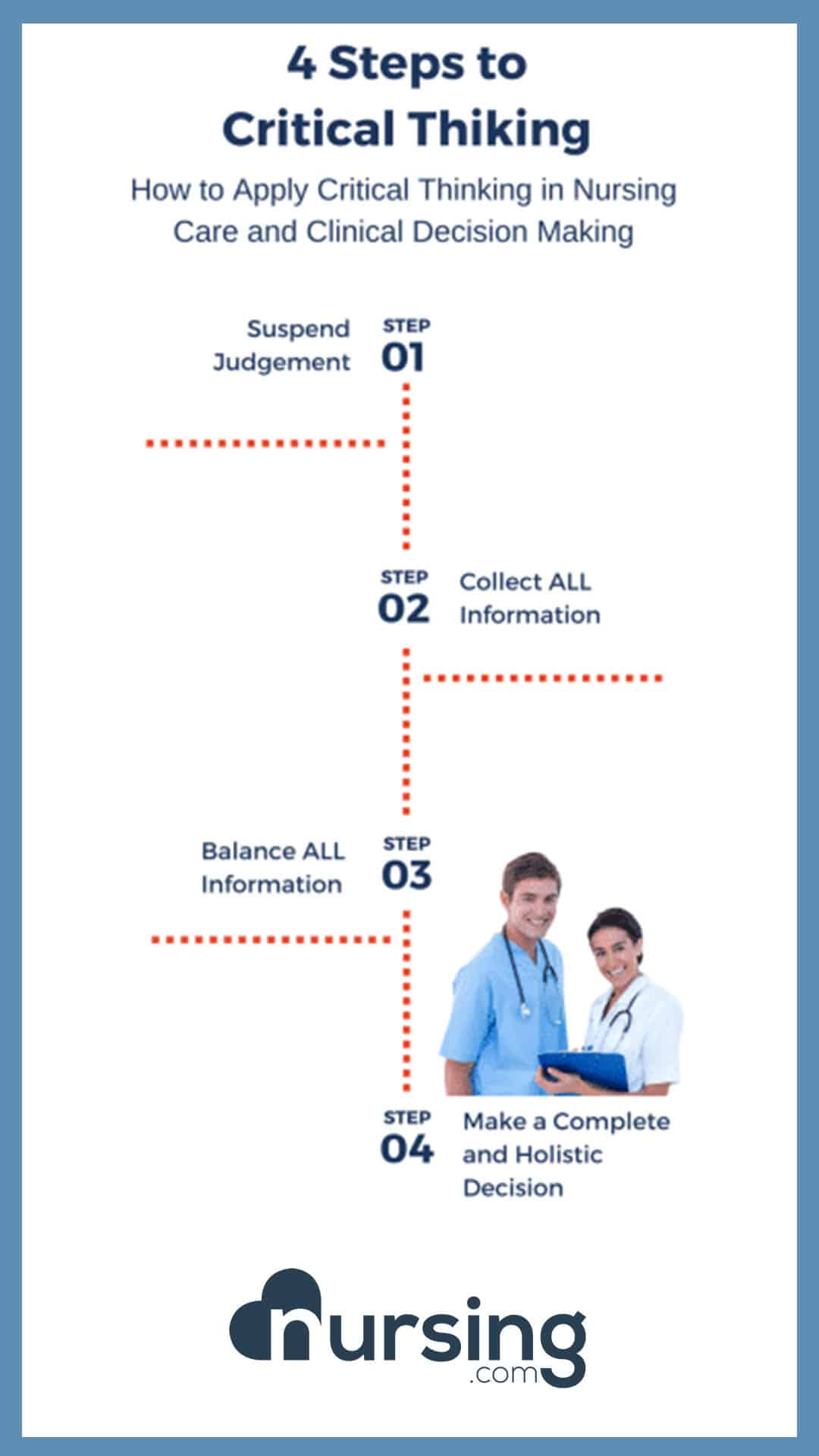
Before diving into the four individual steps let’s point out the use of the word “ALL” in each of the steps.
This is important because few individuals can make decisions with this inclusive word. It literally means ALL. To make a complete and holistic decision based upon critical thinking you have to have and weight ALL information. Otherwise you are just making a regular old decision.
- Suspend All Judgement
You have to start by suspending all judgement. In other words, if you walk into a patients room and see them tachycardic an amature decision would be to run and grab the metoprolol to try to drop the heart rate.
An advanced clinician will WAIT until they have more information . . . not leaving the patient untreated . . . but not jumping freakishly into the WRONG treatment because they learned that tachycardia is bad . . .
Suspending judgement means that you don’t make a decision based upon the first sign. You also don’t walk into any situation of NCLEX question with a decision already made. You will treat all facts as equal until you can gather the needed information.
Not suspending judgment leaves you open to make biased decisions. This is detrimental in medicine and nursing. This will also result in poor success on nursing exams and the NCLEX.
As you read through nursing questions you must force yourself to refrain from jumping to conclusions until you have read the question in full. Do not allow yourself to assume what the question is asking or what the patient outcome is until you have read the question in full.
Obviously this sounds simple, but it is this step that, if missed, will through more nursing students and nurses off.
- Collect All Information
Now you must collect ALL information. This is clutch! Don’t make a decision until you have collected every piece of data that you need to collect . . . on a tachycardic patient you can check BP, temp, run an EKG, check urine output.
Think of this as data mining. You are looking to have every piece of information you can find to put the puzzle pieces together.
When it comes to taking nursing tests you only have one place that you can collect the information . . . and that is from the test question itself. Do not go looking outside of the question of infer any details that are not provided within the question.
One thing we have noticed students doing almost more than anything else on test questions is reading into them. Don’t do this. Gather all the information you can . . . and when it comes to NCLEX questions, the only place you can gather information is from the question itself.
- Balance All Information
Now, balance all information. This means take all the data that you have and start weighing it to find out what is pertinent and what you can ignore. If the temp is 98.9 . . . it’s probably not the cause. If the BP is 74/56 are we looking at a volume issue?
In this step you are deciding what is important and what isn’t. While a pressure ulcer is important, if the patient is actively having a heart attack . . . it just doesn’t matter. At least, not until we take care of the MOST important issue.
NCLEX style questions will be FULL of extra information, things that you just really do not need to know to make a decision on the patient.
The NCSBN (who administers the NCLEX) in an effort to simulate real life nursing writes questions that include both important information and details that you just simply don’t need to know. It is your job to sift through the data and determine what you actually need to know.
Balancing means giving each data point a level of importance for your given patient. Some pieces of information will score much higher than others.
At this point you must all consider the implications of the possible options. Look at the available options and think to yourself, “if I choose this option, what happens next?”. As it relates to nursing, ask yourself these questions:
“Does this achieve a desired patient outcome?”
Or
“If I do this and then go home, what happens to my patient?”
Forcing yourself to consider the implications allows you to look beyond the information presented and consider the RESULTS of your choices. Critical thinking thrives on looking beyond the presented data.
- Make a Holistic Decision
Finally, make your decision . . . with all the data in and after looking over it all very closely you can begin to make your decision.
Your goal is to make the decision that best serves the patient and addresses their most immediate concerns.
Critical Thinking in Nursing and on the NCLEX®
Lastly, I just want to talk briefly about how this applies to NCLEX questions . . .
Here is an actual practice NCLEX question from our Nursing Practice Questions Program (or NPQ, as we like to call it)!
A 56-year-old male patient has been admitted to the cardiac unit with exacerbation of heart failure symptoms. The nurse has given him a nursing diagnosis of decreased cardiac output related to heart failure, as evidenced by a poor ejection fraction, weakness, edema, and decreased urinary output. Which of the following nursing interventions are most appropriate in this situation?
42% of the students that have taken this question have selected this answer:
Administer IV fluid boluses to increase urinary output
The problem with that answer is that it fails to weigh the most important issue facing this patient.
Test takers see urine output as low . . . and want to correct that quickly with fluids.
However, this is a CHFer . . . you can’t (shouldn’t) bolu especially during an exacerbation . . . you could send the patient into pulmonary edema and drastically impact their respiratory status.
So the lesson here. . . . in school, on the NCLEX, and on the clinical floor . . . slow down, stay calm and start thinking at an analysis level.
And I promise you this helps in “REAL” life too . . . not just in nursing. You will begin to be a tad more skeptical and deliberate with your decisions.
Resources
Here are a couple resources that will help you in the process of developing critical thinking.
The process for developing critical thinking is slow and arduous. However, don’t be hard on yourself. According to CriticalThiking.org the vast majority of colleges are not appropriately incorporating critical thinking into the college classroom. This means that while you might not being taught the skill as you should . . . most people aren’t. Using the strategies outlined above will put you light years ahead of most.
The nurse that is able to follow these four steps is a tremendous asset on a clinical floor.
Transcript
So, we’re gonna talk about critical thinking. Now, if you’ve gone to even just one day of nursing school, you understand that critical thinking is really a buzz word in nursing schools. Nursing professors and nursing schools love to talk about critical thinking. Now, why? Well, the job of the nurse is essentially to take millions and millions of data points, millions of possible patient outcomes, be able to analyze that and arrive at a correct decision based on all that data. Now, this is no easy task. And there’s very few jobs out there in the world which require this on the scale of nursing. Or, with human lives in the balance. Now, we take all these data points and we’re making these decisions very quickly. Very quickly, we’re making tons and tons of decisions, and there’s really nothing out, there’s no job out there that requires it at the magnitude of nursing or with human lives in the balance.
Now, what is critical thinking? Critical thinking has been defined as the intellectually disciplined process of actively and skillfully, conceptualizing, applying, analyzing, synthesizing and/or evaluating affirmation gathered from or generated by observation, experience, reflection, reasoning, or communication as a guide to belief and action. Now, that’s a massive definition, okay. Let me give you another definition. Basically, what you’re doing is it’s a disciplined process. It’s a process. It’s a skill, where you take all the information available to you through different ways of obtaining it, reading, observing, whatever it is, and you synthesize all that information, you evaluate all that information, and you arrive at a decision. Alright, now, critical thinking is really something that can grow. Now, we all make tons and tons of decisions everyday, thousands of decisions everyday. Should I get up? Should I set my alarm? Should I push my alarm off? What color of clothes should I wear, etc. We make so many decisions on a daily basis. Now, most of these decisions don’t require any sort of critical thinking. So, it’s possible that before nursing school, before this upper division classes, and before working on the clinical floor, you may not have used critical thinking much because you haven’t had to, right? You’re really just making regular daily decisions. But I want you to understand that critical thinking is a skill that can grow and develop with time. As you enter nursing school, you’re not expected to be an expert in the skill. Even as you entered the floor, you’re not expected to be an expert. You’re going to grow this skill. But I’m gonna give you a framework to help you develop it more quickly and more appropriately. Okay, what you should understand is critical thinking involves a level of decision making far beyond normal day to day decision making. With critical thinking, you are analyzing, conceptualizing, digging deep into questions and data that is presented. When it comes to nursing, oftentimes, you’re presented with real life or death situations. You’re presented with saving one patient or determining what’s the most important solution is to highly complex problem. And those nurses that develop critical thinking skills find increased success in their careers, they find more ability to last longer in nursing because they’re not as stressed. They’re able to look at all the data, stay calm and make appropriate decision.
So, let’s talk about critical thinking in nursing. The NCSBN has defined critical thinking. Now, the NCSBN is the company that administers and scores, etc, the NCLEX. So, this is what they’ve said about critical thinking. Since the practice of nursing requires you to apply knowledge, skills, and abilities, the majority of questions on the NCLEX are written at the cognitive level of apply or higher. Now, we’ll get into this more when we talk Bloom’s Taxonomy, okay. And these questions, by nature, require critical thinking. So, answering these higher cognitive domain questions will require you to do something with what you’ve learned. To manipulate previously learned material in a new way or find connections between many data points and many facts. Again, since majority of NCLEX questions fall into this category, this is exactly the type of questions you need to practice answering. This is exactly the kind of questions you need to understand. Okay, there’s that buzz word again, right? That critical thinking. But once again, no tips or information on what that means or how to develop it. So, let’s dive in and provide you with a simple framework and method for developing critical thinking and using it in your nursing practice.
This is just a 4-step method that I’ve developed that I think will help you make decisions slowly. In other words, how to critically think through different decision processes. Okay, now, essentially, I believe there’s really this 4 steps to critical thinking in nursing analyze and developing these ability to critically think will work wonders in your life. The first step is you suspend all judgment. The second step is you collect all information. The 3rd step is you balance all the information. And the 4th step is you make a holistic decision, or you make the best decision possible.
Now, before diving into the 4 individual step, let’s point out the use of the word ALL in each of the step. This is important because few individuals can make decisions with this inclusive word. It literally means, all, when we’re talking about critical thinking. To make a complete and holistic decision based upon critical thinking, you have to have and weigh all information. Otherwise, you’re making just a regular old decision. So, when we say suspend all judgment, it literally means suspending all judgment. Wipe all previous judgment out of your mind. When we say, balancing all information, it literally means balancing everything that you’ve been given, okay, collecting all information, etc. So, when I say all, I literally mean all. I mean, you need to really get to this point of all, all inclusive.
So, the first step is suspending all judgment. You have to start by suspending all your judgment, right? In other words, if you walk into a patient’s room, see them tachycardic, an amateur decision would be to run and grab the metoprolol to try to drop their heart rate. That’s an amateur decision. You see one piece of information, you have a response to that, alright? An advanced clinician will wait until they have more information, not leaving the patient untreated but not jumping freakishly into the wrong treatment because they learned that tachycardia is bad, right? Suspending judgment means that you don’t make a decision based upon the first sign. You also don’t walk into any situation of the NCLEX or any question on the NCLEX with a decision already made. You will treat all facts as equal until you gather the needed information. Not suspending judgment leaves you open to make biased decision and this is detrimental in medicine, nursing and life. The moment you become biased, you’re really walking on very thin ice, okay. This will result in poor success on nursing exams and school, on the NCLEX and as a nurse. Okay, you don’t jump freakishly to amateur decisions. You suspend judgment and wait to ensure that you have all the information you need. As you read the nursing questions, you must force yourself to refrain from jumping to conclusions until you have read question in full. Don’t allow yourself to assume what the question is asking or what the patient outcome is until you have read the entire question. Obviously, I know this sounds really simple but it is this step that if missed, it throws more nursing students and nurses off of anything else. This was one thing that I struggle with a lot in nursing school was I would read half a question and then like boom, I know exactly what the answer is, without reading the rest of the question. They got me into a lot of trouble sometimes.
The second step guys is collecting all information. This is very very important and you can see it kinda goes along with all the first step. Don’t make a decision until you have collected every piece of data that you need to collect. The first step, we were suspending all judgment until we collect data. Now, in this step, we’re collecting all the needed data. So, on that tachycardic patient, we’re talking about 4. You would need to check their blood pressure, their temperature, run an EKG, check urine output, okay. Is this a volume situation? Is it an infection situation? Okay, what’s the reason for this? Let’s just not treat that heart rate. If we treat that heart rate, maybe, that’s a volume situation, you know, in the hypovolemic, possibly hemorrhaging, whatever, and then we give them metoprolol and then drop that heart rate, then we’re not helping the perfusion issue, okay? So, you really have to get every piece of information you can. One way to think of this is data mining. You’re looking to have every piece of information you can find to put the puzzle pieces together. When it comes to taking nursing test, you only have one place that you can collect that information and that is from the actual item, the test question itself. Don’t go looking outside of the question or for any details that are not provided directly in the question on nursing exams. In real life, you’ll have a little bit more lea way to really look at every possible option. However, in a nursing question, you deal with exactly what’s in the question. One thing we noticed that nursing students doing almost more than anything else on test is reading into them. Don’t do this. Gathering all the information you can. And again, when it comes to NCLEX questions, the only place you can gather information is in the test question. Don’t start making up alternative scenarios to try to piece together things that aren’t in the question, you have to go with what’s there. Now, we’re gonna balance all information. This means that all the data you have, you get it all together, you piece it all together and you start weighing it to find out what is pertinent and what you can ignore. So, back to our tachycardic patient. If the temp is 98.9, it’s probably not the cause of this tachycardia. If the blood pressure is 74 / 56, now, okay, are we looking at a volume problem? Now, we needed to gather all this information because we didn’t know the reason for that tachycardia. However, now, at this point, in the question, in the care of this patient, we know, we have our temperature, so boom, they can throw out, they can likely throw out infection. Now, we have a blood pressure, okay, now, we’re looking at possibly a volume issue with this patient. So, in this step, what you really do is you’re deciding what is important and what isn’t. While a pressure ulcer is important, if the patient is actively having a heart attack, it just doesn’t matter, at least not until we take care of the most important issue, the ABCS. And that’s a framework you can use to balance information, your ABC’s. Airway, breathing, circulation, safety and Maslow’s, we go in that more throughout the course. NCLEX style questions will be full of extra information. Things you just really do not need to know to make a decision on your patient. The NCSBN, in an effort to simulate real life nursing, writes questions that include both important and unimportant information. It’s your job to sift through that data and determine what is actually needed to know to take care of that patient. Balancing means giving each data point a level of importance for your given patients. Some pieces of information will score much higher than others. And again, we’ll go over this in some of the framework for how to answer NCLEX questions is the ABC’s. You can use Airway, Breathing, Circulation, Safety and then going down to Maslow’s Hierarchy of Needs to balance information to determine what is most important. At this point, you must consider all implications of the possible options. Look at all the available options and think to yourself. If I choose this option, what happens next? As you realize in nursing, ask yourself this questions. Does this achieve a desired patient outcome? Or, another way of saying that would be, if I do this, and then go home, what happens to my patient? Forcing yourself to consider the implications allows you to look beyond the information presented and consider the results of your choices. What happens if? Critical thinking drives on looking beyond the presented data. Okay, you’re looking beyond. You’re not just taking everything at face value, you’re looking beyond it.
Now, our last and final step is making a holistic decision. Finally, now that you’ve suspended judgment, you’ve collected your data, you balanced that data, now it’s time to make your decision. With all the data in, after looking through everything very closely, you can begin to make your decision. Your goal is to make a decision that best serves the patient and addresses their most immediate concern. I wanna give you guys an example of one question in our nursing practice questions that we’ve seen a lot of our nursing students skip some of these steps. So, the question is, a 56-year-old male patient has been admitted to the cardiac unit with exacerbation of heart failure symptoms. The nurse has given him a nursing diagnosis of decreased cardiac output related to heart failure as evidenced by poor ejection fraction, weakness, edema and decreased urinary output. Which of the following nursing interventions are most appropriate in this situation? Now, the option that has been selected 42% of the time was to Administer IV fluid bolus to increase urinary output. Okay, the problem with that answer is that it fails to weigh the most important issues facing the patient, that this patient is a CHF patient, okay. With exacerbation of that. Now, what happens is test taker see low urine output and they see, okay, administer IV bolus for urinary output and they immediately jump to that as the correct answer, okay. However, remember, this is a CHF. You can’t or shouldn’t bolus especially during exacerbation. We’ve seen a patient with pulmonary edema and drastically impact their entire respiratory status, thereby altering their breathing, okay, their ABC’s, right? So, lesson here guys, is in school, on exams, and on the NCLEX, and on the clinical floor, slow down, stay calm, and start thinking at an analysis level. And I promise you, this helps in real life too, not just in nursing. You’ll begin to see everything a bit more skeptic, okay. You’ll start making more deliberate decisions whether that’s financially and how you invest, how you put up to loans, where you get a job, you’ll start slowing down and thinking through things over a little bit more. And that’s an important skill to have. It’s gonna help you very much throughout your life. The process of developing critical thinking is very slow and arduous. However, don’t be hard on yourself.
There’s a website called criticalthinking.org and it states that the vast majority of colleges are not appropriately incorporating critical thinking into the classroom. So, what this means is that while you might not be being thought the skill as you should, most other college students aren’t either. Using the strategies in the outline, using this 4 steps method, will put you light years ahead of most. The nurse that is able to follow these 4 steps is a tremendous asset on the clinical floor. So, I want you guys to start incorporating this. We have a cheat sheet for these 4 steps and I want you to use that. And the biggest things you guys need to do is just slow down and think. Think through these 4 steps and it’s going to make an enormous impact on the way you make decisions, on the way you take tests, and on the way you think through everything that’s presented to you on a daily basis.
Kaiser Ann Pajulas, USRN
Concepts Covered:
- Basics of Sociology
- Statistics
- Communication
- Fundamentals of Emergency Nursing
- Musculoskeletal Disorders
- Cardiac Disorders
- Emergency Care of the Cardiac Patient
- Medication Administration
- Gastrointestinal Disorders
- Pregnancy Risks
- Labor Complications
- Factors Influencing Community Health
- Respiratory Disorders
- Emergency Care of the Neurological Patient
- EENT Disorders
- Newborn Complications
- Documentation and Communication
- Preoperative Nursing
- Legal and Ethical Issues
- Adult
- Substance Abuse Disorders
- Hematologic Disorders
- Musculoskeletal Trauma
- Intraoperative Nursing
- Microbiology
- Disorders of Pancreas
- Oncology Disorders
- Anxiety Disorders
- Neurologic and Cognitive Disorders
- Personality Disorders
- Basics of NCLEX
- Studying
- Newborn Care
- Basics of Mathematics
- Note Taking
- Integumentary Disorders
- Emergency Care of the Trauma Patient
- Respiratory Emergencies
- Developmental Considerations
- Digestive System
- Lower GI Disorders
- Central Nervous System Disorders – Brain
- Postpartum Care
- Basic
- Infectious Respiratory Disorder
- Integumentary Disorders
- Eating Disorders
- Circulatory System
- Cardiovascular Disorders
- Test Taking Strategies
- Musculoskeletal Disorders
- EENT Disorders
- Postoperative Nursing
- Neurological Emergencies
- Cognitive Disorders
- Concepts of Population Health
- Community Health Overview
- Noninfectious Respiratory Disorder
- Delegation
- Depressive Disorders
- Terminology
- Postpartum Complications
- Vascular Disorders
- Nervous System
- Upper GI Disorders
- Renal and Urinary Disorders
- Developmental Theories
- Fetal Development
- Endocrine and Metabolic Disorders
- Prenatal Concepts
- Trauma-Stress Disorders
- Psychological Emergencies
- Adulthood Growth and Development
- Childhood Growth and Development
- Prenatal and Neonatal Growth and Development
- Renal Disorders
- Hematologic Disorders
- Liver & Gallbladder Disorders
- Tissues and Glands
- Disorders of Thermoregulation
- Urinary Disorders
- Urinary System
- Shock
- Labor and Delivery
- Oncologic Disorders
- Emotions and Motivation
- Peripheral Nervous System Disorders
- Bipolar Disorders
- Infectious Disease Disorders
- Immunological Disorders
- Sexually Transmitted Infections
- Disorders of the Thyroid & Parathyroid Glands
- Male Reproductive Disorders
- Central Nervous System Disorders – Spinal Cord
- Female Reproductive Disorders
- Acute & Chronic Renal Disorders
- Prioritization
- Somatoform Disorders
- Pediatric
- Perioperative Nursing Roles
- Concepts of Pharmacology
- Psychotic Disorders
- Concepts of Mental Health
- Neurological Trauma
- Health & Stress
- Respiratory System