Atrial Fibrillation (A Fib)

You're watching a preview. 300,000+ students are watching the full lesson.
Brad Bass
ASN,RN
Master
To Master a topic you must score > 80% on the lesson quiz.
Take Quiz

Included In This Lesson

Study Tools For Atrial Fibrillation (A Fib)

Atrial Fibrillation (Image)
10 Common EKG Heart Rhythms (Cheatsheet)
EKG Chart (Cheatsheet)
EKG Electrical Activity Worksheet (Cheatsheet)
Heart Rhythms Signs and Symptoms (Cheatsheet)
Heart Rhythm Identification (Cheatsheet)
Atrial Fibrillation Cheatsheet (Cheatsheet)
NURSING.com students have a 99.25% NCLEX pass rate.

Outline

Overview

  1. Atrial fibrillation
    1. Multiple disorganized cells produce  additional electrical impulse in atria
      1. Causes atria to quiver at a fast rate
        1. <300 bpm
        2. Unable to effectively contract
          1. Pooling of blood in atria
          2. High risk for stroke
      2. AV node blocks some of the  electrical impulses from reaching the ventricles
        1. Rapid irregular ventricular contractions
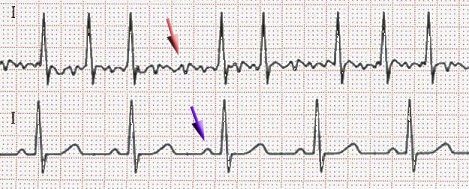
<span data-sheets-value="{"1":2,"2":"EKG of atrial fibrillation (top) and normal sinus rhythm (bottom). The purple arrow indicates a P wave, which is lost in atrial fibrillation."}" data-sheets-userformat="{"2":33555201,"3":{"1":0},"11":4,"12":0,"28":1}">EKG of atrial fibrillation (top) and normal sinus rhythm (bottom). The purple arrow indicates a P wave, which is lost in atrial fibrillation.</span>
By J. Heuser – Own work, CC BY-SA 3.0, https://commons.wikimedia.org/w/index.php?curid=465397

Nursing Points

General

  1. Characteristics of Atrial fibrillation  
    1. Rhythm
      1. Irregular
    2. Rate
      1. Atrial rate
        1. >300  bpm
        2. Wavy baseline
      2. Ventricular rate
        1. 60-100 bpm
        2. >100 bpm
          1. “Rapid Ventricular Response” (RVR)
    3. P:QRS ratio
      1. No obvious P waves
        1. Wavy baseline
      2. Not measurable
    4. PR interval
      1. Not measurable
    5. QRS complex
      1. 0.06-0.12 seconds

Assessment

  1. Patient Presentation
    1. Palpitations
    2. Fatigue
    3. Lightheaded/Syncope
  2. Acute or chronic
    1. If chronic
      1. Monitor rate/meds
    2. If  acute
      1. Convert to NSR
  3. Atrial and ventricular rates
    1. RVR
  4. Decreased Cardiac Output
    1. Syncope
    2. Hypotension
  5. PT/INR
    1. If taking Coumadin

Therapeutic Management

  1. Nursing Interventions
    1. Acute or chronic
    2. 12 Lead EKG
    3. Restore NSR
    4. Assess for s/s of stroke
  2. Convert to  NSR
  3. Control ventricular rate
    1. Medications
      1. Antiarrhythmics
      2. BB
      3. Calcium Channel Blockers
    2. Transesophageal Echocardiogram (TEE) or Cardioversion (CV)
    3. Ablations
  4. Decreased risk for stroke
    1. Anticoagulants
      1. Coumadin (Warfarin)
      2. Xarelto (Rivaroxaban)
      3. Eliquis (Apixaban)

Nursing Concepts

  1. EKG Rhythms
  2. Perfusion
  3. Clotting

Patient Education

  1. Do not miss a dose of on anticoagulants
    1. Check PT/INR as instructed
  2. Check radial pulse
    1. Report if >100

Related Lesson

Unlock the Complete Study System

Used by 300,000+ nursing students. 99.25% NCLEX pass rate.

200% NCLEX Pass Guarantee.
No Contract. Cancel Anytime.

Transcript

Hey guys, my name is Brad and welcome to nursing.com. And in today’s video, we are going to discuss atrial fibrillation, also known as AFib. I’d like to discuss some of the physiology behind what a-fib actually is, how this might present in a patient, some of the treatment modalities, and most importantly, for this lesson, how to recognize it on an EKG. Let’s dive in. 

So in atrial fibrillation, what is occurring is the atria quiver, those top two chambers of the heart, instead of contracting and ejecting blood down into those ventricles, they just kind of quiver. No real conduction occurs, no real contraction occurs. And as a result, blood just sits there, stagnated in those atrium. And the reason why is, we don’t have proper conduction from this SA node, a normal electrical conduction system originates at the SA node, going down to the AV node, through the bundle of His and terminating in those Purkinje fibers.  In a-fib we actually have an issue with that SA node. There’s a problem there. And let’s also remember that this electrical conduction system actually resides within the heart muscle itself. This SA node kind of being up here in the right atria. What actually occurs, because we have a dysfunctional SA node, our electrical impulse comes from this atrial tissue itself, and that is problematic. What this essentially occurs, or causes to occur, is a cyclical, electrical impulse to be sent cyclically, circularly all throughout this atrial tissue at a rate of 400 beats per minute. Now let’s recall also from our electrical A and P that this AV node actually acts as a filter. So let’s imagine it’s a filter and we don’t want to allow 400 atrial beats per minute to reach these ventricles because if that were to occur, then we’re basically looking at 400 beats per minute ventricularly. That’s not compatible with life. So this AV node acts as a filter, not allowing all 400 beats per minute to go through. It actually ends up reducing this ventricular rate for about 150 beats per minute. This is important. This is going to be clinically significant whenever we’re actually looking at a-fib. 

So what are some causes of atrial fibrillation? Well, this all really kind of comes down to poor perfusion of that heart tissue, right? In instances, such as hypertension, congestive heart failure, coronary artery disease. Essentially, you have to remember guys, this is so crucially important. You have to remember that, that electrical conduction system that we mentioned, it all actually lies right here within this heart muscle itself. So in cases, such as coronary artery disease, where there is a poor perfusion to this heart tissue itself, you have to remember, if there is no perfusion, then there is going to be no conduction. And if there’s no conduction, there’s going to be no contraction, right? You have to remember, not only is that heart muscle responsible for contracting, so if there is an impaired amount of blood being delivered to these heart tissues, you’re not only impairing the muscle itself, but you’re also impairing that electrical conduction system as well. Some assessment findings that we may see in patients who have a-fib are palpitations. Again, an atrial rate of 400 beats per minute, atria just quivering and not quite contracting, a hundred percent going to result in palpitations. You’re going to feel that fluttering in your chest, this fluttering in your chest causes anxiety. This atrial quiver, this impaired electrical conduction system is going to cause shortness of breath, right? Impaired perfusion, impaired electrical conduction system, impaired contraction. If your LV can’t contract effectively to get blood out of the heart, we’re going to end up seeing shortness of breath as a result. 

And it’s also important to remember your atrial kick. It’s something that they call an atrial kick, right? This is essentially the kick of blood that comes out of the atria down into the ventricles and the amount of blood that ends up getting ejected out of your ventricles, right? The amount of blood that ends up getting ejected out of these ventricles down here, 30% of that comes from your atria. That’s why, a-fib is so devastating. You’re literally losing 30% of your atrial kick. You’re losing 30% of the blood normally ejected out of the ventricles because instead of properly contracting, these atria are just quivering. 

Now some therapeutic management that is important to be mindful of, right? How are we going to treat a patient who is in  a-fib whose atria are contracting at 400 beats per minute, and we’re losing that atrial kick of blood, right? Cardioversion. This could be mechanical. This could also be chemical cardioversion being hooking a patient up to that defibrillator machine. And instead of using it to defibrillate them, we can use it to cardiovert them, basically providing a shock to the heart, less joules, less energy than we normally would in cardiac code defibrillating. But a way to try and knock that heart out of that abnormal rhythm. Cardioversion can also be a chemical, right?  Antiarrhythmic medications such as amiodarone, right. These are medications used to try and stabilize wild and erratic rhythms. Also medications such as negative chronotropes. Remember chronotropes  essentially are medications that affect heart rate and negative chronotropes are responsible for decreasing heart rate. Medications such as, metoprolol, for instance, right, ending in -olol. And then also anticoagulation. This is a big component of the big thing to know with, a-fib, okay. Important, incredibly important because these atria are not contracting. And instead they’re just quivering and blood is just sitting in here, stagnant, not emptying. We’re not getting rid of that atrial kick of 30% of blood, right? Instead it’s just stagnating and sitting there quivering. Stagnant blood clots, guys. So clots can form in these atria. And if these clots were to get ejected through the ventricles and out of the body, this is going to be problematic, right? Pulmonary embolisms strokes, myocardial infarction. 

Now using the six step method to solve for a-fib. This is how we’re going to be able to read a-fib on an EKG, right? Our heart rate, remember that atrially, we’re looking at 400 beats per minute and ventricularly, what we should see is approximately 150 beats per minute. 

Regularity. That R to R regularity. There will be no regularity at all. It’s going to be completely variable that R to R interval. And this is just due to the rapid nature at which those atria are contracting. 

P to QRS interval. The big, important thing that you need to know whenever you’re looking at an AFib on an EKG is that P waves are gone. You can not see P waves and why? Well, again, remember that cyclical nature at which those atrial tissues are firing these electrical impulses off at approximately 400 beats per minute. You’re not able to distinguish a P wave on an EKG due to such rapid firing. And because there’s no P wave identifiable, you can not measure a PR interval. 

And then regarding the QRS complex, you’re going to see a normal QRS complex length. Remember it’s 0.06 0.12 seconds. Let’s take a look at an example to bring further clarity. 

So if we wanted to take a look at the six step method that we normally would use to solve a-fib and we were taking a look at this one here in particular, as an example, let’s remember, let’s take a look at our heart right now. There’s no real identifiable way to measure an atrial heart rate. It’s just important to know in a-fib. And it’s approximately 400 beats per minute, but let’s take a look at our six seconds strip over here and actually measure our heart rate. Remember how many QRS complexes do we have? And then we multiply that by 10. So 1, 2, 3, 4, 5, 6, 7, 8, 9, 10, 11, 12 times 10 (12 X 10 = 120) giving us a heart rate of approximately 120 beats per minute. Like I said, we’ve been educating that we look at approximately 150 beats per minute. It’s not always exactly150, as we can see by this example. 

Now, the next thing that we want to do is take a look at our R to R interval. Again, we’re actually looking at the R wave and we’re measuring the distance between each individual R wave. And what you will notice is that there’s actually variability here, right? This is much longer in length than this shorter R to R interval again, in a-fib, no actual regularity in the R to R or P to QRS complex ratio. Again, P waves are gone. We cannot see these P waves complete loss of P waves, right? So you cannot measure the P to QRS complex ratio like that. Next thing would be our PR interval. Again, you cannot see a P wave. So we can’t measure a PR interval. That is the big distinguishing factor with a-fib. There’s no P wave and we have a rapid heart rate. 

Next thing is our QRS complex. We would actually measure our QRS complex looking at one small square 0.04, two small squares 0.08. So our QRS complex is 0.08 seconds (0.04 X 2 = 0.08), which again, we will remember is normal. And this is the way that we’re going to solve for a-fib. We have a loss of P waves. Our heart rate is approximately 150 beats per minute, no regularity at all with our R to R interval. We are certainly looking at a rhythm that is a-fib. 

So to summarize some of our key points with a-fib, it’s important to remember in atrial fibrillation, the atria are just quivering, right? Blood is sitting in there, stagnated.  Electrical impulse originating from atrial tissues, instead of the SA node, is just cyclical firing, and then uncoordinated in an uncontrolled manner at approximately 400 beats per minute. And then it eventually is filtered out by that AV node, leaving a ventricular rate of approximately 150 beats per minute. We’re going to recall that there is no regularity. This is a completely uncontrolled firing of impulses from that atrial tissue. It’s uncontrolled. So there’s no regularity at all. Then we’re also going to notice there is a loss of P wave, complete loss of P wave, a big clinical indicator whenever you’re reading EKG. So you’re not going to be able to see one P wave for every QRS, nor are you going to be able to measure a PR interval length. But whenever we take a look at the QRS complex recall, that is indeed going to be identified as normal.

Guys, I really hope that this helps you understand a-fib, not just looking at an EKG test, but also to be able to clinically understand what a patient is experiencing physiologically and how we may be able to treat that patient experiencing AFib. I hope that you guys go out there and be your best selves today. And as always, happy nursing.


Study Faster with Full Video Transcripts

99.25% NCLEX Pass Rate vs 88.8% National Average

200% NCLEX Pass Guarantee.
No Contract. Cancel Anytime.

🎉 Special Offer 🎉

Nursing School Doesn't Have To Be So Hard

Go from discouraged and stressed to motivated and passionate

NCLEX POA

Concepts Covered:

  • Studying
  • Urinary System
  • Hematologic System
  • Circulatory System
  • Respiratory System
  • Endocrine and Metabolic Disorders
  • Basics of Human Biology
  • Noninfectious Respiratory Disorder
  • Test Taking Strategies
  • Adult
  • Medication Administration
  • Microbiology
  • Cardiac Disorders
  • Anxiety Disorders
  • Depressive Disorders
  • Intraoperative Nursing
  • Central Nervous System Disorders – Brain
  • Immunological Disorders
  • Concepts of Pharmacology
  • Vascular Disorders
  • Disorders of Pancreas
  • Neurological
  • Postoperative Nursing
  • Upper GI Disorders
  • Bipolar Disorders
  • Psychotic Disorders
  • Nervous System
  • Prenatal Concepts
  • Learning Pharmacology
  • Metabolism
  • Liver & Gallbladder Disorders
  • Hematology
  • Basics of Chemistry
  • Concepts of Population Health
  • Factors Influencing Community Health
  • Community Health Overview
  • Legal and Ethical Issues
  • Emergency Care of the Cardiac Patient
  • Emergency Care of the Neurological Patient
  • Emergency Care of the Respiratory Patient
  • Fundamentals of Emergency Nursing
  • Emergency Care of the Trauma Patient
  • Delegation
  • Health & Stress
  • Developmental Considerations
  • Childhood Growth and Development
  • Prenatal and Neonatal Growth and Development
  • Developmental Theories
  • Trauma-Stress Disorders
  • Writing
  • Basic
  • Pregnancy Risks
  • Labor Complications
  • Newborn Complications
  • Newborn Care
  • Postpartum Complications
  • Fetal Development
  • Postpartum Care
  • Labor and Delivery
  • Terminology
  • Med Term Basic
  • Acute & Chronic Renal Disorders
  • Disorders of the Adrenal Gland
  • Sexually Transmitted Infections
  • Hematologic Disorders
  • Oncology Disorders
  • Infectious Respiratory Disorder
  • Integumentary Disorders
  • Musculoskeletal Disorders
  • EENT Disorders
  • Respiratory Emergencies
  • Musculoskeletal Trauma
  • Lower GI Disorders
  • Disorders of the Posterior Pituitary Gland
  • Shock
  • Renal Disorders
  • Disorders of the Thyroid & Parathyroid Glands
  • Disorders of Thermoregulation
  • Preoperative Nursing
  • Integumentary Important Points
  • Neurological Emergencies
  • Male Reproductive Disorders
  • Urinary Disorders
  • Renal and Urinary Disorders
  • Neurological Trauma
  • Communication
  • Perioperative Nursing Roles
  • EENT Disorders
  • Infectious Disease Disorders

Study Plan Lessons

Alkalosis and Acidosis Nursing Mnemonic (Kick Up, Drop Down)
Blood Grouping
Blood Plasma
Blood Pressure (BP) Control
Breathing Control
Breathing Movements
Causes of Poor Gas Exchange Nursing Mnemonic (All People Can Value Lungs)
EKG (ECG) Waveforms
Electrolytes – Location in Body Nursing Mnemonic (PISO)
Electrolytes Involved in Cardiac (Heart) Conduction
Fluid & Electrolytes Course Introduction
Fluid Volume Deficit
Hyperkalemia – Causes Nursing Mnemonic (MACHINE)
Hyperkalemia – Management Nursing Mnemonic (AIRED)
Hyperkalemia – Signs and Symptoms Nursing Mnemonic (Murder)
Hypernatremia – Causes Nursing Mnemonic (MODEL)
Nursing Care Plan (NCP) for Fluid Volume Deficit
Renal (Kidney) Fluid & Electrolyte Balance
Renal (Kidney) Acid-Base Balance
Respiratory Functions of Blood
Tonicity of Solutions – Live Tutoring Archive
Trach Suctioning
12 Points to Answering Pharmacology Questions
ACLS (Advanced cardiac life support) Drugs
Anti-Infective – Antifungals
Anti-Platelet Aggregate
Antianxiety Meds
Antidepressants
Barbiturates
Buspirone (Buspar) Nursing Considerations
Cefdinir (Omnicef) Nursing Considerations
Carbidopa-Levodopa (Sinemet) Nursing Considerations
Cyclosporine (Sandimmune) Nursing Considerations
Drug Interactions Nursing Mnemonic (These Drugs Can Interact)
Hydralazine
IM Injections
Injectable Medications
Insulin
Insulin – Long Acting (Lantus) Nursing Considerations
Insulin Mixing
Interactive Pharmacology Practice
IV Infusions (Solutions)
IV Push Medications
Maintenance of the IV
Mannitol (Osmitrol) Nursing Considerations
Medication Errors
Meperidine (Demerol) Nursing Considerations
Metoclopramide (Reglan) Nursing Considerations
Montelukast (Singulair) Nursing Considerations
Mood Stabilizers
Olanzapine (Zyprexa) Nursing Considerations
Parasympathomimetics (Cholinergics) Nursing Considerations
Rh Immune Globulin in Pregnancy
SubQ Injections
The SOCK Method – Overview
Introduction to Metabolism
Anti-Infective – Antifungals
Antiviral Agents for Treatment
Hb (Hepatitis) Vaccine
Infection or Inflammation? The Quick & Dirty on CBCs – Live Tutoring Archive
Infection or Inflammation? The Quick & Dirty on CBCs 2 – Live Tutoring Archive
Infection Stages
Key Nutrients in the Prevention of Chronic Disease
Nursing Care Plan (NCP) for Infection
Tonicity of Solutions – Live Tutoring Archive
Viruses & Fungi
Scientific Notation & Measurement
Care for Asian-Indian Patient Populations
Care for Hispanic Patient Populations
Care for Native American Patient Populations
Care of Vulnerable Populations
Caring for African Patient Populations
Child Abuse/Neglect – Warning Signs Nursing Mnemonic (CHILD ABUSE)
Communicable Diseases
Community Health Course Introduction
Community Health Tool Nursing Mnemonic (MAP-IT)
Continuity of Care
Cultural Care
Environmental Health
Epidemiology
Fire and Electrical Safety
Health Promotion & Disease Prevention
High Risk Behavior Nursing Mnemonic (HEADSS)
Levels of Prevention
Planning Community Health Interventions Nursing Mnemonic (PRECEDE-PROCEED)
Technology & Informatics
Program Planning
1st Degree AV Heart Block
Acute Confusion
Acute Coronary Syndrome (ACS)
Acute Respiratory Distress
Aneurysm & Dissection
Atrial Fibrillation (A Fib)

Calling for RRT, Code Blue
Crush Injuries
Delegation of Tasks to Assistive Personnel for Certified Emergency Nursing (CEN)
Drugs for Bradycardia & Low Blood Pressure Nursing Mnemonic (IDEA)
Dysrhythmia Emergencies
EKG Basics – Live Tutoring Archive
Fall and Injury Prevention
Heart (Heart) Failure Exacerbation
Hypertension (HTN) Concept Map
Hypertensive Emergency
Increased Intracranial Pressure
Legal & Ethical Issues in ER
Nursing Care Plan (NCP) for Atrial Fibrillation (AFib)
Pulmonary Embolism
Rapid Sequence Intubation
Premature Ventricular Contraction (PVC)
Premature Atrial Contraction (PAC)
Safety Check Nursing Mnemonic (MADLE)
Stress and Crisis
Supraventricular Tachycardia (SVT)
Trauma – Complications Nursing Mnemonic (TRAUMATIC)
Ventricular Fibrillation (V Fib)
Ventricular Tachycardia (V-tach)
Aggressive & Violent Patients
Cultural Awareness and Influences on Development
Developmental Stages and Milestones
Erikson’s Theory of Psychosocial Development
Handling Death and Dying
Kohlberg’s Theory of Moral Development
Overview of Childhood Growth & Development
Overview of Developmental Theories
Growth and Development – Prenatal
Piaget’s Theory of Cognitive Development
Vocabulary
Brief CPR (Cardiopulmonary Resuscitation) Overview
Abortion in Nursing: Spontaneous, Induced, and Missed
Abruptio Placentae (Placental abruption)
Acyclovir (Zovirax) Nursing Considerations
Addicted Newborn
Antepartum Testing
Babies by Term
Betamethasone and Dexamethasone
Bicarbonate (HCO3) Lab Values
Blood Cultures
Blood Transfusions (Administration)
Cardiac (Heart) Disease in Pregnancy
Causes of Chorioamnionitis Nursing Mnemonic (Pregnancies Are Very Interesting)
Causes of Labor Dystocia Nursing Mnemonic (Having Extremely Frustrating Labor)
Causes of Postpartum Hemorrhage Nursing Mnemonic (4 T’s)
Day in the Life of a Labor Nurse
Congestive Heart Failure (CHF) Labs
Disseminated Intravascular Coagulation (DIC)
Diuretics (Loop, Potassium Sparing, Thiazide, Furosemide/Lasix)
Factors That Can Put a Pregnancy at Risk Nursing Mnemonic (RIBCAGE)
Fetal Alcohol Syndrome (FAS)
Fetal Circulation
Fetal Heart Monitoring (FHM)
Fundal Height Assessment for Nurses
Gestation & Nägele’s Rule: Estimating Due Dates
Gestational Diabetes (GDM)
Gestational HTN (Hypertension)
HELLP Syndrome
Hyperbilirubinemia (Jaundice)
Hydrochlorothiazide (Hydrodiuril) Nursing Considerations
Initial Care of the Newborn (APGAR)
Mastitis
Maternal Risk Factors
Newborn of HIV+ Mother
Nifedipine (Procardia) Nursing Considerations
Nursing Care Plan (NCP) for Dystocia
Nursing Care Plan (NCP) for Mastitis
Nursing Care Plan (NCP) for Premature Rupture of Membranes (PROM) / Preterm Premature Rupture of Membranes (PPROM)
OB Non-Stress Test Results Nursing Mnemonic (NNN)
Oxytocin (Pitocin) Nursing Considerations
Pediatric Vital Signs (VS)
Placenta Previa
Post-Partum Assessment Nursing Mnemonic (BUBBLE)
Possible Infections During Pregnancy Nursing Mnemonic (TORCH)
Preload and Afterload
Probable Signs of Pregnancy Nursing Mnemonic (CHOP BUGS)
Prolapsed Umbilical Cord
Spironolactone (Aldactone) Nursing Considerations
Stages of Fetal Development Nursing Mnemonic (Proficiently Expanding Fetus)
Terbutaline (Brethine) Nursing Considerations
Transient Tachypnea of Newborn
VEAL CHOP Nursing Mnemonic (Fetal Accelerations and Decelerations) (VEAL CHOP)
Cardiac Terminology
Hematology Oncology & Immunology Terminology
MedTerm Basic Word Structure
Psychiatry Terminology
ACE (angiotensin-converting enzyme) Inhibitors
Acute Renal (Kidney) Module Intro
Addisons Assessment Nursing Mnemonic (STEROID)
Addisons Disease
Altered Mental Status Nursing Mnemonic (AEIOU TIPS)
Angiotensin Receptor Blockers
Anticonvulsants
Antidiabetic Agents
ASA (Aspirin) Nursing Considerations
Atorvastatin (Lipitor) Nursing Considerations
Azithromycin (Zithromax) Nursing Considerations
Bleeding Precautions Nursing Mnemonic (RANDI)
Blood Flow Through The Heart
Breast Cancer Concept Map
Breast Cancer
Bronchoscopy
Burn Injuries
Calcium Channel Blockers
Canes Nursing Mnemonic (COAL)
Cardiac Stress Test
Cardiovascular Disorders (CVD) Module Intro
Cataracts
Causes of Dyspnea Nursing Mnemonic (The 6 P’s)
Causes of Pancreatitis Nursing Mnemonic (BAD HITS)
Central Line Dressing Change
Chest Tube Assessment Nursing Mnemonic (Two AA’s)
Chest Tube Management
CHF Treatment Nursing Mnemonic (UNLOAD FAST)
Circulatory Checks (5 P’s) Nursing Mnemonic (The 5 P’s)
Cirrhosis Complications Nursing Mnemonic (Please Bring Happy Energy)
Coagulation Studies (PT, PTT, INR)
Clopidogrel (Plavix) Nursing Considerations
Complications of Immobility
Continuous Renal Replacement Therapy (CRRT, dialysis)
COPD Concept Map
Cor Pulmonale – Signs & Symptoms Nursing Mnemonic (Please Read His Text)
Coronary Artery Disease Concept Map
Crohn’s Morphology and Symptoms Nursing Mnemonic (CHRISTMAS)
Cushings Assessment Nursing Mnemonic (STRESSED)
Dementia and Alzheimers
Diabetes Insipidus Nursing Mnemonic (DDD)
Diabetes Management
Diabetes Mellitus Type 1- Signs & Symptoms Nursing Mnemonic (The 3 P’s)
Diltiazem (Cardizem) Nursing Considerations
Discharge (DC) Teaching After Surgery
Diverticulitis Complications Nursing Mnemonic (Please Fix His Abscess SOon)
DKA Treatment Nursing Mnemonic (KING UFC)
Diabetic Ketoacidosis for Progressive Care Certified Nurse (PCCN)
Dopamine (Inotropin) Nursing Considerations
Encephalopathies
Enoxaparin (Lovenox) Nursing Considerations
Enteral & Parenteral Nutrition (Diet, TPN)
Essential NCLEX Meds by Class
Evaluation of Irregular Moles Nursing Mnemonic (ABCDE)
Fibromyalgia
Fluid Volume Overload
Gastrointestinal (GI) Bleed Concept Map
Genitourinary (GU) Assessment
Glaucoma
Glipizide (Glucotrol) Nursing Considerations
Hearing Loss
Heart (Cardiac) Failure Therapeutic Management
Heart (Cardiac) Sound Locations and Auscultation
Heart Failure – Right Sided Nursing Mnemonic (HEAD)
Heart Failure-Left-Sided Nursing Mnemonic (CHOP)
Heart Failure-Origin Nursing Mnemonic (Left – Lung|Right – Rest)
Hemodialysis (Renal Dialysis)
Heparin (Hep-Lock) Nursing Considerations
Hepatic Disorders (Cirrhosis, Hepatitis, Portal Hypertension) for Progressive Care Certified Nurse (PCCN)
HMG-CoA Reductase Inhibitors (Statins)
Hypercalcemia – Signs and Symptoms Nursing Mnemonic (GROANS, MOANS, BONES, STONES, OVERTONES)
Hyperglycaemic Hyperosmolar Non-ketotic syndrome (HHNS)
Hypernatremia – Signs and Symptoms 2 Nursing Mnemonic (FRIED)
Hypernatremia – Signs and Symptoms 2 Nursing Mnemonic (SWINE)
Hypernatremia – Signs and Symptoms 3 Nursing Mnemonic (SALT)
Hypertension – Nursing care Nursing Mnemonic (DIURETIC)
Hyperthermia (Thermoregulation)
Hypertonic Solutions (IV solutions)
Hypocalcemia – Definition, Signs and Symptoms Nursing Mnemonic (CATS)
Hypoglycemia
Hypoglycemia symptoms Nursing Mnemonic (DIRE)
Hypokalemia – Signs and Symptoms Nursing Mnemonic (6 L’s)
Hypoglycemia – Signs and Symptoms Nursing Mnemonic (TIRED)
Hypoglycemia Management Nursing Mnemonic (Cool and Clammy – Give ‘Em Candy)
Hyponatremia- Definition, Signs and Symptoms Nursing Mnemonic (SALT LOSS)
Hypoparathyroidism
Hypotonic Solutions (IV solutions)
Hypovolemic and Distributive Shock for Certified Emergency Nursing (CEN)
Hypoxia – Signs and Symptoms Nursing Mnemonic (RAT BED)
Individualized Physical Assessments for Certified Perioperative Nurse (CNOR)
Informed Consent
Insulin Mnemonic (Ready, Set, Inject, Love)
Intake and Output (I&O)
Integumentary (Skin) Important Points
Interventions for Aphasia Nursing Mnemonic (PROP)
Intrarenal Causes of Acute Kidney Injury Nursing Mnemonic (TONIC)
Isoniazid (Niazid) Nursing Considerations
Leukemia – Signs and Symptoms Nursing Mnemonic (ANT)
Levels of consciousness Nursing Mnemonic (Never Carry Dirty Socks Or Smelly Clothes)
Losartan (Cozaar) Nursing Considerations
Macular Degeneration
Malignant Hyperthermia
Management of Pressure Ulcers (Pressure Injuries) Nursing Mnemonic (SKIN)
Management of Glomerulonephritis Nursing Mnemonic (Please Help Deliver Diuretics)
Mechanical Aids
Medication Classess for IBD Nursing Mnemonic (Sometimes I Can’t Answer)
Medications to Prevent Seizures Nursing Mnemonic (Pretty Little Liars Forever)
Meniere’s Disease
Metabolic Acidosis (interpretation and nursing diagnosis)
Methylprednisolone (Solu-Medrol) Nursing Considerations
Mobility & Assistive Devices
Montelukast (Singulair) Nursing Considerations
Myocardial Infarction Nursing Mnemonic (MONATAS)
Naproxen (Aleve) Nursing Considerations
Neurogenic Shock for Certified Emergency Nursing (CEN)
Nursing Care and Pathophysiology for Acquired Immune Deficiency Syndrome (AIDS)
Nursing Care and Pathophysiology for Cardiogenic Shock
Nursing Care and Pathophysiology for Cardiomyopathy
Nursing Care and Pathophysiology for Cholecystitis
Nursing Care and Pathophysiology for Cirrhosis (Liver Disease, Hepatic encephalopathy, Portal Hypertension, Esophageal Varices)
Nursing Care and Pathophysiology for Compartment Syndrome
Nursing Care and Pathophysiology for Cushings Syndrome
Nursing Care and Pathophysiology for Distributive Shock
Nursing Care and Pathophysiology for Epididymitis
Nursing Care and Pathophysiology for Hashimoto’s Thyroiditis
Nursing Care and Pathophysiology for Hepatitis (Liver Disease)
Nursing Care and Pathophysiology for Herpes Simplex (HSV, STI)
Nursing Care and Pathophysiology for Human Papilloma Virus (HPV STI)
Nursing Care and Pathophysiology for Hyperthyroidism
Nursing Care and Pathophysiology for Hypothyroidism
Nursing Care and Pathophysiology for Hypovolemic Shock
Nursing Care and Pathophysiology for Meningitis
Nursing Care and Pathophysiology for Osteomyelitis
Nursing Care and Pathophysiology for Pulmonary Edema
Nursing Care and Pathophysiology for Rhabdomyolysis
Nursing Care and Pathophysiology for Rheumatoid Arthritis (RA)
Nursing Care and Pathophysiology for Sepsis
Nursing Care and Pathophysiology for SIADH (Syndrome of Inappropriate antidiuretic Hormone Secretion)
Nursing Care and Pathophysiology for SIRS & MODS
Nursing Care and Pathophysiology for Tuberculosis (TB)
Nursing Care and Pathophysiology of Acute Respiratory Distress Syndrome (ARDS)
Nursing Care and Pathophysiology of BPH (Benign Prostatic Hyperplasia)
Nursing Care and Pathophysiology of COPD (Chronic Obstructive Pulmonary Disease)
Nursing Care and Pathophysiology of Diabetic Ketoacidosis (DKA)
Nursing Care and Pathophysiology of Diabetes Mellitus (DM)
Nursing Care and Pathophysiology of Endocarditis and Pericarditis
Nursing Care and Pathophysiology of Myocardial Infarction (MI)
Nursing Care and Pathophysiology of Myocarditis
Nursing Care and Pathophysiology of Nephrotic Syndrome
Nursing Care and Pathophysiology of Osteoarthritis (OA)
Nursing Care Plan (NCP) for Addison’s Disease (Primary Adrenal Insufficiency)
Nursing Care Plan (NCP) for Aspiration
Nursing Care Plan (NCP) for Bronchoscopy (Procedure)
Nursing Care Plan (NCP) for Cardiogenic Shock
Nursing Care Plan (NCP) for Emphysema
Nursing Care Plan (NCP) for Enuresis / Bedwetting
Nursing Care Plan (NCP) for Hyperosmolar Hyperglycemic Nonketotic Syndrome (HHNS)
Nursing Care Plan (NCP) for Hypovolemic Shock
Nursing Care Plan (NCP) for Respiratory Failure
Nursing Care Plan (NCP) for Risk for Fall
Nursing Care Plan (NCP) for Skin cancer – Melanoma, Basal Cell Carcinoma, Squamous Cell Carcinoma
Nursing Care Plan (NCP) for Spinal Cord Injury
Nursing Care Plan (NCP) for Systemic Lupus Erythematosus (SLE)
Nursing Care Plan (NCP) for Thoracentesis (Procedure)
Nursing Care Plan (NCP) for Thrombophlebitis / Deep Vein Thrombosis (DVT)
Nursing Care Plan (NCP) for Thrombocytopenia
Nursing Care Plan for Amputation
Nursing Care Plan for Compartment Syndrome
Nursing Care Plan for Distributive Shock
Nursing Case Study for Pneumonia
Nursing Case Study for Diabetic Foot Ulcer
Oncology Important Points
Oxygen Delivery Module Intro
Pain and Nonpharmacological Comfort Measures
Pain Assessment Questions Nursing Mnemonic (OPQRST)
Patient Consent for Treatment for Certified Emergency Nursing (CEN)
Patient Communication Techniques for Certified Perioperative Nurse (CNOR)
Patients with Communication Difficulties
Perioperative Nursing Course Introduction
Peritoneal Dialysis (PD)
Pneumonia Concept Map
PPE Donning & Doffing
Pressure Ulcers/Pressure injuries (Braden scale)
Propylthiouracil (PTU) Nursing Considerations
Pulmonary edema treatment Nursing Mnemonic (MAD DOG)
Sepsis Concept Map
Sepsis Labs
Shock – Signs and symptoms Nursing Mnemonic (TV SPARC CUBE)
Specialty Diets (Nutrition)
Stages of Hepatitis Nursing Mnemonic (PIP)
Strabismus
Stroke Assessment (CVA)
TB Drugs Nursing Mnemonic (RIPE)
The Medical Team
Thrombolytics
Toxicity Sepsis- Signs and Symptoms Nursing Mnemonic (The 6 T’s)
Trach Care
Traction – Nursing Care Nursing Mnemonic (TRACTION)
Trauma – Assessment (Emergency) Nursing Mnemonic (ABCDEFGHI)
Types of Anemia Nursing Mnemonic (Always Introduce Special Patients)
Understanding Blood Pressure Meds! – Live Tutoring Archive
Vaccine-Preventable Diseases (Measles, Mumps, Pertussis, Chicken Pox, Diphtheria) for Certified Emergency Nursing (CEN)
Vascular disease – Raynaud’s symptoms Nursing Mnemonic (COLD HAND)
Vasopressin
Warfarin (Coumadin) Nursing Considerations
Who Needs Dialysis Nursing Mnemonic (AEIOU)
Wound Infections for Certified Emergency Nursing (CEN)