
Hyperthyroidism Case Study (75 min)

Included In This Lesson
Study Tools For Hyperthyroidism Case Study (75 min)
Outline
Mrs. Black is a 31 year old female who is 2 weeks postpartum. This morning her husband found her difficult to rouse and confused, and called 911. The husband indicates she has been quite anxious since the birth of their first child. He reports she has had nausea and vomiting for two days, as well as watery diarrhea and generalized abdominal pain. She hasn’t been able to breastfeed baby because she’s been too anxious. Husband denies any sick contacts or recent travel.
What other medical history would you want to attempt to gather from the husband?
What initial nursing assessments should be performed?
Upon further questioning, the husband reports Mrs. Black has a history of Hyperlipidemia, Graves Disease, and asthma and takes simvastatin and propylthiouracil daily, plus her rescue inhaler when she needs it. Upon assessment, Mrs. Black is somnolent and only minimally responsive to painful stimuli. She is unable to answer orientation questions and just keeps repeating her husband’s name. The nurse notes redness to her eyes and swelling around her eyelids. Heart rate is rapid and irregular. Lungs have diffuse crackles bilaterally. Vital signs are as follows:
HR 145 bpm
BP 120/76 mmHg
RR 32 bpm
Temp 101°F
SpO2 89% on 4L nasal cannula
What should the nurse’s first action be?
Based on the information you have, what diagnostic laboratory tests would you anticipate the provider ordering?
Mrs. Black becomes more obtunded and her heart rate goes up to 155. The provider orders a 12-lead EKG and proceeds to prepare for intubation for airway protection. The Respiratory Therapist comes to bedside and notes the patient has a swollen thyroid gland. For this reason, the Anesthesia team is called to the bedside to assist in a successful intubation. The provider orders a full lab panel, including CBC, CMP, LFTs, and a Thyroid Panel, plus an Arterial Blood Gas, and consults the ICU team to admit Mrs. Black.
This is the 12-lead EKG:
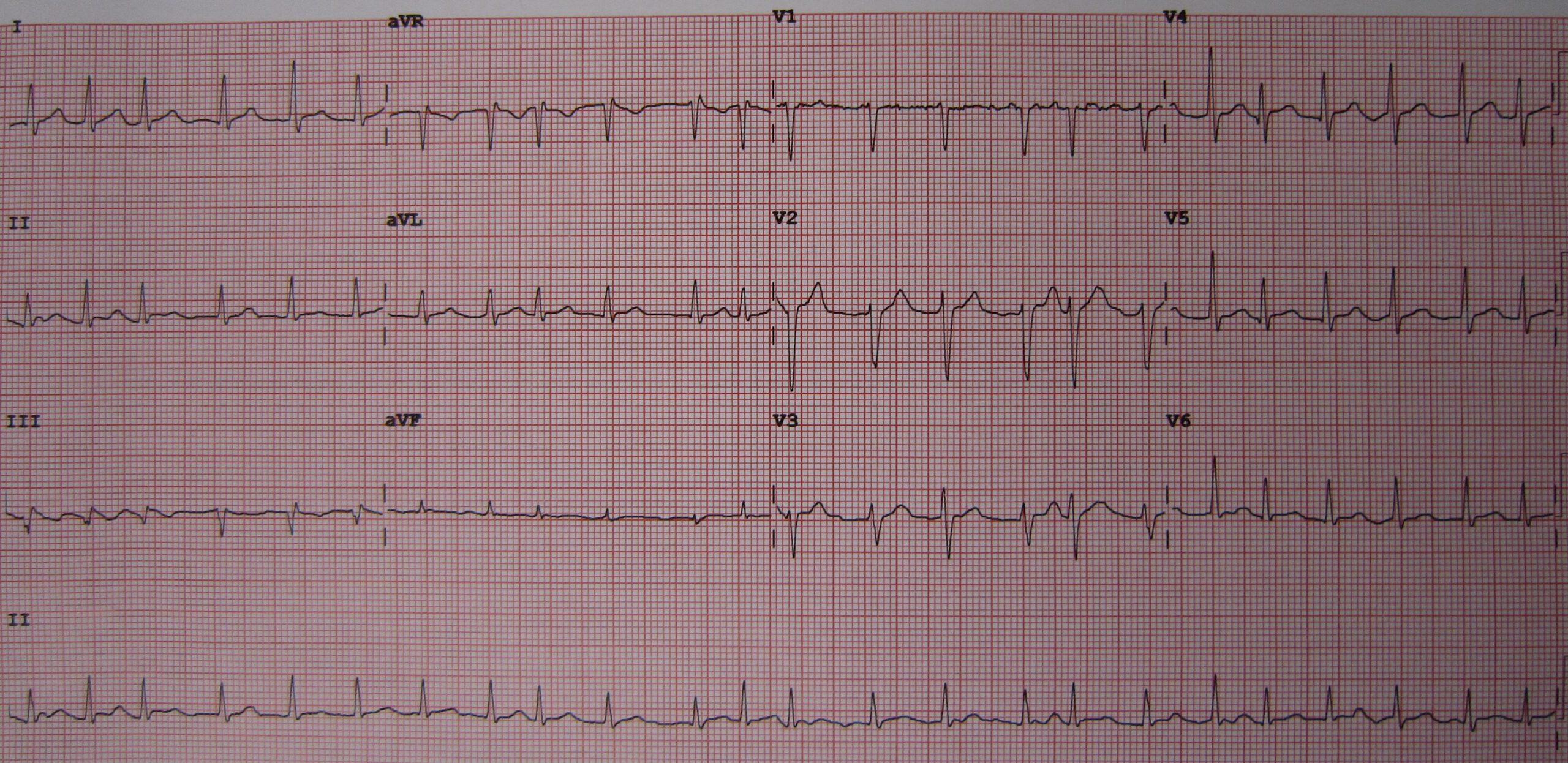
By James Heilman, MD – Own work, CC BY-SA 3.0, https://commons.wikimedia.org/w/index.php?curid=19126125
Interpret this EKG. What are the implications of this rhythm for the patient?
What
Lab results return on Mrs. Black as she is transferred to the ICU:
Na 144 pH 7.33 TSH 0.1
K 5.0 pCO2 48 WBC 14K
Mg 1.0 HCO3– 24 Hgb 12.5
BUN 11 pO2 190 Hct 38%
Cr 0.7 Lactate 3.2 Plt 450K
What is going on physiologically with Mrs. Black?
What medications do you anticipate the provider ordering for Mrs. Black?
The provider orders a beta blocker and IV fluids for Mrs. Black, as well as an increased dose of propylthiouracil (PTU). She is stable for now, but it may take a few days for her to overcome this thyroid storm/crisis. Her husband asks the nurse what caused this.
What is the best response to the husband to explain what triggered Mrs. Black’s Thyroid Storm/Crisis?
Tiona RN
Concepts Covered:
- Studying
- Medication Administration
- Adult
- Emergency Care of the Cardiac Patient
- Intraoperative Nursing
- Microbiology
- Cardiac Disorders
- Vascular Disorders
- Nervous System
- Upper GI Disorders
- Central Nervous System Disorders – Brain
- Immunological Disorders
- Fundamentals of Emergency Nursing
- Dosage Calculations
- Understanding Society
- Circulatory System
- Concepts of Pharmacology
- Hematologic Disorders
- Newborn Care
- Adulthood Growth and Development
- Disorders of Pancreas
- Postoperative Nursing
- Pregnancy Risks
- Neurological
- Postpartum Complications
- Noninfectious Respiratory Disorder
- Peripheral Nervous System Disorders
- Learning Pharmacology
- Prenatal Concepts
- Tissues and Glands
- Developmental Considerations
- Factors Influencing Community Health
- Childhood Growth and Development
- Prenatal and Neonatal Growth and Development
- Developmental Theories
- Basic
- Neonatal
- Pediatric
- Gastrointestinal
- Newborn Complications
- Labor Complications
- Fetal Development
- Terminology
- Labor and Delivery
- Postpartum Care
- Communication
- Basics of Mathematics
- Statistics
- Basics of Sociology
- Cardiovascular
- Shock
- Shock
- Disorders of the Posterior Pituitary Gland
- Endocrine
- Disorders of the Thyroid & Parathyroid Glands
- Liver & Gallbladder Disorders
- Lower GI Disorders
- Respiratory
- Delegation
- Perioperative Nursing Roles
- Acute & Chronic Renal Disorders
- Respiratory Emergencies
- Disorders of the Adrenal Gland
- Documentation and Communication
- Preoperative Nursing
- Legal and Ethical Issues
- Oncology Disorders
- Female Reproductive Disorders
- Musculoskeletal Trauma
- Renal Disorders
- Male Reproductive Disorders
- Sexually Transmitted Infections
- Infectious Respiratory Disorder
- Integumentary Disorders
- Emergency Care of the Trauma Patient
- Urinary Disorders
- Musculoskeletal Disorders
- EENT Disorders
- Neurological Emergencies
- Disorders of Thermoregulation
- Neurological Trauma
- Basics of NCLEX
- Integumentary Important Points
- Multisystem
- Test Taking Strategies
- Urinary System
- Emergency Care of the Neurological Patient
- Central Nervous System Disorders – Spinal Cord
- Respiratory System
- Emergency Care of the Respiratory Patient
- Cognitive Disorders
- Anxiety Disorders
- Depressive Disorders
- Trauma-Stress Disorders
- Substance Abuse Disorders
- Bipolar Disorders
- Psychotic Disorders
- Concepts of Mental Health
- Eating Disorders
- Personality Disorders
- Health & Stress
- Psychological Emergencies
- Somatoform Disorders
- Prioritization
- Community Health Overview
- Gastrointestinal Disorders
- Integumentary Disorders
- Respiratory Disorders
- Neurologic and Cognitive Disorders
- Renal and Urinary Disorders
- Infectious Disease Disorders
- EENT Disorders
- Hematologic Disorders
- Cardiovascular Disorders
- Musculoskeletal Disorders
- Endocrine and Metabolic Disorders
- Oncologic Disorders
- Behavior
- Emotions and Motivation
- Growth & Development
- Intelligence and Language
- Psychological Disorders
- State of Consciousness
- Note Taking
- Concepts of Population Health
- Basics of Human Biology