
Anatomy of an NCLEX Question

Included In This Lesson
Study Tools For Anatomy of an NCLEX Question
Outline
The NCLEX® is composed entirely of multiple choice questions. Your ability to work as a nurse comes down to a single test with multiple choice answer options.
Think it’s important to understand a bit more about these questions?
Basically you have two options:
- Complain about the tests, the questions, and the answers.
- Learn everything you can about the questions and how to dissect them and demolish them.
Since only one of these options is going to get you closer to RN, let’s focus on learning how to dissect the questions.
So let’s break down the anatomy of the question:
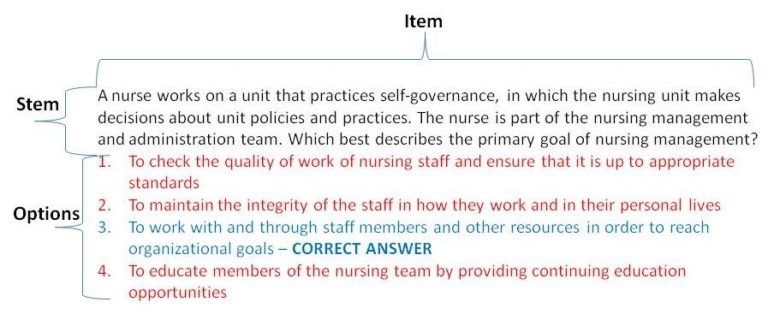
- Item: the entire question and answer
- Stem: the actual question, what is being asked
- Options: possible responses
- Correct answer: umm, the correct answer
- Distractors: incorrect answers
Stem:
The stem will have a few characteristics that you must consider.
- Complete sentence
- Incomplete sentence – becomes complete with the correct answer
- Positive – asks a question regarding what is true
- Negative – asks a question regarding what is false. Be very careful with these questions. These tend to be missed more often simply because students fail to read the entire question. ALWAYS read the entire stem carefully and completely.
- Look for these words when determining if the stem is negative:
- Except
- Not
- Never
- Further
- Least
- Avoid
- Contraindicated
- Sometimes these items will be identified with bold or italic lettering but ultimately it is your job as the student to read the question and identify what is actually being asked . . . so read carefully.
- Look for these words when determining if the stem is negative:
Transcript
When we talk about the anatomy of an NCLEX question, a lot of these information might seem really basic, it might seem really simple. But what we’re doing here guys, what we’re doing in this entire course is we’re giving you a tool set of information, of techniques and of skills to help you then go out and approach these questions from a new point. We’re not giving you this simple tree, you know, of decisions, that you then don’t have to learn the information. What we’re doing is we’re giving you the background information to help you approach those questions appropriately. We’re not giving you hacks, what we’re doing is giving you the information you need to approach questions appropriately. So, what we’re gonna do here is we’re gonna just talk really briefly about the anatomy of an NCLEX question or of a nursing school test question. So, first of all, it’s important to understand that the NCLEX is composed entirely of multiple choice question. Now they also might come across as audio, they might be a picture, the might be a SATA question. But each of these questions is a multiple choice question. So, take a moment and think about that for a second. Your ability to work as a nurse comes down to a single test with multiple choice options. Literally, everything you’ve done getting to this point, going through nursing school, taking the NCLEX, becoming a nurse, all of that comes down entirely to a multiple choice test. So, do you think it’s important to understand a bit more about these questions? Now, with this, you basically have two options, we’ve talked about this before but I want to really help this sink in. You can decide to complain about this test, the questions and the answers and say “They’re not fair! They’re terribly written. They’re horrible, I hate them!” or you can learn everything you can about the questions and how to dissect them and demolish them.
Now, since only one of these two options is gonna get you closer to that goal of RN, let’s focus on learning how to dissect questions. Now, let’s picture here, this is obviously not a picture from an NCLEX test because this girl here, she’s way too happy. Either that, or she’s like, I don’t know. This dude is like, “Oh screw it, I’m falling asleep.” And this guy here is like “Yeah, I’m just gonna cheat.” So, obviously not coming from an NCLEX test room but, you know, NCLEX is computer based. You’re gonna go in there, you’re gonna get earphones, you’re gonna get a scratch piece of paper, pen, you’re gonna be able to sit down and take this test.
So, let’s talk about the different pieces of an NCLEX question. For nursing students, your enemy, what you’re trying to conquer is the NCLEX. Now I say enemy a lot, you know, I grew up a lot playing sports. I did wrestling, football, and track in high school, did a little bit of wrestling in college, did a lot of marathons, and competitive running after high school, after college. So, I always remember thinking of my enemy, my opponent, while I was working out. My son is now doing wrestling as well, and one thing that coaches always say is we’re gonna work harder today than your opponent, okay. Or, when they get into the really hard part of the workout, they’ll say, now think about it, your opponent has now quit and gone home, he’s taking an evening off, you’re going to now work harder. Alright, so that’s what you’re doing here. So, that’s what you’re doing as member of the NRSNG Academy. That’s what you’re doing now as you’re getting that extra piece of information that no one else is getting. Every piece of information you get is only going to be to your advantage. Okay, your enemy, your opponent is the NCLEX, it is the one thing standing between you and RN. So rather than complain about the test and how hard it is, let’s present another possible option. So, everything we can about how it is written at the different pieces.
So, this isn’t a great graphic here, but what I want to show you guys, are the different pieces of the question. Because understanding this, understanding this terminology is now going to help you more as we dive in to a couple of the different strategies. This is gonna help you as you sit down and you take a question. Because what you’re gonna be able to do is you’re gonna think, “Okay, what’s the stem saying? What are the options saying, basically?” So, if we take this multiple choice question here, we can break it into basically 3 parts. First of all, we have the item. What the item refers to is the entire question. When you say an NCLEX item, you’re saying the question on the NCLEX. Then, when you say Stem, what you’re talking about when you say stem is you’re talking a about this actual question portion of it. Okay, it’s the actual question. It’s what being asked. What’s being asked of you is the stem. Then, you have options. Options of course, are possible responses. Inside those options, then what you have is you have a correct answer which is drum roll the correct answer and then you have distractors. What distractors are is they are the wrong answers. These are the things that you don’t want to select. So, I really want you to understand this, I know this might seem massively over simple and why am I even covering this? But I really want you to understand your opponent. Okay, the item is the entire question. It’s the entire, everything composed of that point, okay. Stem is the question itself. Options are the possible responses. Correct answer is obviously the correct answer. And distractors are all the wounds you should not select.
Now, there’s a couple of different kinds of stems. So, we’re gonna go over the different kinds of stems that there are. Some stems will be complete sentences, we’ll have full complete sentence with punctuation at the end and then you’re expected to select the response based on that. Some would be incomplete sentences. So, what you’re looking for with an incomplete sentence stem, is you’re looking for an answer option that completes that sentence. Then, the first, okay, so, let me think of an example of this. So, the nurse would first do and then you would select it. Okay, this one here, that we’re looking at, the nurse is part of the nursing management and administration team. Which best describes? That’s obviously a complete sentence. But an incomplete sentence would be something that you’re looking for in your response. The correct response is you’re going to complete that sentence. Then, we’re also gonna have positive stems. What a positive stem is, is it’s asking a question regarding what is true. That’s what we’re used to answering, that’s what we’ve seen so many times in test from kindergarten on, is positive statement. What’s true? What’s the correct answer here? However, what we’re now presented within nursing school and this what we’re gonna spend a little bit of time on, is we’re presented with negative statement. Okay, a stem that’s actually asking a question regarding what is false. And now you might say why do I even need to know what’s false? Well, the point of asking these negative statements is a couple of reasons. They want to see if you’re paying attention, which you need to read questions very closely. They wanna see if you can analyze and critically think and they wanna see if you can draw out what you would not do, right? The NCLEX is all about safety. They wanna know how safe they’re gonna be, they wanna know you know what not to do, just as important as knowing what to do as a nurse is knowing what not to do. So, be really careful with these questions. These tends to be missed more often simply because students fail to read the entire question. Always, always, always read the entire stem carefully and completely. Complete statements are very easy. Positive statements are very easy. Where you can get fumbled up on is incomplete statements where you’re trying to complete a sentence and negative statements where they’re trying to figure out what is false? Now, how can you identify these negative statements? So how can you know when it’s time for you to select the false answer? Now, we’re not talking true or false, we’re talking a multiple choice question where what you’re actually trying to do is you’re trying to find out which one of all these options is false. So, I’m gonna give you a couple of keywords that you can use to know if you’re expected to find the false answer. Now, sometimes, these items or these words will be identified with bold or italic lettering. But a lot of times, they won’t be. And ultimately, it’s your job, as the student, to read the question, identify actually what is being asked, and if you’re supposed to find the correct answer or the false answer. So, read very carefully. I missed these more than anything else because I would get in rush and I would feel over confident, get in rush, and just completely miss the answer then.
So, some of the ways you’re gonna find these would be the word except. The nurse would do all the following except. Which of the following options would the nurse not do? The nurse should never do this. Okay, when taking the temperature of a patient, the nurse should never… And then, you find out. Further. Further, this one can be, this one can be a little bit tricky because you might really miss this and it’s not like this big negative word that we’re used to seeing. So, you might really miss this word in a stem. But further would be which statement by the patient would indicate the need for further teaching. That’s the most popular way they’re gonna use further. Which statement by the patient would indicate the need for further teaching? Or, which finding would indicate the nurse needs further assessment? Alright, so that’s one that you’re looking for the negative one. Alright, for teaching the patient about beta blockers, and they ask which would indicate further teaching? You know, it’s gonna be something about “I’m gonna take it when my blood pressure is 30/10” We don’t wanna do that. So, make sure we identify ‘cause what a lot of time happens is these questions guys, is you get in there, you don’t see that it’s a negative thing. We start reading the responses, you’re like, men, 2 and 3 really sound right, one of them seems a little off, and you don’t realize that you’re actually looking for that negative response. So be really careful with that. Another one is least, okay. Which patient is least likely to experience an aneurysm, for example. Or, which patient is least likely to suffer from high blood pressure. Again, you’re looking for that negative response. Another one here is avoid. Which action would the nurse avoid when caring for a pediatric patient? So, what don’t you wanna do in that instance. That’s a really big one, it’s really important. Another one is contraindicated. Which medication is contraindicated in a patient who is African American? Or, which treatment is contraindicated in a patient who is drinking grapefruit juice? Or, when would it be contraindicated to intubate? So, these are times, you know, these 7 words, I want you to write down, I want you to remember these and I want, more importantly than anything else, I want you to start watching out for these, okay? Start realizing these are gonna be spread out, sprinkled in, peppered in to your questions, so I really want you to be very careful about looking for these, finding these, and making sure you understand that you’re looking for a negative answer, alright. So, that’s really how the NCLEX question is structured, that’s the anatomy, that’s the basic set up of an NCLEX question. And with this information, I want you to kinda store this back in there and realize that with this information, you can now approach these questions.
NCLEX Review
Concepts Covered:
- Noninfectious Respiratory Disorder
- Test Taking Strategies
- Respiratory Disorders
- EENT Disorders
- Prenatal Concepts
- Studying
- Prefixes
- Suffixes
- Acute & Chronic Renal Disorders
- Disorders of the Adrenal Gland
- Integumentary Disorders
- Oncology Disorders
- Preoperative Nursing
- Musculoskeletal Trauma
- Bipolar Disorders
- Disorders of the Posterior Pituitary Gland
- Hematologic Disorders
- Community Health Overview
- Immunological Disorders
- Renal Disorders
- Childhood Growth and Development
- Labor Complications
- Upper GI Disorders
- Medication Administration
- Neurological Emergencies
- Adulthood Growth and Development
- Disorders of Pancreas
- Musculoskeletal Disorders
- Cardiac Disorders
- Disorders of the Thyroid & Parathyroid Glands
- Integumentary Important Points
- Pregnancy Risks
- Urinary Disorders
- Vascular Disorders
- Eating Disorders
- Learning Pharmacology
- Anxiety Disorders
- Basics of NCLEX
- Factors Influencing Community Health
- Lower GI Disorders
- Intraoperative Nursing
- Integumentary Disorders
- Neurologic and Cognitive Disorders
- Trauma-Stress Disorders
- Central Nervous System Disorders – Brain
- Somatoform Disorders
- Dosage Calculations
- Depressive Disorders
- Personality Disorders
- Cognitive Disorders
- Substance Abuse Disorders
- Psychological Emergencies
- Circulatory System
- Postoperative Nursing
- Hematologic Disorders
- Liver & Gallbladder Disorders
- Infectious Respiratory Disorder
- Central Nervous System Disorders – Spinal Cord
- Emergency Care of the Cardiac Patient
- Concepts of Population Health
- Peripheral Nervous System Disorders
- Note Taking
- Female Reproductive Disorders
- Oncologic Disorders
- Postpartum Complications
- Endocrine and Metabolic Disorders
- Fetal Development
- Shock
- Emergency Care of the Neurological Patient
- Respiratory Emergencies
- Labor and Delivery
- Gastrointestinal Disorders
- EENT Disorders
- Postpartum Care
- Cardiovascular Disorders
- Newborn Care
- Renal and Urinary Disorders
- Newborn Complications
- Urinary System
- Musculoskeletal Disorders
- Infectious Disease Disorders
- Nervous System
- Psychotic Disorders