
Time Management
Included In This Lesson
Study Tools For Time Management
NURSING.com students have a 99.25% NCLEX pass rate.
Outline
Time management is perhaps the one element of nursing that all nurses, from novice to expert, struggle with more than anything else.
From the moment you enter nursing school you are given an unmanageable amount of tasks to complete. This does not change as you leave school and enter the workforce.
Part of succeeding in nursing school and scoring well on exams comes done to learning how to manage your time. Hence, we begin our “Test Taking” course with a module in Time Management.
I believe this is the foundation to success in school and throughout your career as a nurse. Mastering this one skill will make all the difference in your career.
Here I will present a few key strategies the nurse and nursing student can implement to improve their command on their time.
Plan
Effective time management comes down to creating a plan. At the risk of sounding oversimplified please understand that without a plan it is hard to really accomplish any great task.
Most people take little or no time to actually sit down and document WHAT they are committed to accomplish. Before you can create an effective study schedule you must document and outline everything that you are required to do.
This is simple.
- Pull out a sheet of paper and your syllabi and write out everything that you are required to do.
- Order each item by most important to least important.
- Don’t waste time on an assignment that is only worth 5% of your grade if you haven’t yet completed the paper that is worth 25%.
- GPA is weighted by how many credits a course is worth. A 4 credit course will count 4X toward your GPA as a 1 credit class . . . and it is usually more important.
- What subjects are the most important?
- What assignments count for the majority of your grade?
- What subjects count for more of your GPA?
Once you have your plan take this paper and sit in from of Google Calendar (this is the preferred scheduling tool).
Develop a color for each course or each type of assignment.
Using Google Calendar:
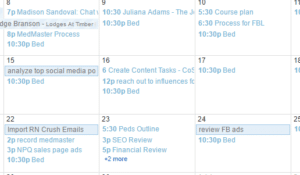
- Start by plugging in due dates. When are assignments actually due?
- Add in test dates.
- Now schedule time to work on any given assignment.
- Don’t just assign a day . . . assign an actual time to work on the assignment. The logic behind this is that once a task is on paper and time allocated to work on it you can forget about it until that time. If you don’t do this you will continue to stress about a task or what needs to be done with it. If you have scheduled and allocated time to work on the task you can forget about it and divert your mental energy to what you need to work on now rather than being distracted. Scheduling out your study times also allows you to enjoy your time off. If everything is scheduled you can add in time to relax and actually enjoy that time.
- Schedule out other life tasks.
- Your life isn’t all about nursing school. Plan in time to do laundry, go to the bank, etc . . . all those things that are important but not nursing school related.
- Schedule in rest time.
- This might sound overkill, but you need to plan time to “turn off”. If everything else is scheduled out as above your brain will be able to turn nursing school off when it is time to relax.
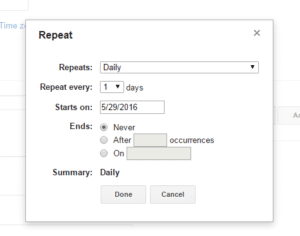
One feature I really like about Google Calendar is the ability to make tasks recurring. You could use this function for classes, specific study groups, or other repeatable tasks. I actually have a daily reminder on when I need to go to bed . . . to make sure I’m getting as much sleep as I should.
Pomodoro Technique
Attention is fleeting. Your ability to focus is short lived. It feels great to say you studied for 4 hours, but how much of that was effective, focused study time?
Pomodoro Technique is a time management technique developed by Francesco Cirillo in the late 1980s. The idea is to break work down into 25 minute intervals broken up by short breaks. The short focused sessions and break time is thought to improve mental agility.
Here is how it works:
- Decide on a task you will be working on (NCLEX questions, an essay, studying MedSurg, etc. . . ).
- Grab a timer (you can use the timer on your phone).
- Set the timer to 25 minutes.
- Turn off all email notifications, music, close down all social media. For the next 25 minutes do NOTHING other than focus on the task.
- When the timer goes off, take a 5-10 minute break. Go crazy on social media, eat a snack, do anything BUT study.
This technique will help you study with more focus, more energy, and allow you to retain and learn more.
It is important that you stick to your times. The temptation in the beginning will be to keep on studying through your first break or to just check one message during a cram session . . . avoid doing this.
When it is time to study . . . study.
When it is time to break . . . break.
To help you avoid the temptation (that we all feel) to check Instagram or Twitter or send a short email, or check the news during a cram session, here are a few Google Chrome extensions that will keep you on track:
- Momentum: Replaces your normal home page with a beautiful landscape image and asks your what your one and only focus is for the day. This makes you think about “What do I need to accomplish before anything else?” Rather than being distracted the moment you open a new internet tab.
- Stay Focused: StayFocusd is a productivity extension for Google Chrome that helps you stay focused on work by restricting the amount of time you can spend on time-wasting websites.
- Strict Workflow: Enforces a Pomodoro Technique workflow by limiting access to the internet for 25 minute intervals.
Limited Mental Energy
Willpower and mental energy are depleting resources. This is also referred to as Ego Depletion. That is to say that each day you wake up with a given amount of willpower and a given level of mental energy. As you make decisions and determine what is important and where you should focus your energy that level is depleted a little bit.
Think of it as a muscle. You wear out your muscles just as you wear out your mental energy (will power). Ever wonder why at the end of a mentally stressful day all you want to do is sit on the couch and eat oreos?
Your brain can only focus for so long.
With each choice you make on a daily basis you use one “unit” of willpower.
So it is important to choose wisely where you allow your energy to be diverted. Are you using your most effective hours to focus on your most important tasks?
Expending a great deal of mental energy also lowers our glucose levels which further limits our abilities to focus.
When it comes to nursing school and time management it is vital to keep this in mind.
You should be doing your most important work when you have the mental capacity to study. For some it is the early morning. For others it might be the late evening.
To determine the best time to complete your most mentally exhausting tasks like studying new material use this worksheet from Oregon State University to determine how many hours you have each week and where they are being spent.
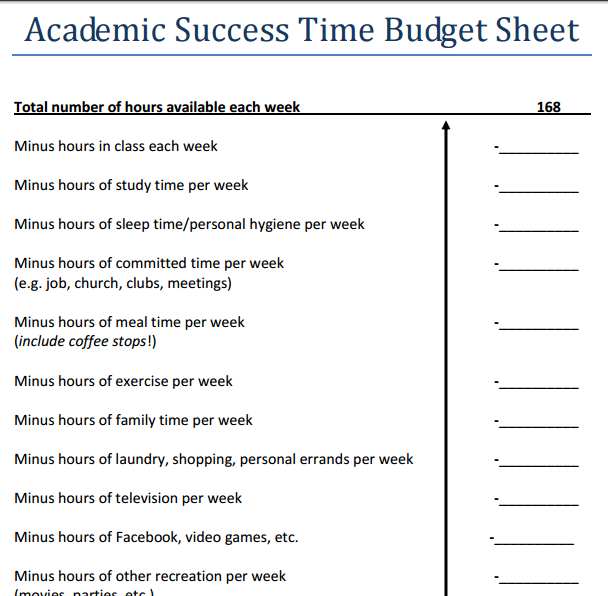
You can print the full document here: http://success.oregonstate.edu/sites/success.oregonstate.edu/files/LearningCorner/Tools/time_budet_sheet.pdf
Deep Work
By this point you should have a solid grasp on WHAT needs to be done, and WHEN you should do it.
To help make the most of this study time it is important for you to understand a concept called “Deep Work”.
Coined by Cal Newport, deep work is the ability to focus without distraction on a cognitively demanding task.
Learning how to do so will allow you to master complex material in less time.
Nursing school is a tremendously cognitively demanding environment. Apart from learning all of the material there are mountains of assignments and tasks to complete each week on top of clinical assignments. It is imperative that you learn how to maximize study time and develop skills to master the new, complex material.
Here are 7 strategies to embrace Deep Work in your life. See if you can begin to incorporate these today:
- Block Out Time – as mentioned above it is essential that you physically block out time on your schedule to work on your cognitively demanding tasks. At a minimum you should block out 90 minutes. Don’t just schedule “Study Time” on Tuesday. Physically block out 90 minutes on your calendar to study “Heart Failure”. Once that time is blocked out treat it is sacred. Nothing will come up to take you away from that task. You can schedule Pomodoros within this time but you should remain focused for the 90 minutes.
- Embrace Boredom – we don’t like to be bored. With phones, internet, movies, social media it is hard for us to even think about not looking at or reading something for even a couple seconds. To get to deep work it is necessary that you learn how to train your brain to be a little bit bored. To make the connections that are required to deeply understand heart failure you will need to spend time contemplating, analyzing, and focusing. If you never allow yourself to be bored it will be hard to focus as you need to when it comes time to study.
- Productive Meditation – one way to train your brain to focus is to think of a complex problem, concept, or thing you would like to solve. Do not allow your mind to wander as you are thinking of this problem. If your mind starts to wander . . . bring it back. This could be thinking about the RAA system as you walk around a park. Allowing your mind to only think on the RAA system and how it applies to heart failure. You can schedule time daily to walk and think. For me, the early morning is best for this.
- Zero-Tolerance – we’ve discussed this already above, but when you are engaged in deep work, do not allow anything to pull you away. You are not to look at your email even once during a session.
- Prepare for Deep Work – just as you would prepare for a long race, you should prepare for your deep work sessions. Drink water and eat prior to going into a session. Let you family and friends know that you will not be accessible during that time. You could even set up an email autoresponder that says something like: “Sorry, I am currently studying. I’ll get back to you at XX:XX”. It can be helpful to have a routine that you follow prior to each session. For me it was a short session of meditation, a splash of water on the face, reading a book with positive affirmations, and a short journaling session. Once that is done I grab a cup of coffee and water and begin my deep work session.
- Know the Outcome – have a set outcome that will be accomplished at the end of the session. Going into a session with an achievable goal can help you feel like something has been completed.
- 20% Less Rule – cut your deadlines by 20%. This will create a sense of urgency. If a paper is due in 5 days . . . set your deadline to 4 days. This will make you focus more intently as you are working on the task.
- ✓Full lesson outlines
- ✓NCLEX simulator (SIMCLEX)
- ✓6,500+ practice questions
- ✓2,000+ lesson videos
- ✓300+ cheatsheets
200% NCLEX Pass Guarantee.
No Contract. Cancel Anytime.
Transcript
Alright guys, I’m gonna be honest here, time management is not something that most people are super excited to learn about. You know, we’re not talking critical care, we’re not talking emergency room care, we’re talking a basic strategy about time management. So, I know, a lot of you aren’t very excited about this. But I really want to encourage you, before we get started, to watch this whole video to go through this entire module and to learn everything you can about time management. The reason for that guys is that time management is perhaps the one element of nursing that all nurses, from novice to expert, struggle with, more than anything else. Our entire career is built around time management. And nursing schools, really, like we say all the time, is kinda like drinking from a fire hose. So, for the moment you entered nursing school, you really get an unmanageable amount of tasks to complete. From the moment you start your first job on the floor, you’re given an unmanageable amount of tasks to complete. So, I really want you to focus on this and to listen to this and to learn. And part of succeeding in nursing school and scoring well on exams is learning how to manage your time. I really believe this is the foundation of success in nursing school and throughout your career. It can really come down to mastering time management. So, I’m gonna give you a couple of strategies and tips and things to help you learn how to manage your time.
One thing I want you to understand guys is that “A goal without a plan is just a wish.” Effective time management comes down to creating a plan. Please understand that without a plan, it is hard to really accomplish any great task. Now, we’ve learned that from the time we’re little kinds, right? Create your plan first and everything. But, I really want you to internalize that. Now, I really want you to internalize the importance of having a plan. And with nursing school, what happens is, when we get all these tasks, when we get all these things that we know we must do and which are all very important, we start to forget about the whole planning phase and we jump straight into the doing phase without really knowing what we need to do or how we need to do it. So, most people take little or no time to actually sit down and document what they’re committed to accomplish. Before you create an effective study schedule, you must document, outline, everything that you’re required to do.
So, how do you get things done, you guys? It’s actually really simple. You have to do 2 things and ask yourself 3 questions. So I want you to pull out a sheet of paper and your syllabus. Okay, pull out all the syllabi for all your different courses, every single one of them. MedSurg, Community Health, Fundamentals of Nursing, Anatomy and Physiology, depending on where you are, you know, in your career or in your phase of nursing school, I want you to pull out everything that you must do, everything that you’re required to do. And I want you to order each item by most to least important. Okay, so I want you to write it down and I want you to order it by most to least important. Now, how do you do that? How do you organize and order things by most to least important, right? Because every professor, every teacher is going to tell you that everything is the most important and every task is the most important. That can really become tricky when you’re working as a nurse because everything does seem important. And in the test taking module later on, I’m gonna show you how to even prioritize patient care. So, while everything is important guys, there’s always a most important. Alright, that know that can sound really annoying but I’m gonna give you a way to order your tasks, your assignments, to determine what’s really the most important. So, I want you to ask yourself 3 questions. First of all, what subjects matter? What are the most important subjects for you to learn? Well, I think, nursing research is important. And while you need to understand the basics of nursing research, when it comes down to it, adult care for MedSurg is more important to becoming a successful nurse. To doing the basics of nursing care, you really need to understand MedSurg more. Or, community health and pharmacology. Without understanding nursing pharmacology, it’s going to be hard to be a nurse. It’s gonna be hard to monitor for side effects in a patient. Well, with community health, a lot they can be learned as you’re working as a nurse, as you’re working in community health. So, you really need to look at what are the most important subjects? While all subjects matter, all are important, I know that those that want to go into research or those that want to go to community health might get or maybe saying that they’re less important than MedSurg. You have to assign a specific hierarchy to every course. You have to determine in your mind what is the most important for you to learn. If you had to decide between community health and MedSurg, you need to understand MedSurg, you know, sympathophysiology of the body and different disease processes more than you need to understand community health to be a nurse. And that’s why a lot of our focus is on these topics. That’s what we’ve done here at NRSNG and I think that’s why people really appreciate our teaching style is because we’ve taken all these different topics. Everything that you you’re thrown is thrown at you at nursing school. And we’ve shown you what’s really important, what really matters. So, you need to do the same thing. Layout all your syllabi for any given semester and rank them in most important to least important to what you really need to know. Then, beyond that, you need to look at what assignments really matter. I noticed myself doing this in nursing school a lot is there would be an assignment or something that I was excited about or I thought was important or was just massively time consuming and I would start to spend a lot of time on it. Well, when it came down to it, that assignment was only worth 5% of my grade and I was spending 80% of my time on it. Alright, so, versus spending time on what really matter, you know, a paper that’s worth a 25% of your grade. So, I want you to really divide out the different assignments that you have by what matters most. Like, these are called the linchpin right? This is what we’ll talk about all the time here at NRSNG. Those couple of assignments that are going to make all the difference in your GPA and in your grade. So, if you focus on those assignments, before you focus on the 1% or the 2% assignments, it’s gonna have a much greater impact on your grades, on your understanding and on your learning. So, for example, I remember when I was in nursing school, one of our classes we had to, you know, participate in these discussion groups. Now, participating in a discussion group weekly was worth of a total of about 2% of my grade. So, if I didn’t do any of it, I can still get a 98% in the course. If I did all of it, I can get a 100%. But that was only worth 2% of my grade but it could take up a lot of time. You know, responding to other students, reading everything everyone else post, looking for good things to post. But in the end, it wasn’t going to affect my GPA. So, I did what I needed to there but I spent 2% of my time on that. I didn’t spend 25% of my time or 50% of my time. And what I want you to understand is those things could start to become big traps. The little assignments that are very time consuming might not be worth much of your grade. So, give it the amount of time that makes sense. The last question I want you to ask yourself is how many credits is this specific course worth? Okay, what subjects count more for your GPA? Now, it’s important in nursing school to learn everything you can, it’s also important to do well. And GPA is weighted by how many credits a course is worth. For example, a 4-credit course will count 4 times towards the GPA as a 1 credit course. And it’s usually more important. So, usually, courses like MedSurg, courses like pharmacology, course like pathophysiology will be worth 4 or 5, even 6 credits. Now, that 6-credit, that 4-credit course, or whatever, is going to be worth that many times more than 1-credit course. So, for example, I remember when we had a health informatics course and it was worth 1%. We had a medical terminology course that wasn’t 1%. I wanted to learn those things, I was interested in those things, but at the end of the day, my MedSurg course was worth 5 credits and that course is only worth 1 credit. So, getting a 50% in a 5-credit course will have a tremendous impact on my GPA even if I get a 100% in the 1-credit course. You understand how that works? Your GPA is weighted across all credits and those 4, those 5-credit courses are worth that many times more than the 1-credit course. So, if you have, let’s just look at all these 3 questions together. If you have a health informatics assignment, you know, create an Excel spreadsheet, or whatever it is, that is only worth 5% of your grade in that class. And that class is only worth 1-credit. And you have a research paper for a MedSurg course that’s worth 40% of your grade in a 4-credit course. You know, it’s worth exponentially more to your GPA and to your learning to spend time on that course and that assignment that is worth more. You’re gonna learn more and it’s gonna be worth more on your GPA and it’s worth more of your time than the 5% assignment in a 1-credit course. So, that makes sense. Once you divide, once you got all your syllabi laid out, what subjects matter, what assignments matter and how many credits is a course worth. And that’s how you can start allotting importance to each different assignment that you have.
So, at this point, I’m gonna give you a couple of tools. Let me give you a couple of things that you can use to help organize your time and make sure that you’re focusing where you need to, and you’re focusing how you need to. Everybody loves tools. So, I want you to use some of these tools, these are the tools I use after much trial and error. These are the tools that I have found helped me the most. So, one of the tools I use the most is this something called Google calendar. Hopefully you have access to this before, hopefully, you used this before. But Google calendar is a tremendously helpful tool for organizing yourself and organizing your time. It is a wonderful app that integrates with your phone, integrates with your schedule. Most other scheduling programs, most other things integrate really well with Google calendar, works with your Gmail account. It’s just a really helpful tool for keeping yourself organized. So, once you’ve created your plan on paper, once you understand what classes, what matters the most, I want you to go into Google calendar and I want you to develop a color for each course or each assignment type. So, here’s what I mean by this. You can assign different colors to many different kinds of tasks. So, I can create new calendars based on different subjects. So, like, I can go in here and I can create a MedSurg calendar, alright. And once I create that MedSurg calendar, I can then put it on my list. And with all my different calendars, you can see it has a different color assigned to it. So, if I go in here, and I create an event, I can add it to my MedSurg calendar. So, I can say, this test is on this date. And you can see, it pops up with that color. So, I know that this test is specific to my MedSurg course. Now, let’s say, so what’s really helpful here is you can create all these different calendars based on your different courses. So, you can create one for MedSurg, one for Pharm, one for OB-Peds, one for Research, and you can have all these different calendars built out. Another thing that I really like about Google calendar is you can create events that are recurring. Meaning, let’s say, you have discussion topics to every single week. You can come in here, you can make a repeat task, you can say it’s due every week on Wednesday, and you can even give it a time that’s it’s due. So, the way how we do it, if I was starting out using Google calendar, first thing I would do guys, is I would start by plugging in due dates. When are assignments actually due? Okay, so, let’s say, I have an assignment due this Friday, I wanna plug that in, I wanna assign it to the MedSurg calendar and I wanna make sure I know for that course, this assignment is due. Then, I want you to add in your test dates. When are the most important test dates due? Now, I want you to schedule time to work on any given assignment. Don’t just set a date. So, I don’t want you to just set a set day here to say, you know, I don’t want you to do this, I don’t want you to “Study MedSurg.” Okay, I don’t want you to just do that. Because if you just said it on a day, it’s very easy to push that off. The logic behind this is that once a task is on paper and time is allocated, you can then forget about it, okay? You can then let go of that task. And so then when you open your calendar on your phone or on your schedule each morning, if you have a lot of time for it, you know that from 8 o’clock to 2 o’clock, you’re gonna study. So, rather than just saying “Today, I wanna study.” What I want you to do is I want you to set a time for that. And then, I know that on these days leading up to this test, I can schedule, I have this time scheduled and I can forget about it. I don’t have to worry about studying for MedSurg ever again because I know I have a lot of the correct amount of time to study for that test. Alright, a lot of the correct amount of time to work on that paper. Then, I want you to schedule out other life tasks. So, things like doing laundry, going to the bank, etc. I know that sounds really maybe over the top but these other tasks like doing laundry, cleaning the house, going grocery shopping, can really eat up space in our mind as we’re trying to be focused if we don’t have it scheduled. And then, it becomes very easy to move advance as well in Google Calendar which is really nice. You can drag it around and move it and say, you know, it didn’t happen that day, that’s fine. You know, maybe I didn’t get my studying done that day, that’s okay. I had it scheduled and I tried to get it scheduled as much as I could. So, you really maybe create a workout calendar, you create a home calendar and you could even create a social calendar. And that’s the last thing I’d really recommend you do with Google calendar is I want you to schedule out your rest time. It’s just important that you rest as it is that you study. You know, one quote I really like is, “Any bow strung too tight will eventually break.” You know, it breaks like a bow and arrow. If you string a bow too tight, it will snap. Once you have everything else scheduled, you need to schedule time for your brain to turn off for your brain to relax. So, schedule time to watch TV. Schedule time to go to the movie. Schedule time to go out to eat.
Alright, another tool I wanna give you guys is something called the Pomodoro Technique. Now, I want you to understand that attention is fleeting. Your ability to focus is very short-lived. It feels great to say you studied for 4 hours. But how much of that time was effective, was focused, study time? So, one technique to help you get more out of your study time, to focus more on your study time is something called the Pomodoro Technique. It’s a time management system developed by Francisco Cirillo in the late 1980’s and the idea is to break work down into 25-minute intervals broken up with short break periods. The short focus sessions and break time is thought to improve your mental agility. And here’s how Pomodoro technique works. First, you have to select your task. You have to decide on the task you will be working on. Whether it’s NCLEX questions, essays, studying MedSurg, etc. Then, you need to grab a timer. Okay, you can use a timer on your phone, you can buy a cheap 200-dollar timer at the Dollar store or Walmart or whatever. And then you need to set the timer to 25 minutes. At this point, you need to focus. You need to turn off all email notifications, turn off all music, close down all social media. And for the next 25 minutes, do nothing other than focus on that specific task. Don’t do anything else. Turn every other single notification off. Don’t even check your e-mail once for 25 minutes, that’s it. And then, when the timer goes off, you take a break. Okay, you go crazy on social media, you eat a snack, you do anything but study. Don’t allow yourself to do anything else other than break. Watch TV, do anything for 5-10 minutes, and give yourself that time and make those break times just as sacred as the study time. Okay, what happens a lot of time is, you know, with me, is I’ll start to push those focus sessions into my break and before I noticed, it’s been 40 minutes. Because what happens after a couple of those sessions, after a couple of times of pushing into your break time, is you start to become demotivated, stressed, unfocused, and that work time starts to become just as unfocused as any other if you weren’t doing the Pomodoro technique. So, select your task, set the timer, focus for that time, don’t do anything else. And then, during the break time, once the timer goes off, go crazy, do anything else you want. Now, I really believe this technique will help you study with more focus, more energy and to retain more information. And again, when it’s study time, study. When it’s break time, break, and stick to those timers.
Now, what happens a lot of times guys is that you become distracted, right? You wanna check your social media, you wanna just see one quick little snap, you wanna send a snap, like “Look, I’m studying!” And the irony of that is obviously insane. But, you wanna check Instagram really quick, you wanna see if someone responded to you, that gets really really hard. You wanna send one quick e-mail, check the news during cram session, whatever. So, I wanna talk about a few different Chrome extensions that can really help you and these links will be down below. The first Chrome extension is something called momentum. And it replaces the normal homepage on your desktop, on your laptop or desktop, with a beautiful landscape image and ask you “What’s your one focus for the today?” And this really helps you focus on, okay, “What do I want to accomplish today?” My one focus today is to finish this MedSurg paper. My one focus today is to do a 100 NCLEX questions. Whatever it is, rather than being distracted in the moment by whatever tab is opened on the internet, every time you open a new tab, you’re gonna be reminded of that focus for that day.
Another Google extension I really like is something called “Stay Focused” and it really helps with productivity, it helps you stay focused by restricting the amount of time you can spend on time wasting websites. So, you can insert different time wasting websites, you know, social media sites, it has a couple of list of things, new sites, sports sites, whatever, and it limits the amount of time. You can say I’m allowed to spend this much time on there. So, the Stay Focused app allows you to only spend that much time on those things.
Another one I really like is one called “Strict work flow.” It enforces the Pomodoro technique by limiting access in the internet for 25-minute intervals. So, once you turn strict workflow on, it’s gonna limit your ability to get on the internet. You won’t be able to access the internet for those 25 minutes while you’re supposed to be studying. So, you turn it on, you start your Pomodoro, you start reading, you start studying, you start taking NCLEX questions. And for those 25 minutes, you just can’t access anything else. So, those links for those extensions are gonna be down below and they’re incredibly helpful.
Something else I wanna talk to you guys is about, is something that is really important to me and I really love talking about, is the fact that we have limited mental energy. This idea of limited mental energy is called Ego Depletion. Okay, will power and mental energy are depleting resources. They are just like physical engine. And, as the day goes on, as we make decisions, our ability to make wise decisions or our desire to make wise good decisions begins to deplete. As to say that each day you wake up with a given amount of will power and a given level of mental energy. As you make decisions and determine what is important and where you should focus your energy, that level is depleted a little bit. It’s like a bank account, and we spend energy, we spend decision making ability each day as we make more and more decisions. Think about like a muscle. You wear out your muscles just as you wear out your mental energy or your will power. Have you ever wondered why at the end of a really long mentally stressful day, the day you have to give a presentation, the day you did clinical for the very first time. You know, these days you that you have a tremendous amount of mental energy being expended, why the only thing you want to do at the end of the day is sit on the couch and eat oreos and watch, binge, you know, watch Netflix. The reason for that is your energy begins to deplete as you go throughout your day. Your brain can only focus for so long. Your brain can only give a 100%, can only make wise decisions for so long, and once that becomes depleted, we lose our ability to make those good decisions. So, this choice you make, think of it on a daily basis, with each choice you make, you spend 1 unit of will power. So, it’s important to choose wisely where you allow your energy to be diverted. Are you using your most effective hours to focus on your most important tasks?
To help you with that guys, I want you to use this tool. It’s Academic Success Time Budget. Okay, so, spending a great deal of mental energy also lowers our glucose levels which further limits our ability to focus. Our brain is a glucose machine, it’s fueled by glucose. And so, as we use our brain, we deplete all these glucose and we become less able to make good decisions. So, when it comes to nursing school and time management, it’s vital to keep this in mind. You should be doing your most important work when you have the mental capacity to study, when you are most mentally effective. For some, it might be in early morning, for some it might be in late evening. For me, it’s early morning and late evening, that’s when I’m best, from about 11 to 3 in the afternoon, I’m pretty much worthless. And so, I try to focus my time, you know, on things that I create for you guys, the things that we work on here at NRSNG, I try to focus on early morning hours and late evening hours. And I want you to have a tool, I want you to know what’s the best time for you to study. Alright, there’s this tool made by Organ State University to help you determine how many hours you have each week and where they’re being spent. And this is called the “Academic Success Time Budget.” There’s a link below where you can get this full document, print it out, and this will help you kinda determine where are my hours being spent? How much time is being spent in class? How much time is leftover? And then I want you to think about when I should be doing the most important task. Remember, that’s what we did at the beginning of this presentation, to determine what are the most important task.
The last tip, the last trick I want to give you, is something called Deep Work. If you’ve done what I’ve asked you to do here, if you’ve worked through your syllabi, if you’ve done all these different things, installed these different extensions, started scheduling out your time, you have a solid grasp on what needs to be done and when you should do it. Now, to help you make the most of this study time, it’s important for you to understand the concept called deep work. Deep work was coined by Cal Newport in his book, by the same name, Deep work and his ability to focus without distraction on a cognitive demanding task. So learning a new skill, learning how to do an IV, learning how to insert a catheter, learning how to study, writing an involved essay, requires deep work, requires us to focus without distraction on these very cognitive demanding task. Alright, so learning how to do so will light and master complex material in less time. So, I wanna teach you how to achieve deep work. If you wanna read the book, it’s a wonderful book, you can get it on Amazon, I’m sure. Used are pretty cheap or an audio version and listen to it. But I’m gonna give you a run down of how to achieve deep work. Nursing school is tremendously cognitive demanding. Okay, apart from learning all the material, there are mountains of assignments and tasks to complete each week on top of clinical assignments and on top of learning how to do all these clinical skills. It’s imperative that you learn how to maximize study time and develop skills to master new complex material. So, here are 7 Strategies for Deep Work and I want you to, you know, take from this what you can and if you have time, we do have a podcast on Deep Work where I talk a little bit about it and provide these 7 strategies and then this book is also a wonderful book. I would recommend learning more about it or listen to some podcast with Cal Newport.
So, these 7 strategies for achieving deep work. First of all guys, the first one is Blocking time. As mentioned above, it’s essential that you physically block out time on your schedule to work on your demanding task. At a minimum, you should block out 90 minutes. Don’t just say ‘Study time on Tuesday.’ Physically block out 90 minutes on your calendar to study Heart Failure. Once this time is blocked out, treat it as sacred. Nothing will come up to take you away from that task. You can schedule Pomodoro’s, it’s only 25 minutes time schedules within this 90-minute focused sessions. So, the last thing I want you to do is go to your Google calendar and write ‘Study MedSurg.’ I want you to write exactly what you’re going to be studying, exactly when, and then treating that time as a very sacred time. That’s blocking that time. Nothing can come between that. And you can even say, every Tuesday, is my study time. And then, each week, plan what you’re gonna study in that time. Let your family know. I’m not gonna answer my phone in this time. Let your friends know. I’m never going out to lunch in this time. Whatever it is. The next strategy, guys, is to embrace boredom. Look guys, we don’t like to be bored. We’re becoming a society of people who like to be bored less and less and less. With phones, internet, movies, social media, it’s hard for us to even think about not looking at something or reading something for even a couple of seconds. How many times have you checked your phone today? It’s probably hundreds of times. To get debored, it’s necessary that you learn how to train your brain to be just a little bit bored. To make the connections that are required to deeply understand material, to deeply understand heart failure. You need to spend time contemplating, analyzing and focusing. If you never allow yourself to be bored, it will be hard to focus as you need to when times comes to study. And learning how to be bored, learning how to analyze like this is gonna help you, as you become a nurse, as you work on the floor, when you look at a lab value, when you look at the ABG, it will allow you to sit back and think about what needs to be done. Tip number 3 is Productive Meditation. One way to train your brain to focus and to learn how to be a little bit bored, is to think of a complex problem, concept or thing that you would like to solve. Do not allow your mind to wander as you are thinking of this problem. If your mind starts to wander, bring it back. This could be a thing about the RAA system, the Renin-Angiotensin-Aldosterone System, as you walk around the park. Allowing your mind to think and to ponder only on RAA system and how it applies to heart failure. You can schedule time daily to walk and think. For me, early morning is always best, like 6 AM when no one’s out, streets are dark, streets are quiet, that’s when I like productive meditation. So, for me, it’s really hard to meditate. For me, it’s really hard to sit down and think of nothing. Okay, like Zen Meditation. But for me, productive meditation is something that I really like, rather than just sitting there and trying to empty your mind, you’re walking around productively thinking about a complex task. The next tip I wanna give you for deep work is Zero Tolerance. We discussed this already. But when you are engaged in deep work, do not allow anything to pull you away. You are not to look at your e-mail even once during your session. Don’t tolerate anything to get you away. Even if your mom says, you know, I really wanna go to lunch today. Say, I’m sorry, Tuesday is my study time, that’s sacred to me, I can’t do anything else during that time. Number 5 is Prepare for Deep Work. I used to run marathons a lot. And before a marathon, you know, I would prepare for weeks in advance, you know. And then even the day coming up to it, I would carb load the night before, I would hydrate, I would do all these different things to prepare for these deep work sessions. So, just as you’re preparing for a long race, you should prepare for your deep work sessions. Drink water and eat prior to going into a session. Let your family and friends know that you will be inaccessible during that time. You can even set up an auto e-mail or respond that says something like “Sorry, I’m currently studying. I’ll get back to you at point.” So, whenever someone messages you or e-mails you, they automatically get a response saying “Tuesdays from 12 – 2 are my study times. I cannot respond at that time.” And eventually, you’ll start training your family, you’ll start training your friends to know that they can’t get a hold of you at this time. That’s really easy to set up with e-mail service. Now, it can be really helpful to have a set up routine that you follow before a session. So, you know, before each session, I take a deep breath, I drink, you know, 8 ounces of water, I walk around the campus, and then I go into it. And this will start preparing your mind after a couple of time of doing this routine prior to entering a session to be prepared for focusing. So, if you lie your mind to know “This is what I’m gonna do every time, this is what you’re gonna do.” Okay? Once that’s done, what I usually do is I’ll wake up in the morning, splash some water on my face, read a book with positive affirmations and a short journaling session. Once that’s done, I grab a cup of coffee, and water and begin my deep work session. So, my mind knows “Here we go, we’re about to get into a deep work session.” Number 6 is knowing the outcome. You should have an outcome that will be accomplished at the end of each session. So, read example, Heart Failure. Your outcome is, at the end of this 90-minute session, I will be able to draw a picture of a patient suffering heart failure and be able to do a whole concept map. Okay, so when you start, you can’t do the whole concept map. Maybe you’re missing the Pharmacology department, maybe you’re missing the signs and symptoms, you’re missing early signs versus late signs, right side versus left side. Your outcome that you have in mind before you start is I’m going to draw a complete concept map of heart failure. And then you start the session knowing what you’re gonna accomplish by the time you finish. Lastly guys, the last tip I wanna give you here with how to achieve deep work is the 20% less rule. This can be a little bit intimidating but basically it deals with cutting your deadlines by 20%. This will create a sense of urgency in you and require you to focus even more. If the paper is doing 5 days, set your deadline to 4 days. If it’s due Friday, say, you know what, it’s gonna be done Thursday by midnight rather than Friday at midnight. This makes you focus more intently, focus more intensely, as you’re working on a task.
Now guys, this has been a long presentation. Okay, and I realize this is not exciting stuff. It isn’t as exciting as critical care or MedSurg. But I believe, as you probably already know, if you listen to podcast, or the blog, dealt with NRSNG for a very long, that a large portion of success in life and in nursing school is techniques and strategies. Now, some of you recognize this image on the screen, this is He-Man. He-Man would always say, is he would say throw a sort of an arrow, this big lightning bolt will come and he would say “I have the power!” You know, this was a show that was showed on the 80’s when I was a little kid. Some of you have probably no clue who this is but what you got here guys, what you’ve got in this tiny management you guys, please understand that this is massive amount of power. If you use these strategies, it is going to propel you so far in your nursing education, in your career as a nurse, and in your life. I promise you, please use these strategies, please apply them.
- ✓Full lesson outlines
- ✓NCLEX simulator (SIMCLEX)
- ✓6,500+ practice questions
- ✓2,000+ lesson videos
- ✓300+ cheatsheets
200% NCLEX Pass Guarantee.
No Contract. Cancel Anytime.
aja -year off
Concepts Covered:
- Basics of Sociology
- Statistics
- Fundamentals of Emergency Nursing
- Factors Influencing Community Health
- Concepts of Population Health
- Studying
- Community Health Overview
- Developmental Considerations
- Microbiology
- Communication
- Legal and Ethical Issues
- Understanding Society
- Circulatory System
- Emergency Care of the Cardiac Patient
- Emergency Care of the Trauma Patient
- Emergency Care of the Neurological Patient
- Neurological
- Multisystem
- Medication Administration
- Emergency Care of the Respiratory Patient
- Health & Stress
- Delegation
- Cardiovascular
- Labor Complications
- Pregnancy Risks
- Newborn Complications
- Fetal Development
- Terminology
- Prenatal Concepts
- Newborn Care
- Labor and Delivery
- Postpartum Care
- Postpartum Complications
- Gastrointestinal
- Behavior
- Concepts of Mental Health
- Emotions and Motivation
- Growth & Development
- Intelligence and Language
- Psychological Disorders
- State of Consciousness
- Test Taking Strategies
- Note Taking
- Basics of NCLEX
- Substance Abuse Disorders
- Urinary System
- Nervous System
- Respiratory System
- Basics of Human Biology
- Concepts of Pharmacology
- Gastrointestinal Disorders
- Depressive Disorders
- Prioritization
- Anxiety Disorders
- Cognitive Disorders
- Eating Disorders
- Personality Disorders
- Psychotic Disorders
- Trauma-Stress Disorders
- Bipolar Disorders
- Psychological Emergencies
- Somatoform Disorders
- Peripheral Nervous System Disorders
- Cardiac Disorders
- Musculoskeletal Disorders
- Noninfectious Respiratory Disorder
- Central Nervous System Disorders – Brain
- Respiratory Emergencies
- Perioperative Nursing Roles
- Integumentary Disorders
- Disorders of Pancreas
- Neurological Emergencies
- Intraoperative Nursing
- Central Nervous System Disorders – Spinal Cord
- Shock
- Preoperative Nursing
- Vascular Disorders
- Postoperative Nursing
- Neurological Trauma
- Musculoskeletal Trauma
- EENT Disorders
- Prefixes
- Suffixes
- Proteins
- Med Term Basic
- Med Term Whole
- Basics of Mathematics
- Adult
- Basic
- Neonatal
- Pediatric
- Respiratory Disorders
- Writing
- EENT Disorders
- Acute & Chronic Renal Disorders
- Documentation and Communication
- Urinary Disorders
- Hematologic Disorders
- Renal Disorders
- Shock
- Endocrine System
- Oncology Disorders
- Adulthood Growth and Development
- Prenatal and Neonatal Growth and Development
- Childhood Growth and Development
- Developmental Theories
- Disorders of the Adrenal Gland
- Disorders of the Thyroid & Parathyroid Glands
- Upper GI Disorders
- Disorders of the Posterior Pituitary Gland
- Female Reproductive Disorders
- Infectious Respiratory Disorder
- Learning Pharmacology
- Tissues and Glands
- Respiratory
- Digestive System