Critical Thinking

You're watching a preview. 300,000+ students are watching the full lesson.
Jon Haws
BS, BSN,RN,CCRN Alumnus
Master
To Master a topic you must score > 80% on the lesson quiz.
Take Quiz

Included In This Lesson

Study Tools For Critical Thinking

4 Critical Thinking Steps (Cheatsheet)
Survival Guide for Nurses (Book)
NURSING.com students have a 99.25% NCLEX pass rate.

Outline

If you have gone to one day of nursing school you understand that “critical thinking” is a buzzword.

Nursing schools love to talk about critical thinking.

Why?

The job of a nurse is essentially to take millions of data points and be able to arrive at a correct decision based on that data.

This is no easy task and there are few jobs which require this on the scale of nursing or with human lives in the balance.


What is Critical Thinking?

Critical thinking is defined as:
Clear, rational thinking involving critique. Its details vary amongst those who define it. According to Barry K. Beyer (1995), critical thinking means making clear, reasoned judgments. During the process of critical thinking, ideas should be reasoned, well thought out, and judged. The National Council for Excellence in Critical Thinking defines critical thinking as the intellectually disciplined process of actively and skillfully conceptualizing, applying, analyzing, synthesizing, and/or evaluating information gathered from, or generated by, observation, experience, reflection, reasoning, or communication, as a guide to belief and action. Source.

So, while you are familiar with making decisions on a daily basis, most daily decisions do not require critical thinking (what color of shirt should I wear, what should I eat for dinner, etc).

It is a skill that can grow and develop with time and as you enter nursing school you are not expected to be an expert in the skill.

However, what you should understand is that critical thinking involves a level of decision making far beyond normal day to day decision making. With critical thinking you are analyzing, conceptualizing, and digging deep into the questions presented.

When it comes to nursing, often times you are presented with real life or death situations. You are presented with saving one patient or determining what the most important solution is to a highly complex problem.

Those nurses who develop advanced critical thinking skills find increased success in their careers.


Critical Thinking in Nursing

So let’s talk about critical thinking and how it applies to everything we are talking about here.

The NCSBN website states the following:
Since the practice of nursing requires you to apply knowledge, skills and abilities, the majority of questions on the NCLEX are written at the cognitive level of apply or higher. And these questions, by nature, require critical thinking.

Answering these correctly will require you to do something with what you have learned, to manipulate previously learned material in new ways or find connections between many facts.

Again, since the majority of NCLEX questions fall into this category, this is exactly the type of questions you need to practice answering!

There it is again . . . the BUZZ word (critical thinking) . . . but once again no tips or information on what that means or how to develop it is given.

So let’s dive in and provide you with a simple framework and method for developing critical thinking.


How to Critically Think in Nursing

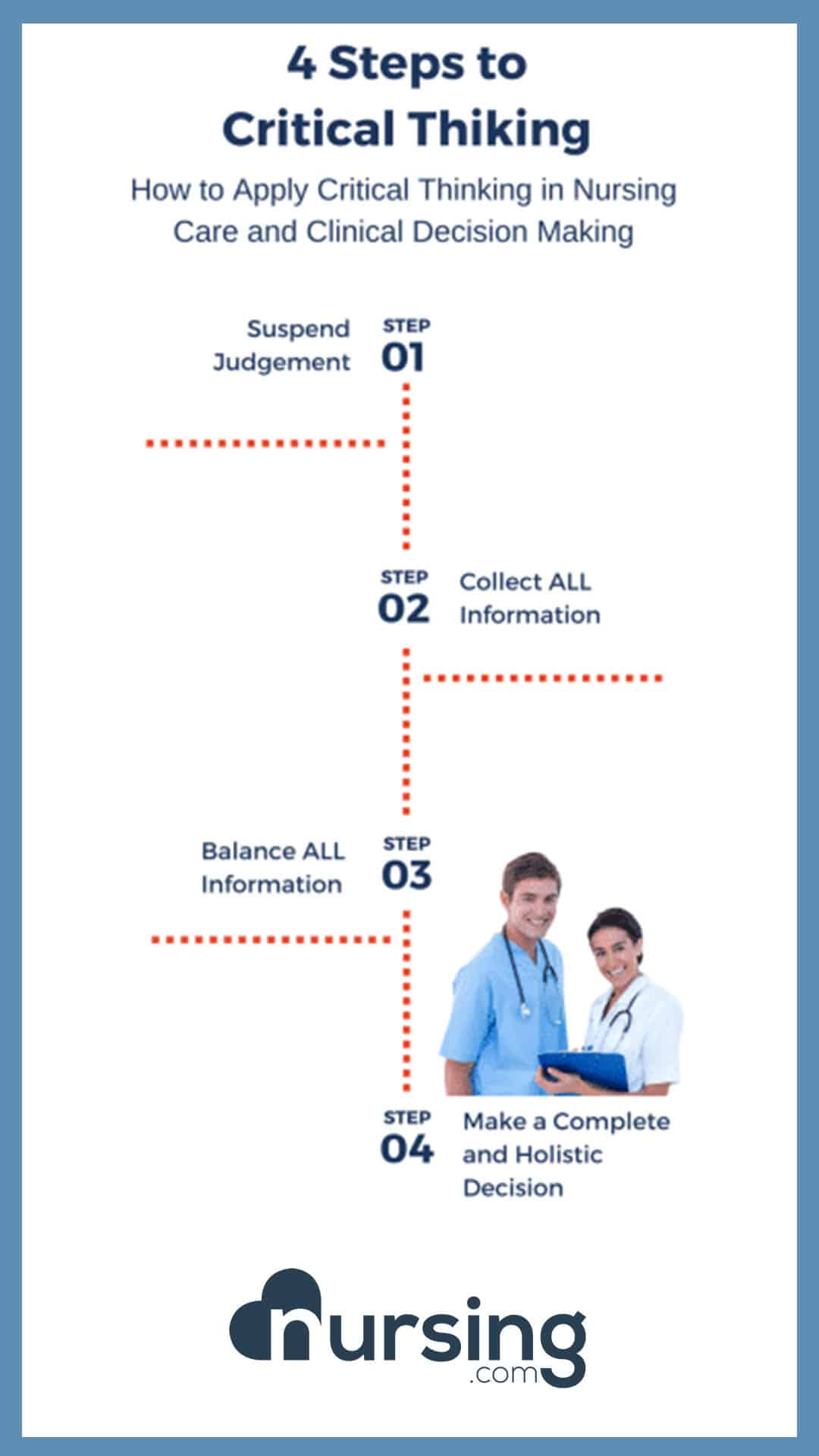
While there are many frameworks and methods for developing critical thinking, here we will provide you with a basic 4 step method.

At the risk of sounding oversimplified, this simple method will allow you to cut through the clutter, think critically, and arrive at correct decisions in even the most complex of scenarios.

Essentially there are 4 steps to critical thinking . . . in nursing and in life . . . and developing the ability to critically think will work wonders in your life.

  • Suspend ALL Judgement
  • Collect ALL Information
  • Balance ALL Information
  • Make a Complete and Holistic Decision

Before diving into the four individual steps let’s point out the use of the word “ALL” in each of the steps.

This is important because few individuals can make decisions with this inclusive word. It literally means ALL. To make a complete and holistic decision based upon critical thinking you have to have and weight ALL information. Otherwise you are just making a regular old decision.


  1.  Suspend All Judgement

You have to start by suspending all judgement. In other words, if you walk into a patients room and see them tachycardic an amature decision would be to run and grab the metoprolol to try to drop the heart rate.

An advanced clinician will WAIT until they have more information . . . not leaving the patient untreated . . . but not jumping freakishly into the WRONG treatment because they learned that tachycardia is bad . . .

Suspending judgement means that you don’t make a decision based upon the first sign. You also don’t walk into any situation of NCLEX question with a decision already made. You will treat all facts as equal until you can gather the needed information.

Not suspending judgment leaves you open to make biased decisions. This is detrimental in medicine and nursing. This will also result in poor success on nursing exams and the NCLEX.

As you read through nursing questions you must force yourself to refrain from jumping to conclusions until you have read the question in full. Do not allow yourself to assume what the question is asking or what the patient outcome is until you have read the question in full.

Obviously this sounds simple, but it is this step that, if missed, will through more nursing students and nurses off.


  1. Collect All Information 

Now you must collect ALL information. This is clutch! Don’t make a decision until you have collected every piece of data that you need to collect . . . on a tachycardic patient you can check BP, temp, run an EKG, check urine output.

Think of this as data mining. You are looking to have every piece of information you can find to put the puzzle pieces together.

When it comes to taking nursing tests you only have one place that you can collect the information . . . and that is from the test question itself. Do not go looking outside of the question of infer any details that are not provided within the question.

One thing we have noticed students doing almost more than anything else on test questions is reading into them. Don’t do this. Gather all the information you can . . . and when it comes to NCLEX questions, the only place you can gather information is from the question itself.


  1. Balance All Information

Now, balance all information. This means take all the data that you have and start weighing it to find out what is pertinent and what you can ignore. If the temp is 98.9 . . . it’s probably not the cause. If the BP is 74/56 are we looking at a volume issue?

In this step you are deciding what is important and what isn’t. While a pressure ulcer is important, if the patient is actively having a heart attack . . . it just doesn’t matter. At least, not until we take care of the MOST important issue.

NCLEX style questions will be FULL of extra information, things that you just really do not need to know to make a decision on the patient.

The NCSBN (who administers the NCLEX) in an effort to simulate real life nursing writes questions that include both important information and details that you just simply don’t need to know. It is your job to sift through the data and determine what you actually need to know.

Balancing means giving each data point a level of importance for your given patient. Some pieces of information will score much higher than others.

At this point you must all consider the implications of the possible options. Look at the available options and think to yourself, “if I choose this option, what happens next?”. As it relates to nursing, ask yourself these questions:

“Does this achieve a desired patient outcome?”

Or

“If I do this and then go home, what happens to my patient?”

Forcing yourself to consider the implications allows you to look beyond the information presented and consider the RESULTS of your choices. Critical thinking thrives on looking beyond the presented data.


  1. Make a Holistic Decision

Finally, make your decision . . . with all the data in and after looking over it all very closely you can begin to make your decision.

Your goal is to make the decision that best serves the patient and addresses their most immediate concerns.


Critical Thinking in Nursing and on the NCLEX®

Lastly, I just want to talk briefly about how this applies to NCLEX questions . . .

Here is an actual practice NCLEX question from our Nursing Practice Questions Program (or NPQ, as we like to call it)!

A 56-year-old male patient has been admitted to the cardiac unit with exacerbation of heart failure symptoms. The nurse has given him a nursing diagnosis of decreased cardiac output related to heart failure, as evidenced by a poor ejection fraction, weakness, edema, and decreased urinary output. Which of the following nursing interventions are most appropriate in this situation?

42% of the students that have taken this question have selected this answer:


Administer IV fluid boluses to increase urinary output

The problem with that answer is that it fails to weigh the most important issue facing this patient.

Test takers see urine output as low . . . and want to correct that quickly with fluids.

However, this is a CHFer . . . you can’t (shouldn’t) bolu especially during an exacerbation . . . you could send the patient into pulmonary edema and drastically impact their respiratory status.

So the lesson here. . . . in school, on the NCLEX, and on the clinical floor . . . slow down, stay calm and start thinking at an analysis level.

And I promise you this helps in “REAL” life too . . . not just in nursing. You will begin to be a tad more skeptical and deliberate with your decisions.


Resources

Here are a couple resources that will help you in the process of developing critical thinking.


The process for developing critical thinking is slow and arduous. However, don’t be hard on yourself. According to CriticalThiking.org the vast majority of colleges are not appropriately incorporating critical thinking into the college classroom. This means that while you might not being taught the skill as you should . . . most people aren’t. Using the strategies outlined above will put you light years ahead of most.

The nurse that is able to follow these four steps is a tremendous asset on a clinical floor.

Unlock the Complete Study System

Used by 300,000+ nursing students. 99.25% NCLEX pass rate.

200% NCLEX Pass Guarantee.
No Contract. Cancel Anytime.

Transcript

So, we’re gonna talk about critical thinking. Now, if you’ve gone to even just one day of nursing school, you understand that critical thinking is really a buzz word in nursing schools. Nursing professors and nursing schools love to talk about critical thinking. Now, why? Well, the job of the nurse is essentially to take millions and millions of data points, millions of possible patient outcomes, be able to analyze that and arrive at a correct decision based on all that data. Now, this is no easy task. And there’s very few jobs out there in the world which require this on the scale of nursing. Or, with human lives in the balance. Now, we take all these data points and we’re making these decisions very quickly. Very quickly, we’re making tons and tons of decisions, and there’s really nothing out, there’s no job out there that requires it at the magnitude of nursing or with human lives in the balance.

Now, what is critical thinking? Critical thinking has been defined as the intellectually disciplined process of actively and skillfully, conceptualizing, applying, analyzing, synthesizing and/or evaluating affirmation gathered from or generated by observation, experience, reflection, reasoning, or communication as a guide to belief and action. Now, that’s a massive definition, okay. Let me give you another definition. Basically, what you’re doing is it’s a disciplined process. It’s a process. It’s a skill, where you take all the information available to you through different ways of obtaining it, reading, observing, whatever it is, and you synthesize all that information, you evaluate all that information, and you arrive at a decision. Alright, now, critical thinking is really something that can grow. Now, we all make tons and tons of decisions everyday, thousands of decisions everyday. Should I get up? Should I set my alarm? Should I push my alarm off? What color of clothes should I wear, etc. We make so many decisions on a daily basis. Now, most of these decisions don’t require any sort of critical thinking. So, it’s possible that before nursing school, before this upper division classes, and before working on the clinical floor, you may not have used critical thinking much because you haven’t had to, right? You’re really just making regular daily decisions. But I want you to understand that critical thinking is a skill that can grow and develop with time. As you enter nursing school, you’re not expected to be an expert in the skill. Even as you entered the floor, you’re not expected to be an expert. You’re going to grow this skill. But I’m gonna give you a framework to help you develop it more quickly and more appropriately. Okay, what you should understand is critical thinking involves a level of decision making far beyond normal day to day decision making. With critical thinking, you are analyzing, conceptualizing, digging deep into questions and data that is presented. When it comes to nursing, oftentimes, you’re presented with real life or death situations. You’re presented with saving one patient or determining what’s the most important solution is to highly complex problem. And those nurses that develop critical thinking skills find increased success in their careers, they find more ability to last longer in nursing because they’re not as stressed. They’re able to look at all the data, stay calm and make appropriate decision.

So, let’s talk about critical thinking in nursing. The NCSBN has defined critical thinking. Now, the NCSBN is the company that administers and scores, etc, the NCLEX. So, this is what they’ve said about critical thinking. Since the practice of nursing requires you to apply knowledge, skills, and abilities, the majority of questions on the NCLEX are written at the cognitive level of apply or higher. Now, we’ll get into this more when we talk Bloom’s Taxonomy, okay. And these questions, by nature, require critical thinking. So, answering these higher cognitive domain questions will require you to do something with what you’ve learned. To manipulate previously learned material in a new way or find connections between many data points and many facts. Again, since majority of NCLEX questions fall into this category, this is exactly the type of questions you need to practice answering. This is exactly the kind of questions you need to understand. Okay, there’s that buzz word again, right? That critical thinking. But once again, no tips or information on what that means or how to develop it. So, let’s dive in and provide you with a simple framework and method for developing critical thinking and using it in your nursing practice.

This is just a 4-step method that I’ve developed that I think will help you make decisions slowly. In other words, how to critically think through different decision processes. Okay, now, essentially, I believe there’s really this 4 steps to critical thinking in nursing analyze and developing these ability to critically think will work wonders in your life. The first step is you suspend all judgment. The second step is you collect all information. The 3rd step is you balance all the information. And the 4th step is you make a holistic decision, or you make the best decision possible.

Now, before diving into the 4 individual step, let’s point out the use of the word ALL in each of the step. This is important because few individuals can make decisions with this inclusive word. It literally means, all, when we’re talking about critical thinking. To make a complete and holistic decision based upon critical thinking, you have to have and weigh all information. Otherwise, you’re making just a regular old decision. So, when we say suspend all judgment, it literally means suspending all judgment. Wipe all previous judgment out of your mind. When we say, balancing all information, it literally means balancing everything that you’ve been given, okay, collecting all information, etc. So, when I say all, I literally mean all. I mean, you need to really get to this point of all, all inclusive.

So, the first step is suspending all judgment. You have to start by suspending all your judgment, right? In other words, if you walk into a patient’s room, see them tachycardic, an amateur decision would be to run and grab the metoprolol to try to drop their heart rate. That’s an amateur decision. You see one piece of information, you have a response to that, alright? An advanced clinician will wait until they have more information, not leaving the patient untreated but not jumping freakishly into the wrong treatment because they learned that tachycardia is bad, right? Suspending judgment means that you don’t make a decision based upon the first sign. You also don’t walk into any situation of the NCLEX or any question on the NCLEX with a decision already made. You will treat all facts as equal until you gather the needed information. Not suspending judgment leaves you open to make biased decision and this is detrimental in medicine, nursing and life. The moment you become biased, you’re really walking on very thin ice, okay. This will result in poor success on nursing exams and school, on the NCLEX and as a nurse. Okay, you don’t jump freakishly to amateur decisions. You suspend judgment and wait to ensure that you have all the information you need. As you read the nursing questions, you must force yourself to refrain from jumping to conclusions until you have read question in full. Don’t allow yourself to assume what the question is asking or what the patient outcome is until you have read the entire question. Obviously, I know this sounds really simple but it is this step that if missed, it throws more nursing students and nurses off of anything else. This was one thing that I struggle with a lot in nursing school was I would read half a question and then like boom, I know exactly what the answer is, without reading the rest of the question. They got me into a lot of trouble sometimes.

The second step guys is collecting all information. This is very very important and you can see it kinda goes along with all the first step. Don’t make a decision until you have collected every piece of data that you need to collect. The first step, we were suspending all judgment until we collect data. Now, in this step, we’re collecting all the needed data. So, on that tachycardic patient, we’re talking about 4. You would need to check their blood pressure, their temperature, run an EKG, check urine output, okay. Is this a volume situation? Is it an infection situation? Okay, what’s the reason for this? Let’s just not treat that heart rate. If we treat that heart rate, maybe, that’s a volume situation, you know, in the hypovolemic, possibly hemorrhaging, whatever, and then we give them metoprolol and then drop that heart rate, then we’re not helping the perfusion issue, okay? So, you really have to get every piece of information you can. One way to think of this is data mining. You’re looking to have every piece of information you can find to put the puzzle pieces together. When it comes to taking nursing test, you only have one place that you can collect that information and that is from the actual item, the test question itself. Don’t go looking outside of the question or for any details that are not provided directly in the question on nursing exams. In real life, you’ll have a little bit more lea way to really look at every possible option. However, in a nursing question, you deal with exactly what’s in the question. One thing we noticed that nursing students doing almost more than anything else on test is reading into them. Don’t do this. Gathering all the information you can. And again, when it comes to NCLEX questions, the only place you can gather information is in the test question. Don’t start making up alternative scenarios to try to piece together things that aren’t in the question, you have to go with what’s there. Now, we’re gonna balance all information. This means that all the data you have, you get it all together, you piece it all together and you start weighing it to find out what is pertinent and what you can ignore. So, back to our tachycardic patient. If the temp is 98.9, it’s probably not the cause of this tachycardia. If the blood pressure is 74 / 56, now, okay, are we looking at a volume problem? Now, we needed to gather all this information because we didn’t know the reason for that tachycardia. However, now, at this point, in the question, in the care of this patient, we know, we have our temperature, so boom, they can throw out, they can likely throw out infection. Now, we have a blood pressure, okay, now, we’re looking at possibly a volume issue with this patient. So, in this step, what you really do is you’re deciding what is important and what isn’t. While a pressure ulcer is important, if the patient is actively having a heart attack, it just doesn’t matter, at least not until we take care of the most important issue, the ABCS. And that’s a framework you can use to balance information, your ABC’s. Airway, breathing, circulation, safety and Maslow’s, we go in that more throughout the course. NCLEX style questions will be full of extra information. Things you just really do not need to know to make a decision on your patient. The NCSBN, in an effort to simulate real life nursing, writes questions that include both important and unimportant information. It’s your job to sift through that data and determine what is actually needed to know to take care of that patient. Balancing means giving each data point a level of importance for your given patients. Some pieces of information will score much higher than others. And again, we’ll go over this in some of the framework for how to answer NCLEX questions is the ABC’s. You can use Airway, Breathing, Circulation, Safety and then going down to Maslow’s Hierarchy of Needs to balance information to determine what is most important. At this point, you must consider all implications of the possible options. Look at all the available options and think to yourself. If I choose this option, what happens next? As you realize in nursing, ask yourself this questions. Does this achieve a desired patient outcome? Or, another way of saying that would be, if I do this, and then go home, what happens to my patient? Forcing yourself to consider the implications allows you to look beyond the information presented and consider the results of your choices. What happens if? Critical thinking drives on looking beyond the presented data. Okay, you’re looking beyond. You’re not just taking everything at face value, you’re looking beyond it.

Now, our last and final step is making a holistic decision. Finally, now that you’ve suspended judgment, you’ve collected your data, you balanced that data, now it’s time to make your decision. With all the data in, after looking through everything very closely, you can begin to make your decision. Your goal is to make a decision that best serves the patient and addresses their most immediate concern. I wanna give you guys an example of one question in our nursing practice questions that we’ve seen a lot of our nursing students skip some of these steps. So, the question is, a 56-year-old male patient has been admitted to the cardiac unit with exacerbation of heart failure symptoms. The nurse has given him a nursing diagnosis of decreased cardiac output related to heart failure as evidenced by poor ejection fraction, weakness, edema and decreased urinary output. Which of the following nursing interventions are most appropriate in this situation? Now, the option that has been selected 42% of the time was to Administer IV fluid bolus to increase urinary output. Okay, the problem with that answer is that it fails to weigh the most important issues facing the patient, that this patient is a CHF patient, okay. With exacerbation of that. Now, what happens is test taker see low urine output and they see, okay, administer IV bolus for urinary output and they immediately jump to that as the correct answer, okay. However, remember, this is a CHF. You can’t or shouldn’t bolus especially during exacerbation. We’ve seen a patient with pulmonary edema and drastically impact their entire respiratory status, thereby altering their breathing, okay, their ABC’s, right? So, lesson here guys, is in school, on exams, and on the NCLEX, and on the clinical floor, slow down, stay calm, and start thinking at an analysis level. And I promise you, this helps in real life too, not just in nursing. You’ll begin to see everything a bit more skeptic, okay. You’ll start making more deliberate decisions whether that’s financially and how you invest, how you put up to loans, where you get a job, you’ll start slowing down and thinking through things over a little bit more. And that’s an important skill to have. It’s gonna help you very much throughout your life. The process of developing critical thinking is very slow and arduous. However, don’t be hard on yourself.

There’s a website called criticalthinking.org and it states that the vast majority of colleges are not appropriately incorporating critical thinking into the classroom. So, what this means is that while you might not be being thought the skill as you should, most other college students aren’t either. Using the strategies in the outline, using this 4 steps method, will put you light years ahead of most. The nurse that is able to follow these 4 steps is a tremendous asset on the clinical floor. So, I want you guys to start incorporating this. We have a cheat sheet for these 4 steps and I want you to use that. And the biggest things you guys need to do is just slow down and think. Think through these 4 steps and it’s going to make an enormous impact on the way you make decisions, on the way you take tests, and on the way you think through everything that’s presented to you on a daily basis.

Study Faster with Full Video Transcripts

99.25% NCLEX Pass Rate vs 88.8% National Average

200% NCLEX Pass Guarantee.
No Contract. Cancel Anytime.

🎉 Special Offer 🎉

Nursing School Doesn't Have To Be So Hard

Go from discouraged and stressed to motivated and passionate

aja -year off

Concepts Covered:

  • Basics of Sociology
  • Statistics
  • Fundamentals of Emergency Nursing
  • Factors Influencing Community Health
  • Concepts of Population Health
  • Studying
  • Community Health Overview
  • Developmental Considerations
  • Microbiology
  • Communication
  • Legal and Ethical Issues
  • Understanding Society
  • Circulatory System
  • Emergency Care of the Cardiac Patient
  • Emergency Care of the Trauma Patient
  • Emergency Care of the Neurological Patient
  • Neurological
  • Multisystem
  • Medication Administration
  • Emergency Care of the Respiratory Patient
  • Health & Stress
  • Delegation
  • Cardiovascular
  • Labor Complications
  • Pregnancy Risks
  • Newborn Complications
  • Fetal Development
  • Terminology
  • Prenatal Concepts
  • Newborn Care
  • Labor and Delivery
  • Postpartum Care
  • Postpartum Complications
  • Gastrointestinal
  • Behavior
  • Concepts of Mental Health
  • Emotions and Motivation
  • Growth & Development
  • Intelligence and Language
  • Psychological Disorders
  • State of Consciousness
  • Test Taking Strategies
  • Note Taking
  • Basics of NCLEX
  • Substance Abuse Disorders
  • Urinary System
  • Nervous System
  • Respiratory System
  • Basics of Human Biology
  • Concepts of Pharmacology
  • Gastrointestinal Disorders
  • Depressive Disorders
  • Prioritization
  • Anxiety Disorders
  • Cognitive Disorders
  • Eating Disorders
  • Personality Disorders
  • Psychotic Disorders
  • Trauma-Stress Disorders
  • Bipolar Disorders
  • Psychological Emergencies
  • Somatoform Disorders
  • Peripheral Nervous System Disorders
  • Cardiac Disorders
  • Musculoskeletal Disorders
  • Noninfectious Respiratory Disorder
  • Central Nervous System Disorders – Brain
  • Respiratory Emergencies
  • Perioperative Nursing Roles
  • Integumentary Disorders
  • Disorders of Pancreas
  • Neurological Emergencies
  • Intraoperative Nursing
  • Central Nervous System Disorders – Spinal Cord
  • Shock
  • Preoperative Nursing
  • Vascular Disorders
  • Postoperative Nursing
  • Neurological Trauma
  • Musculoskeletal Trauma
  • EENT Disorders
  • Prefixes
  • Suffixes
  • Proteins
  • Med Term Basic
  • Med Term Whole
  • Basics of Mathematics
  • Adult
  • Basic
  • Neonatal
  • Pediatric
  • Respiratory Disorders

Study Plan Lessons

Lab Panels – The Basics and What YOU Need to Know 2 – Live Tutoring Archive
Legal & Ethical Issues in ER
Access to Care
Care for Asian-Indian Patient Populations
Care for Hispanic Patient Populations
Care for Native American Patient Populations
Care of Vulnerable Populations
Caring for African Patient Populations
Child Abuse/Neglect – Warning Signs Nursing Mnemonic (CHILD ABUSE)
Communicable Diseases
Community Aggregates
Community Health Course Introduction
Community Health Education
Community Health Nursing Theories
Community Health Tool Nursing Mnemonic (MAP-IT)
Continuity of Care
Cultural Care
Cultural Considerations (Interpretive Services, Privacy, Decision Making) for Certified Emergency Nursing (CEN)
Day in the Life of a Community Health Nurse
Disasters & Bioterrorism
Disposal of Medical Waste
Environmental Health
Environmental Health Assessment Nursing Mnemonic (I PREPARE)
Epidemiology
Facilitation of Learning for Progressive Care Certified Nurse (PCCN)
Fire and Electrical Safety
Fire Safety 1 Nursing Mnemonic (PASS)
Fire Safety 2 Nursing Mnemonic (RACE)
Giving the Best Patient Education
Health Promotion & Disease Prevention
Health Promotion Assessments
Health Promotion Model
High Risk Behavior Nursing Mnemonic (HEADSS)
High-Risk Behaviors
Intro to Community Health
Levels of Prevention
Malnutrition (Failure to Thrive, Malabsorption Disorders) for Progressive Care Certified Nurse (PCCN)
Patient Education
Planning Community Health Interventions Nursing Mnemonic (PRECEDE-PROCEED)
Practice Settings
Program Planning
Radiation Safety for Nurses
Response to Diversity for Progressive Care Certified Nurse (PCCN)
Technology & Informatics
EKG Basics – Live Tutoring Archive
Emergency Drugs Nursing Mnemonic (LEAN)
Emergency Nursing Course Introduction
EMTALA & Transfers
Ethical Dilemmas for Certified Emergency Nursing (CEN)
Fall and Injury Prevention
Flight Nurse
Forensic Nurse
Gastrointestinal Trauma for Certified Emergency Nursing (CEN)
Head Trauma & Traumatic Brain Injury
Heart (Heart) Failure Exacerbation
Hypertensive Emergency
Increased Intracranial Pressure
Increased Intracranial Pressure (ICP) for Certified Emergency Nursing (CEN)
Injection Injuries for Certified Emergency Nursing (CEN)
Intracranial Hemorrhage
Joint Commission
Legal & Ethical Issues in ER
Massive Transfusion Protocol
Nursing Case Study for Head Injury
Nursing Skills (Clinical) Safety Video
Patient Safety for Certified Emergency Nursing (CEN)
Patient Satisfaction for Certified Emergency Nursing (CEN)
Penetrating Abdominal Trauma
Penetrating Injuries for Certified Emergency Nursing (CEN)
Penetrating Thoracic Trauma
Procainamide (Pronestyl) Nursing Considerations
Pulmonary Embolism
Rapid Sequence Intubation
Restraints
Restraints 101
Risk Management for Certified Emergency Nursing (CEN)
Safety Check Nursing Mnemonic (MADLE)
Safety Checks
Seizure Management in the ER
Sexual Assault and Battery for Certified Emergency Nursing (CEN)
Stress and Crisis
Stroke (CVA) Management in the ER
Transfer and Stabilization for Certified Emergency Nursing (CEN)
Trauma – Complications Nursing Mnemonic (TRAUMATIC)
Trauma Surgery – Medical History Nursing Mnemonic (AMPLE)
Trauma Survey
Triage
Triage in the ER
Triage Nursing Mnemonic (START)
Verapamil (Calan) Nursing Considerations
Dysrhythmia Emergencies
Drugs for Bradycardia & Low Blood Pressure Nursing Mnemonic (IDEA)
Delegation of Tasks to Assistive Personnel for Certified Emergency Nursing (CEN)
Day in the Life of an ICU (Intensive Care Unit) Nurse
Crush Injuries
Critical Incident Management
Crash Cart
Conflict Management (Patient, Perioperative Team, Family) for Certified Perioperative Nurse (CNOR)
Combative: IV Insertion
Cardiovascular Trauma for Certified Emergency Nursing (CEN)
Cardiopulmonary Arrest for Certified Emergency Nursing (CEN)
Cardiopulmonary Arrest
Calling for RRT, Code Blue
Blunt Thoracic Trauma
Blunt Abdominal Trauma
Aneurysm & Dissection
Amiodarone (Pacerone) Nursing Considerations
Aggressive & Violent Patients
Adenosine (Adenocard) Nursing Considerations
Acute Respiratory Distress
Acute Coronary Syndrome for Certified Emergency Nursing (CEN)
Acute Coronary Syndrome (ACS) Module Intro
Acute Coronary Syndrome (ACS)
Acute Confusion
Abuse and Neglect for Certified Emergency Nursing (CEN)
Abuse
02.11 12 Lead EKG- Injuries for CCRN Review
02.10 12 Lead EKG- Lead V1-V6 for CCRN Review
02.09 12 Lead EKG- Leads 1, 2, 3, aVL, and aVF for CCRN Review
02.01 Hypertensive Crisis for CCRN Review
Abruptio Placenta for Certified Emergency Nursing (CEN)
Abruptio Placentae (Placental abruption)
Acyclovir (Zovirax) Nursing Considerations
Addicted Newborn
Adult Vital Signs (VS)
Alpha-fetoprotein (AFP) Lab Values
Ampicillin (Omnipen) Nursing Considerations
Anemia in Pregnancy
Antepartum Testing
Antepartum Testing Case Study (45 min)
Anti-Infective – Aminoglycosides
Anti-Infective – Lincosamide
Babies by Term
Behind The Red Line – Live Tutoring Archive
Betamethasone and Dexamethasone
Betamethasone and Dexamethasone in Pregnancy
Bicarbonate (HCO3) Lab Values
Blood Cultures
Blood Glucose Monitoring
Blood Transfusions (Administration)
Body System Assessments
Breastfeeding
Butorphanol (Stadol) Nursing Considerations
Cardiac (Heart) Disease in Pregnancy
Causes of Chorioamnionitis Nursing Mnemonic (Pregnancies Are Very Interesting)
Causes of Labor Dystocia Nursing Mnemonic (Having Extremely Frustrating Labor)
Causes of Postpartum Hemorrhage Nursing Mnemonic (4 T’s)
Certified Nurse Midwife
Chorioamnionitis
Clindamycin (Cleocin) Nursing Considerations
Congestive Heart Failure (CHF) Labs
Day in the Life of a Labor Nurse
Day in the Life of a Postpartum Nurse
Dexamethasone (Decadron) Nursing Considerations
Direct Bilirubin (Conjugated) Lab Values
Discomforts of Pregnancy
Disseminated Intravascular Coagulation (DIC)
Diuretics (Loop, Potassium Sparing, Thiazide, Furosemide/Lasix)
Dystocia
Ectopic Pregnancy
Ectopic Pregnancy Case Study (30 min)
Ectopic Pregnancy for Certified Emergency Nursing (CEN)
Emergent Delivery (OB) (30 min)
Emergent Delivery for Certified Emergency Nursing (CEN)
Epidural
Episiotomy – Evaluation of Healing Nursing Mnemonic (REEDA)
Erythroblastosis Fetalis
Eye Prophylaxis for Newborn
Eye Prophylaxis for Newborn (Erythromycin)
Factors That Can Put a Pregnancy at Risk Nursing Mnemonic (RIBCAGE)
Family Planning & Contraception
Family Planning & Signs of Pregnancy – Live Tutoring Archive
Fertilization and Implantation
Fetal Alcohol Syndrome (FAS)
Fetal Circulation
Fetal Development
Fetal Distress Interventions Nursing Mnemonic (Stop MOAN)
Fetal Environment
Fetal Heart Monitoring (FHM)
Fetal Heart Monitoring Like A Pro – Live Tutoring Archive
Fetal Heart Monitoring Like A Pro 2 – Live Tutoring Archive
Fetal Wellbeing Assessment Tests Nursing Mnemonic (ALONE)
Fundal Height Assessment for Nurses
Furosemide (Lasix) Nursing Considerations
Gestation & Nägele’s Rule: Estimating Due Dates
Gestational Diabetes (GDM)
Gestational Diabetes and Why YOU Should Know About It – Live Tutoring Archive
Gestational HTN (Hypertension)
Glucagon Lab Values
Glucose Tolerance Test (GTT) Lab Values
Gravidity and Parity (G&Ps, GTPAL)
HELLP Syndrome
HELLP Syndrome – Signs and Symptoms Nursing Mnemonic (HELLP)
Hematomas in OB Nursing: Causes, Symptoms, and Nursing Care
Hemodynamics
Hemoglobin A1c (HbA1C)
Hemorrhage (Postpartum Bleeding) for Certified Emergency Nursing (CEN)
Hepatitis B Vaccine for Newborns
Homocysteine (HCY) Lab Values
Hydatidiform Mole (Molar pregnancy)
Hydralazine (Apresoline) Nursing Considerations
Hydrochlorothiazide (Hydrodiuril) Nursing Considerations
Hyperbilirubinemia (Jaundice)
Hyperemesis Gravidarum
Hyperemesis Gravidarum for Certified Emergency Nursing (CEN)
Hyperglycemia Management Nursing Mnemonic (Dry and Hot – Insulin Shot)
Hypovolemic Shock Case Study (OB sim) (60 min)
Incompetent Cervix
Infections in Pregnancy
Initial Care of the Newborn (APGAR)
Inserting a Foley (Urinary Catheter) – Female
Intra Uterine Device – Potential Problems Nursing Mnemonic (PAINS)
Isotonic Solutions (IV solutions)
Labor Progression Case Study (45 min)
Leopold Maneuvers
Lung Surfactant
Lung Surfactant for Newborns
Magnesium Sulfate
Magnesium Sulfate
Magnesium Sulfate (MgSO4) Nursing Considerations
Magnesium Sulfate in Pregnancy
Mastitis
Maternal Risk Factors
Mechanisms of Labor
Meconium Aspiration
Meds for Postpartum Hemorrhage (PPH)
Meds for PPH (postpartum hemorrhage)
Menstrual Cycle
Methylergonovine (Methergine) Nursing Considerations
Newborn of HIV+ Mother
Newborn Physical Exam
Newborn Reflexes
Nifedipine (Procardia) Nursing Considerations
Nursing Care Plan (NCP) for Abortion, Spontaneous Abortion, Miscarriage
Nursing Care Plan (NCP) for Abruptio Placentae / Placental abruption
Nursing Care Plan (NCP) for Chorioamnionitis
Nursing Care Plan (NCP) for Diabetes Mellitus (DM)
Nursing Care Plan (NCP) for Dystocia
Nursing Care Plan (NCP) for Ectopic Pregnancy
Nursing Care Plan (NCP) for Gestational Diabetes (GDM)
Nursing Care Plan (NCP) for Gestational Hypertension, Preeclampsia, Eclampsia
Nursing Care Plan (NCP) for Hyperemesis Gravidarum
Nursing Care Plan (NCP) for Hypertension (HTN)
Nursing Care Plan (NCP) for Incompetent Cervix
Nursing Care Plan (NCP) for Mastitis
Nursing Care Plan (NCP) for Maternal-Fetal Dyad Using GTPAL
Nursing Care Plan (NCP) for Meconium Aspiration
Nursing Care Plan (NCP) for Neonatal Jaundice | Hyperbilirubinemia
Nursing Care Plan (NCP) for Newborns
Nursing Care Plan (NCP) for Placenta Previa
Nursing Care Plan (NCP) for Postpartum Hemorrhage (PPH)
Nursing Care Plan (NCP) for Premature Rupture of Membranes (PROM) / Preterm Premature Rupture of Membranes (PPROM)
Nursing Care Plan (NCP) for Preterm Labor / Premature Labor
Nursing Care Plan (NCP) for Process of Labor
Nursing Care Plan (NCP) for Transient Tachypnea of Newborn
Nursing Care Plan for (NCP) Fetal Alcohol Syndrome (FAS)
Nursing Care Plan for Newborn Reflexes
Nursing Case Study for Maternal Newborn
Nutrition Assessments
Nutrition in Pregnancy
Nutritional Requirements
OB (Labor) Nurse Report to OB (Postpartum) Nurses
OB Course Introduction
OB Non-Stress Test Results Nursing Mnemonic (NNN)
OB Pharm and What Drugs You HAVE to Know – Live Tutoring Archive
Obstetric Trauma for Certified Emergency Nursing (CEN)
Obstetrical Procedures
Opioid Analgesics in Pregnancy
Oral Birth Control Pills – Serious Complications Nursing Mnemonic (Aches)
Oxytocin (Pitocin) Nursing Considerations
Pediatric Vital Signs (VS)
Physiological Changes
Phytonadione (Vitamin K)
Phytonadione (Vitamin K) for Newborn
Placenta Previa
Placenta Previa for Certified Emergency Nursing (CEN)
Possible Infections During Pregnancy Nursing Mnemonic (TORCH)
Post-Partum Assessment Nursing Mnemonic (BUBBLE)
Postpartum Discomforts
Postpartum Hematoma
Postpartum Hemorrhage (PPH)
Postpartum Interventions
Postpartum Physiological Maternal Changes
Postpartum Thrombophlebitis
Precipitous Labor
Preeclampsia (45 min)
Preeclampsia, Eclampsia, and HELLP Syndrome for Certified Emergency Nursing (CEN)
Preeclampsia: Signs, Symptoms, Nursing Care, and Magnesium Sulfate
Pregnancy Labs
Pregnancy Outcomes Nursing Mnemonic (GTPAL)
Preload and Afterload
Premature Rupture of the Membranes (PROM)
Preterm Labor
Preterm Labor for Certified Emergency Nursing (CEN)
Probable Signs of Pregnancy Nursing Mnemonic (CHOP BUGS)
Process of Labor
Process of Labor – Mom Nursing Mnemonic (4 P’s)
Process of Labor – Baby Nursing Mnemonic (ALPPPS)
Process of Labor – Live Tutoring Archive
Process of Labor 2 – Live Tutoring Archive
Prolapsed Umbilical Cord
Promethazine (Phenergan) Nursing Considerations
Prostaglandins
Prostaglandins in Pregnancy
Protein (PROT) Lab Values
Retinopathy of Prematurity (ROP)
Rh Immune Globulin (Rhogam)
Rh Immune Globulin in Pregnancy
Signs of Pregnancy – Live Tutoring Archive
Signs of Pregnancy (Presumptive, Probable, Positive)
Spironolactone (Aldactone) Nursing Considerations
Stages of Fetal Development Nursing Mnemonic (Proficiently Expanding Fetus)
Subinvolution
Terbutaline (Brethine) Nursing Considerations
Threatened/Spontaneous Abortion for Certified Emergency Nursing (CEN)
Tips & Advice for Newborns (Neonatal IV Insertion)
Tocolytics
Tocolytics
Top 5 Misunderstood OB Concepts – Live Tutoring Archive
Transient Tachypnea of Newborn
Umbilical Cord Vasculature Nursing Mnemonic (2A1V)
Uterine Stimulants (Oxytocin, Pitocin)
Uterine Stimulants (Oxytocin, Pitocin) Nursing Considerations
VEAL CHOP Nursing Mnemonic (Fetal Accelerations and Decelerations) (VEAL CHOP)
What the Heck is Antepartum Testing? – Live Tutoring Archive
Abortion in Nursing: Spontaneous, Induced, and Missed
05.03 Jaundice for CCRN Review
ADLs (Activity of Daily Living) Nursing Mnemonic (BATTED)
Behavioral Genetics
Brain and Behavior
Defense Mechanisms
Emotions and Motivation
Energy Balance and Weight Control
Exercise Guidelines Nursing Mnemonic (FIT)
Growth & Development Theories
Health & Stress
IADLS (Instrumental Activities of Daily Living) Nursing Mnemonic (SCUM)
Intelligence and Language
Intro to Psychology Course Introduction
Learning & Behavior,Memory
Maslow’s Hierarchy of Needs in Nursing
Not Settling
Psychological Disorders
Self Care & Avoiding Nursing Burnout
Sensation & Perception
State of Consciousness
Stress and Crisis
Types of Exercise
01.01 CCRN Test Overview for CCRN Review
12 Points to Answering Pharmacology Questions
5 Rules for Powerpoint
5 Things You Never Knew About The NCLEX – Live Tutoring Archive
9 Easy Steps to Passing Every Nursing School Test | With Jon Haws, BSN, RN, Founder of NURSING.com
Absolute Words
Acute vs Chronic
Addiction – Behavioral Problems Nursing Mnemonic (The 5 D’s)
ADLs (Activity of Daily Living) Nursing Mnemonic (BATTED)
Advanced Critical Thinking
Alcoholism – Outcomes Nursing Mnemonic (BAD)
Alkalosis and Acidosis Nursing Mnemonic (Kick Up, Drop Down)
Anatomy of an NCLEX Question
Anticholinergics – Side Effects Nursing Mnemonic (4 Can’ts)
Arterial Blood Gases Nursing Mnemonic (ROME)
Ask Questions
Avoiding Alarm Fatigue
Backwards and Forwards
Be a Mix Tape (Rewind and Fast-Forward)
Beta 1 and Beta 2 Nursing Mnemonic (1 Heart, 2 Lungs)
Bloom’s Taxonomy
C – Content
Can You Draw It
Care Plan Review (Addresses Patient Considerations) for Certified Perioperative Nurse (CNOR)
Caring Licensed Practical Nurse Nursing Mnemonic (CLPN)
Caring Practices for Progressive Care Certified Nurse (PCCN)
Causes of Poor Gas Exchange Nursing Mnemonic (All People Can Value Lungs)
Chance’s Story on His Personal Journey
Cheatsheets
Child Abuse/Neglect – Warning Signs Nursing Mnemonic (CHILD ABUSE)
CHO, CHO, CHON Nursing Mnemonic (CHO, CHO, CHON)
Cholinergic Crisis – Signs and Symptoms Nursing Mnemonic (SLUDGE)
Clinical Inquiry for Progressive Care Certified Nurse (PCCN)
Community Health Tool Nursing Mnemonic (MAP-IT)
Concept Map Course Introduction
Connections
Course Introduction to Nursing School Preparation
Critical Thinking
Critical Thinking
Degree Restrictions in Career Growth
Denying Feelings
Dig for the Why
Diploma vs ADN vs BSN vs Bridge
Drawing Pictures
Drug Interactions Nursing Mnemonic (These Drugs Can Interact)
Drugs for Bradycardia & Low Blood Pressure Nursing Mnemonic (IDEA)
Duplicate Facts
E – Engagement
Electrolytes – Location in Body Nursing Mnemonic (PISO)
Emergency Drugs Nursing Mnemonic (LEAN)
Environmental Health Assessment Nursing Mnemonic (I PREPARE)
Evaluating Patient Response to Plan of Care for Certified Perioperative Nurse (CNOR)
Exercise Guidelines Nursing Mnemonic (FIT)
Explaining the “Why”
Exporting and Uploading to Frame.io
Fetal Distress Interventions Nursing Mnemonic (Stop MOAN)
Fetal Wellbeing Assessment Tests Nursing Mnemonic (ALONE)
Fire Safety 1 Nursing Mnemonic (PASS)
Fire Safety 2 Nursing Mnemonic (RACE)
Getting Access to frame.io
Getting Started with Tech
Gluten Free Diet Nursing Mnemonic (BROW)
Goal Setting
HESI® Prep Course Introduction
High Risk Behavior Nursing Mnemonic (HEADSS)
How to Write a Nursing Care Plan
Hyperkalemia – Causes Nursing Mnemonic (MACHINE)
Hyperkalemia – Management Nursing Mnemonic (AIRED)
Hyperkalemia – Signs and Symptoms Nursing Mnemonic (Murder)
Hypernatremia – Causes Nursing Mnemonic (MODEL)
IADLS (Instrumental Activities of Daily Living) Nursing Mnemonic (SCUM)
Identifying Interventions per Nursing Diagnoses for Certified Perioperative Nurse (CNOR)
Identifying Measurable Patient Outcomes for Certified Perioperative Nurse (CNOR)
Increase MAP Nursing Mnemonic (VAK)
Inflammation- Signs and Symptoms Nursing Mnemonic (HIPER)
Interviewing for Nursing School
Introduction to CCMM
Jon’s Story on His Personal Journey
Keep it Short
Lesson Elements
MAO Inhibitors Nursing Mnemonic (TIPS)
Marie’s Story on Her Personal Nursing Journey
Miriam’s Story on Her Personal Journey
Mnemonic for Organ Systems (MR DICE RUNS)
MSN (Masters) vs. DNP (Doctorate)
NCLEX Question Traps! – Live Tutoring Archive
NCLEX® Question Traps
Need Help Making A Study Plan? – Live Tutoring Archive
NRSNG | Closing Thoughts
NRSNG Live | 5 Things You Never Knew About NCLEX Questions
NRSNG Live | AMA (Ask Me Anything) Nursing Success Roundtable
NRSNG Live | AMA Student Panel – How I Survive (Barely) Nursing School
NRSNG Live | How I Went From Nursing School Dropout to Passing NCLEX in 75 and Teaching 18 Million Nurses
NRSNG Live | How to Get the Most out of NRSNG
NRSNG Live | How to Pass Any Nursing School Test
NRSNG Live | My Super Secret Note Taking Method
NRSNG Live | The Core Content Mastery Method and How to Use it Throughout Your Nursing Journey
NRSNG Live | The Successful State of Mind
NRSNG Live | What Your Nursing Professors Want to Tell You But Can’t
Nursing Care Plans Course Introduction
Nursing Case Study Introduction
Nursing Process
Nursing Process – Assess
Nursing Process – Diagnose
Nursing Process – Evaluate
Nursing Process – Implement
Nursing Process – Plan
Nursing School Application Essay
NURSING.com Assessment & Skills Checks
NURSING.com Introduction
O – Origins
OLD CARTS Mnemonic (OLD CARTS)
Online vs Brick-and-Mortar
Opposite or the Same – Live Tutoring Archive
Opposites
Our Goals for Teaching
Our Mission
Outline Question Method (Note taking)
Overview of the Nursing Process
Paying for Nursing School
Pharmacokinetics Nursing Mnemonic (ADME)
Pictures
Plan of Care Updates for Certified Perioperative Nurse (CNOR)
Planning Community Health Interventions Nursing Mnemonic (PRECEDE-PROCEED)
Post-Partum Assessment Nursing Mnemonic (BUBBLE)
Prioritization
Prioritizing Assessments
Priority
Purpose of Nursing Care Plans
Questions To Ask Before Applying To A Nursing Program
R – Real-Life
Real Life
Real-Life Experiences
Recording
Repeating Words
Resources for Lesson Creation
RN to MSN
Safety Check Nursing Mnemonic (MADLE)
Same
SATA
SATA like a BOSS – Live Tutoring Archive
SATA like a BOSS 2 – Live Tutoring Archive
SBAR Communication Nursing Mnemonic (SBAR)
Screencastify Setup
Share the Wealth
SSRI’s Nursing Mnemonic (Effective For Sadness, Panic, and Compulsions)
Start and End with the Linchpin
Steps in the Nursing Process 1 Nursing Mnemonic (ADPIE)
Steps in the Nursing Process 2 Nursing Mnemonic (AAPIE)
Steps In The Nursing Process 3 Nursing Mnemonic (SOAPIE)
Study Setting
Study Tips for Success
Systems Thinking for Progressive Care Certified Nurse (PCCN)
TEAS® Prep Course Introduction
Tenet 1 Filet Mignon
Tenet 2 Linchpins & Connections
Tenet 3 Why Behind the What
Tenet 4 Learner-Centered Talkabouts
Test Taking Course Introduction
The Academy
The CARPET Methods of Teaching
The Nurse Routine
The Nursing Process Pro Tips for Test Taking – Live Tutoring Archive
The Outline is the Foundation
Thinking Like a Nurse
Time Management
Time Management
To The Point
Tracheal Esophageal Fistula – Sign and Symptoms Nursing Mnemonic (The 3 C’s)
Trauma – Complications Nursing Mnemonic (TRAUMATIC)
Trauma Surgery – Medical History Nursing Mnemonic (AMPLE)
Triage Nursing Mnemonic (START)
Trusting your Gut
Two pathways of the peripheral nervous system Nursing Mnemonic (SAME)
Using Nursing Care Plans in Clinicals
Vasospasm Therapy Nursing Mnemonic (Triple H Therapy)
VEAL CHOP Nursing Mnemonic (Fetal Accelerations and Decelerations) (VEAL CHOP)
Vitamins – Fat Soluble Nursing Mnemonic (All Dogs Eat Kibble)
Vitamins – Water Soluble Nursing Mnemonic (Birth Control)
Walkers Nursing Mnemonic (Wandering Wilma Always Late)
Welcome to NURSING.com
What Are the Absolutes
What are the NCLEX Categories? – Live Tutoring Archive
What do you want me to know?
What is CCMM?
What is Pedagogy
What is the NCLEX?
What Should They Learn
What to Expect In Clinical
Where To Start
Why NURSING.com?
Working night shift
Your Role
Citations
Evidence Based Research
Nurse Educator
Page Sections, Footnotes & Headers
Page Set-Up
Research Nurse
Title Page
Why CEs (Continuing education) matter
Aging and Socialization
Crime in Society
Dark Skin: IV Insertion
Gender Equity (Inclusion, Gender Transition) for Certified Emergency Nursing (CEN)
Gender Inequality
Global Inequalities
High-Risk Behaviors
Human Trafficking for Certified Emergency Nursing (CEN)
Introduction to Sociology
Lab Panels
Lab Panels – The Basics and What YOU Need to Know – Live Tutoring Archive
Lab Panels – The Basics and What YOU Need to Know 2 – Live Tutoring Archive
Lab Panels – The Basics and What YOU Need to Know 3 – Live Tutoring Archive
Lab Values Course Introduction
Race, Ethnicity, and Migration in Society
Shorthand Lab Values
Social Effects on Health, Illness, and Disability
Social Groups
Social Interactions in Life
Sociological Perspectives
Sociology and Culture
Sociology and Education
Sociology Course Introduction
Sociology Research
Citations
Evidence Based Research
Nurse Educator
Page Sections, Footnotes & Headers
Page Set-Up
Research Nurse
Title Page
Why CEs (Continuing education) matter
01.01 CCRN Test Overview for CCRN Review
12 Points to Answering Pharmacology Questions
5 Rules for Powerpoint
5 Things You Never Knew About The NCLEX – Live Tutoring Archive
9 Easy Steps to Passing Every Nursing School Test | With Jon Haws, BSN, RN, Founder of NURSING.com
Absolute Words
Acute vs Chronic
Addiction – Behavioral Problems Nursing Mnemonic (The 5 D’s)
ADLs (Activity of Daily Living) Nursing Mnemonic (BATTED)
Advanced Critical Thinking
Alcoholism – Outcomes Nursing Mnemonic (BAD)
Alkalosis and Acidosis Nursing Mnemonic (Kick Up, Drop Down)
Anatomy of an NCLEX Question
Anticholinergics – Side Effects Nursing Mnemonic (4 Can’ts)
Arterial Blood Gases Nursing Mnemonic (ROME)
Ask Questions
Avoiding Alarm Fatigue
Backwards and Forwards
Be a Mix Tape (Rewind and Fast-Forward)
Beta 1 and Beta 2 Nursing Mnemonic (1 Heart, 2 Lungs)
Bloom’s Taxonomy
C – Content
Can You Draw It
Care Plan Review (Addresses Patient Considerations) for Certified Perioperative Nurse (CNOR)
Caring Licensed Practical Nurse Nursing Mnemonic (CLPN)
Caring Practices for Progressive Care Certified Nurse (PCCN)
Causes of Poor Gas Exchange Nursing Mnemonic (All People Can Value Lungs)
Chance’s Story on His Personal Journey
Cheatsheets
Child Abuse/Neglect – Warning Signs Nursing Mnemonic (CHILD ABUSE)
CHO, CHO, CHON Nursing Mnemonic (CHO, CHO, CHON)
Cholinergic Crisis – Signs and Symptoms Nursing Mnemonic (SLUDGE)
Clinical Inquiry for Progressive Care Certified Nurse (PCCN)
Community Health Tool Nursing Mnemonic (MAP-IT)
Concept Map Course Introduction
Connections
Course Introduction to Nursing School Preparation
Critical Thinking
Critical Thinking
Degree Restrictions in Career Growth
Denying Feelings
Dig for the Why
Diploma vs ADN vs BSN vs Bridge
Drawing Pictures
Drug Interactions Nursing Mnemonic (These Drugs Can Interact)
Drugs for Bradycardia & Low Blood Pressure Nursing Mnemonic (IDEA)
Duplicate Facts
E – Engagement
Electrolytes – Location in Body Nursing Mnemonic (PISO)
Emergency Drugs Nursing Mnemonic (LEAN)
Environmental Health Assessment Nursing Mnemonic (I PREPARE)
Evaluating Patient Response to Plan of Care for Certified Perioperative Nurse (CNOR)
Exercise Guidelines Nursing Mnemonic (FIT)
Explaining the “Why”
Exporting and Uploading to Frame.io
Fetal Distress Interventions Nursing Mnemonic (Stop MOAN)
Fetal Wellbeing Assessment Tests Nursing Mnemonic (ALONE)
Fire Safety 1 Nursing Mnemonic (PASS)
Fire Safety 2 Nursing Mnemonic (RACE)
Getting Access to frame.io
Getting Started with Tech
Gluten Free Diet Nursing Mnemonic (BROW)
Goal Setting
HESI® Prep Course Introduction
High Risk Behavior Nursing Mnemonic (HEADSS)
How to Write a Nursing Care Plan
Hyperkalemia – Causes Nursing Mnemonic (MACHINE)
Hyperkalemia – Management Nursing Mnemonic (AIRED)
Hyperkalemia – Signs and Symptoms Nursing Mnemonic (Murder)
Hypernatremia – Causes Nursing Mnemonic (MODEL)
IADLS (Instrumental Activities of Daily Living) Nursing Mnemonic (SCUM)
Identifying Interventions per Nursing Diagnoses for Certified Perioperative Nurse (CNOR)
Identifying Measurable Patient Outcomes for Certified Perioperative Nurse (CNOR)
Increase MAP Nursing Mnemonic (VAK)
Inflammation- Signs and Symptoms Nursing Mnemonic (HIPER)
Interviewing for Nursing School
Introduction to CCMM
Jon’s Story on His Personal Journey
Keep it Short
Lesson Elements
MAO Inhibitors Nursing Mnemonic (TIPS)
Marie’s Story on Her Personal Nursing Journey
Miriam’s Story on Her Personal Journey
Mnemonic for Organ Systems (MR DICE RUNS)
MSN (Masters) vs. DNP (Doctorate)
NCLEX Question Traps! – Live Tutoring Archive
NCLEX® Question Traps
Need Help Making A Study Plan? – Live Tutoring Archive
NRSNG | Closing Thoughts
NRSNG Live | 5 Things You Never Knew About NCLEX Questions
NRSNG Live | AMA (Ask Me Anything) Nursing Success Roundtable
NRSNG Live | AMA Student Panel – How I Survive (Barely) Nursing School
NRSNG Live | How I Went From Nursing School Dropout to Passing NCLEX in 75 and Teaching 18 Million Nurses
NRSNG Live | How to Get the Most out of NRSNG
NRSNG Live | How to Pass Any Nursing School Test
NRSNG Live | My Super Secret Note Taking Method
NRSNG Live | The Core Content Mastery Method and How to Use it Throughout Your Nursing Journey
NRSNG Live | The Successful State of Mind
NRSNG Live | What Your Nursing Professors Want to Tell You But Can’t
Nursing Care Plans Course Introduction
Nursing Case Study Introduction
Nursing Process
Nursing Process – Assess
Nursing Process – Diagnose
Nursing Process – Evaluate
Nursing Process – Implement
Nursing Process – Plan
Nursing School Application Essay
NURSING.com Assessment & Skills Checks
NURSING.com Introduction
O – Origins
OLD CARTS Mnemonic (OLD CARTS)
Online vs Brick-and-Mortar
Opposite or the Same – Live Tutoring Archive
Opposites
Our Goals for Teaching
Our Mission
Outline Question Method (Note taking)
Overview of the Nursing Process
Paying for Nursing School
Pharmacokinetics Nursing Mnemonic (ADME)
Pictures
Plan of Care Updates for Certified Perioperative Nurse (CNOR)
Planning Community Health Interventions Nursing Mnemonic (PRECEDE-PROCEED)
Post-Partum Assessment Nursing Mnemonic (BUBBLE)
Prioritization
Prioritizing Assessments
Priority
Purpose of Nursing Care Plans
Questions To Ask Before Applying To A Nursing Program
R – Real-Life
Real Life
Real-Life Experiences
Recording
Repeating Words
Resources for Lesson Creation
RN to MSN
Safety Check Nursing Mnemonic (MADLE)
Same
SATA
SATA like a BOSS – Live Tutoring Archive
SATA like a BOSS 2 – Live Tutoring Archive
SBAR Communication Nursing Mnemonic (SBAR)
Screencastify Setup
Share the Wealth
SSRI’s Nursing Mnemonic (Effective For Sadness, Panic, and Compulsions)
Start and End with the Linchpin
Steps in the Nursing Process 1 Nursing Mnemonic (ADPIE)
Steps in the Nursing Process 2 Nursing Mnemonic (AAPIE)
Steps In The Nursing Process 3 Nursing Mnemonic (SOAPIE)
Study Setting
Study Tips for Success
Systems Thinking for Progressive Care Certified Nurse (PCCN)
TEAS® Prep Course Introduction
Tenet 1 Filet Mignon
Tenet 2 Linchpins & Connections
Tenet 3 Why Behind the What
Tenet 4 Learner-Centered Talkabouts
Test Taking Course Introduction
The Academy
The CARPET Methods of Teaching
The Nurse Routine
The Nursing Process Pro Tips for Test Taking – Live Tutoring Archive
The Outline is the Foundation
Thinking Like a Nurse
Time Management
Time Management
To The Point
Tracheal Esophageal Fistula – Sign and Symptoms Nursing Mnemonic (The 3 C’s)
Trauma – Complications Nursing Mnemonic (TRAUMATIC)
Trauma Surgery – Medical History Nursing Mnemonic (AMPLE)
Triage Nursing Mnemonic (START)
Trusting your Gut
Two pathways of the peripheral nervous system Nursing Mnemonic (SAME)
Using Nursing Care Plans in Clinicals
Vasospasm Therapy Nursing Mnemonic (Triple H Therapy)
VEAL CHOP Nursing Mnemonic (Fetal Accelerations and Decelerations) (VEAL CHOP)
Vitamins – Fat Soluble Nursing Mnemonic (All Dogs Eat Kibble)
Vitamins – Water Soluble Nursing Mnemonic (Birth Control)
Walkers Nursing Mnemonic (Wandering Wilma Always Late)
Welcome to NURSING.com
What Are the Absolutes
What are the NCLEX Categories? – Live Tutoring Archive
What do you want me to know?
What is CCMM?
What is Pedagogy
What is the NCLEX?
What Should They Learn
What to Expect In Clinical
Where To Start
Why NURSING.com?
Working night shift
Your Role
08.01 Psychological Review for CCRN Review
Addiction – Behavioral Problems Nursing Mnemonic (The 5 D’s)
Albumin Lab Values
Alcohol Withdrawal (Addiction)
Alcohol Withdrawal Case Study (45 min)
Alcoholism – Outcomes Nursing Mnemonic (BAD)
Alprazolam (Xanax) Nursing Considerations
Alzheimer – Diagnosis Nursing Mnemonic (The 5 A’s)
Ammonia (NH3) Lab Values
Anorexia – Signs and Symptoms Nursing Mnemonic (ANOREXIA)
Antianxiety Meds
Antianxiety Meds
Antidepressants
Antidepressants
Antipsychotics
Antipsychotics
Anxiety
Anxiety Disorders (PTSD, Anxiety, Panic Attack) for Certified Emergency Nursing (CEN)
Atypical Antipsychotics
Benzodiazepines
Benzodiazepines Nursing Mnemonic (Donuts and TLC)
Blood Urea Nitrogen (BUN) Lab Values
Bulimia – Signs and Symptoms 1 Nursing Mnemonic (BULIMIA)
Bulimia – Signs and Symptoms 2 Nursing Mnemonic (WASHED)
Buspirone (Buspar) Nursing Considerations
Calcium-Ca (Hypercalcemia, Hypocalcemia)
Carbamazepine (Tegretol) Nursing Considerations
Chloride-Cl (Hyperchloremia, Hypochloremia)
Chlorpromazine (Thorazine) Nursing Considerations
Cholesterol (Chol) Lab Values
Cognitive Impairment Disorders
Creatinine (Cr) Lab Values
Day in the Life of a Hospice, Palliative Care Nurse
Day in the Life of a Mental Health Nurse
Defense Mechanisms
Defense Mechanisms
Dementia Nursing Mnemonic (DEMENTIA)
Depression
Depression Assessment Nursing Mnemonic (SIGNS)
Depression Concept Map
Diazepam (Valium) Nursing Considerations
Disruptive Behaviors, Aggression, Violence for Progressive Care Certified Nurse (PCCN)
Dissociative Disorders
Divalproex (Depakote) Nursing Considerations
Eating Disorders (Anorexia Nervosa, Bulimia Nervosa)
Encephalopathy Case Study (45 min)
End of Life for Progressive Care Certified Nurse (PCCN)
End-of-Life and Palliative Care (Organ and Tissue Donation, Advance Directives, Care Withholding, Family Presence) for Certified Emergency Nursing (CEN)
Escitalopram (Lexapro) Nursing Considerations
Fluoxetine (Prozac) Nursing Considerations
Generalized Anxiety Disorder
Glomerular Filtration Rate (GFR)
Grief and Loss
Grief and Loss
Haloperidol (Haldol) Nursing Considerations
Handling Death and Dying
Head to Toe Nursing Assessment (Physical Exam)
Homicidal and Suicidal Ideation for Certified Emergency Nursing (CEN)
Hypochondriasis (Hypochondriac)
Lamotrigine (Lamictal) Nursing Considerations
Lithium (Lithonate) Nursing Considerations
Lithium Lab Values
Liver Function Tests
Lorazepam (Ativan) Nursing Considerations
Magnesium-Mg (Hypomagnesemia, Hypermagnesemia)
Manic Attack – Signs and Symptoms Nursing Mnemonic (DIG FAST)
MAO Inhibitors Nursing Mnemonic (TIPS)
MAOIs
Meds for Alzheimers
Mental Health Course Introduction
Metabolic Alkalosis
Methadone (Methadose) Nursing Considerations
Midazolam (Versed) Nursing Considerations
Mood Disorders (Bipolar, Depression) for Certified Emergency Nursing (CEN)
Mood Disorders (Bipolar)
Mood Stabilizers
Mood Stabilizers
Nurse-Patient Relationship
Nursing Care Plan (NCP) for Alcohol Withdrawal Syndrome / Delirium Tremens
Nursing Care Plan (NCP) for Alzheimer’s Disease
Nursing Care Plan (NCP) for Anxiety
Nursing Care Plan (NCP) for Depression
Nursing Care Plan (NCP) for Dissociative Disorders
Nursing Care Plan (NCP) for Eating Disorders (Anorexia Nervosa, Bulimia Nervosa, Binge-Eating Disorder)
Nursing Care Plan (NCP) for Mood Disorders (Major Depressive Disorder, Bipolar Disorder)
Nursing Care Plan (NCP) for Paranoid Disorders
Nursing Care Plan (NCP) for Personality Disorders
Nursing Care Plan (NCP) for Post-Traumatic Stress Disorder (PTSD)
Nursing Care Plan (NCP) for Schizophrenia
Nursing Care Plan (NCP) for Somatic Symptom Disorder (SSD)
Nursing Care Plan (NCP) for Suicidal Behavior Disorder
Nursing Case Study for (PTSD) Post Traumatic Stress Disorder
Nursing Case Study for Bipolar Disorder
Nursing Case Study for Mania (Manic Syndrome)
Olanzapine (Zyprexa) Nursing Considerations
Oxycodone (OxyContin) Nursing Considerations
Palliative Care for Progressive Care Certified Nurse (PCCN)
Paranoid Disorders
Paroxetine (Paxil) Nursing Considerations
Personality Disorders
Phases of Nurse-Client Relationship
Phosphorus-Phos
Post-Traumatic Stress Disorder (PTSD)
Postmortem Care
Potassium-K (Hyperkalemia, Hypokalemia)
Psychological Disorders (Anxiety, Depression) for Progressive Care Certified Nurse (PCCN)
Quetiapine (Seroquel) Nursing Considerations
Schizophrenia
Schizophrenia Case Study (45 min)
Self Concept
Senile Dementia – Assess for Changes Nursing Mnemonic (JAMCO)
Sertraline (Zoloft) Nursing Considerations
Sodium-Na (Hypernatremia, Hyponatremia)
Somatoform
Somatoform Disorder Case Study (30 min)
SSRI’s Nursing Mnemonic (Effective For Sadness, Panic, and Compulsions)
SSRIs
Substance Abuse (Alcohol, Drug Withdrawal) for Progressive Care Certified Nurse (PCCN)
Substance Abuse (Chronic Alcohol Abuse, Chronic Drug Abuse) for Progressive Care Certified Nurse (PCCN)
Substance Abuse (Drug-Seeking Behavior) for Progressive Care Certified Nurse (PCCN)
Suicidal Behavior
TCAs
Therapeutic Communication
Therapeutic Drug Levels (Digoxin, Lithium, Theophylline, Phenytoin)
Thought Disorders (Psychosis, Schizophrenia) for Certified Emergency Nursing (CEN)
Total Bilirubin (T. Billi) Lab Values
Types of Schizophrenia
Urinalysis (UA)
Vitamin B12 Lab Values
Assessment for Myasthenic Crisis Nursing Mnemonic (BRISH)
Bacterial Endocarditis – Symptoms Nursing Mnemonic (Be Joan Of Arc)
Canes Nursing Mnemonic (COAL)
Causes of Dyspnea Nursing Mnemonic (The 6 P’s)
CHF Treatment Nursing Mnemonic (UNLOAD FAST)
Common Signs of Parkinson’s Nursing Mnemonic (SMART)
Complications of Thoracentesis Nursing Mnemonic (Patients Sometimes Bleed Internally)
Cor Pulmonale – Signs & Symptoms Nursing Mnemonic (Please Read His Text)
Critical Thinking to Facilitate Patient Care for Certified Perioperative Nurse (CNOR)
Evaluation of Irregular Moles Nursing Mnemonic (ABCDE)
Formulating Nursing Diagnoses for Certified Perioperative Nurse (CNOR)
Hypoglycemia – Signs and Symptoms Nursing Mnemonic (TIRED)
Interventions for Aphasia Nursing Mnemonic (PROP)
Lidocaine Toxicity – Signs and Symptoms Nursing Mnemonic (SAMS)
Management of Pressure Ulcers (Pressure Injuries) Nursing Mnemonic (SKIN)
Medications to Prevent Seizures Nursing Mnemonic (Pretty Little Liars Forever)
Multiple Sclerosis Symptoms Nursing Mnemonic (DEMYELINATION)
Personal Growth Resources for Certified Perioperative Nurse (CNOR)
Seizure Causes Nursing Mnemonic (VITAMIN)
Seizure Documentation Nursing Mnemonic (TDOC)
Shock – Signs and symptoms Nursing Mnemonic (TV SPARC CUBE)
02.08 Cardiac Catheterization & Acute Coronary Syndrome for CCRN Review
06.04 Differentiating Ectopy and Aberrancy for CCRN Review
06.05 Wide Complex Tachycardia for CCRN Review
Age and Culturally Appropriate Health Assessment Techniques for Certified Perioperative Nurse (CNOR)
Altered Mental Status- Delirium and Dementia for Progressive Care Certified Nurse (PCCN)
Aneurysm and Dissection for Certified Emergency Nursing (CEN)
Aspiration for Certified Emergency Nursing (CEN)
Assessment for Myasthenic Crisis Nursing Mnemonic (BRISH)
Atrial Dysrhythmias for Progressive Care Certified Nurse (PCCN)
Atrial Fibrillation (A Fib)
Atrial Flutter
AV Blocks Dysrhythmias for Progressive Care Certified Nurse (PCCN)
Bacterial Endocarditis – Symptoms Nursing Mnemonic (Be Joan Of Arc)
Bleeding for Certified Emergency Nursing (CEN)
Canes Nursing Mnemonic (COAL)
Cardiac Arrest Nursing Interventions for Certified Perioperative Nurse (CNOR)
Causes of Dyspnea Nursing Mnemonic (The 6 P’s)
CHF Treatment Nursing Mnemonic (UNLOAD FAST)
Common Signs of Parkinson’s Nursing Mnemonic (SMART)
Complications of Thoracentesis Nursing Mnemonic (Patients Sometimes Bleed Internally)
Cor Pulmonale – Signs & Symptoms Nursing Mnemonic (Please Read His Text)
Critical Thinking to Facilitate Patient Care for Certified Perioperative Nurse (CNOR)
Discharge Planning for Certified Emergency Nursing (CEN)
Dysrhythmias for Certified Emergency Nursing (CEN)
Environmental Cleaning (Spills, Room Turnover, Terminal Cleaning) for Certified Perioperative Nurse (CNOR)
Environmental Stewardship (Waste Minimization) for Certified Perioperative Nurse (CNOR)
Evaluation of Irregular Moles Nursing Mnemonic (ABCDE)
Formulating Nursing Diagnoses for Certified Perioperative Nurse (CNOR)
Fundamentals Course Introduction
Head and Spinal Cord Trauma for Certified Emergency Nursing (CEN)
Hypertension (HTN) Concept Map
Hypertension (Uncontrolled) and Hypertensive Crisis for Progressive Care Certified Nurse (PCCN)
Hypertension for Certified Emergency Nursing (CEN)
Hypoglycemia – Signs and Symptoms Nursing Mnemonic (TIRED)
Interventions for Aphasia Nursing Mnemonic (PROP)
Ischemic (CVA) Stroke Labs
Lacerations for Certified Emergency Nursing (CEN)
Lidocaine Toxicity – Signs and Symptoms Nursing Mnemonic (SAMS)
Management of Pressure Ulcers (Pressure Injuries) Nursing Mnemonic (SKIN)
Maxillofacial Trauma for Certified Emergency Nursing (CEN)
Medications to Prevent Seizures Nursing Mnemonic (Pretty Little Liars Forever)
Multiple Sclerosis Symptoms Nursing Mnemonic (DEMYELINATION)
Nursing Care and Pathophysiology of Osteoporosis
Nursing Care Plan (NCP) for Atrial Fibrillation (AFib)
Nursing Care Plan (NCP) for Seizures
Patient and Healthcare Team Safety (Disasters, Environmental Hazards) for Certified Perioperative Nurse (CNOR)
Personal Growth Resources for Certified Perioperative Nurse (CNOR)
Premature Atrial Contraction (PAC)
Premature Ventricular Contraction (PVC)
Pulmonary Embolus for Certified Emergency Nursing (CEN)
Respiratory Distress Syndrome for Certified Emergency Nursing (CEN)
Respiratory Trauma for Certified Emergency Nursing (CEN)
Seizure Assessment
Seizure Causes (Epilepsy, Generalized)
Seizure Causes Nursing Mnemonic (VITAMIN)
Seizure Documentation Nursing Mnemonic (TDOC)
Seizure Therapeutic Management
Seizures Case Study (45 min)
Seizures Module Intro
Shock – Signs and symptoms Nursing Mnemonic (TV SPARC CUBE)
Sinus Bradycardia
Sinus Tachycardia
Stroke (CVA) Module Intro
Stroke Case Study (45 min)
Supraventricular Tachycardia (SVT)
Trauma Nursing Interventions for Certified Perioperative Nurse (CNOR)
Ventricular Dysrhythmias for Progressive Care Certified Nurse (PCCN)
Ventricular Fibrillation (V Fib)
Ventricular Tachycardia (V-tach)
Wound Bleeding (Uncontrolled External Hemorrhage) for Certified Emergency Nursing (CEN)
54 Common Medication Prefixes and Suffixes
Alpha-fetoprotein (AFP) Lab Values
Carboxyhemoglobin Lab Values
Cardiac Terminology
Diagnostic Testing Course Introduction
Diagnostics Terminology
Digestive Terminology
Gamma Glutamyl Transferase (GGT) Lab Values
Growth Hormone (GH) Lab Values
Hematology Oncology & Immunology Terminology
Integumentary (Skin) Terminology
Mean Corpuscular Volume (MCV) Lab Values
Mean Platelet Volume (MPV) Lab Values
Medical Terminology Course Introduction
MedTerm Basic Word Structure
MedTerm Body as a Whole
MedTerm Prefixes
MedTerm Suffixes
Metabolic & Endocrine Terminology
Methemoglobin (MHGB) Lab Values
Musculoskeletal Terminology
Myoglobin (MB) Lab Values
Neuro Terminology
Pharmacology Terminology
Prealbumin (PAB) Lab Values
Procedural Terminology
Psychiatry Terminology
Reproductive Terminology
Respiratory Terminology
Sensory Terminology
Urinary Terminology
Basic Algebra
Basic Geometry
Basic Operations
Basic Statistics
Common Stat tests
Covariance and Causality
Decimals & Percentages
Distributions
Gamma Glutamyl Transferase (GGT) Lab Values
Graphing Equations
Growth Hormone (GH) Lab Values
Interpreting Trends
Lab Panels
Lab Panels – The Basics and What YOU Need to Know – Live Tutoring Archive
Lab Panels – The Basics and What YOU Need to Know 2 – Live Tutoring Archive
Lab Panels – The Basics and What YOU Need to Know 3 – Live Tutoring Archive
Lab Values Course Introduction
Mathematics Course Introduction
Mean Corpuscular Volume (MCV) Lab Values
Mean Platelet Volume (MPV) Lab Values
Measure of Spread
Normal distribution curve
Prealbumin (PAB) Lab Values
Ratios & Proportions
Response Variable vs. Explanatory variable
Shorthand Lab Values
Working with Fractions
ACLS (Advanced cardiac life support) Drugs
Advanced Cardiovascular Life Support (ACLS)
Brief CPR (Cardiopulmonary Resuscitation) Overview
CPR-BLS (Basic Life Support)
Life Support Review Course Introduction
Neonatal Resuscitation Program (NRP)
Pediatric Advanced Life Support (PALS)
ABG Course (Arterial Blood Gas) Introduction
ABGs Nursing Normal Lab Values