Anatomy of an NCLEX Question

You're watching a preview. 300,000+ students are watching the full lesson.
Jon Haws
BS, BSN,RN,CCRN Alumnus
Master
To Master a topic you must score > 80% on the lesson quiz.
Take Quiz

Included In This Lesson

Study Tools For Anatomy of an NCLEX Question

11 Test Taking Tips (Cheatsheet)
Survival Guide for Nurses (Book)
NURSING.com students have a 99.25% NCLEX pass rate.

Outline

The NCLEX® is composed entirely of multiple choice questions. Your ability to work as a nurse comes down to a single test with multiple choice answer options.

Think it’s important to understand a bit more about these questions?

Basically you have two options:

  1. Complain about the tests, the questions, and the answers.
  2. Learn everything you can about the questions and how to dissect them and demolish them.

Since only one of these options is going to get you closer to RN, let’s focus on learning how to dissect the questions.

So let’s break down the anatomy of the question:


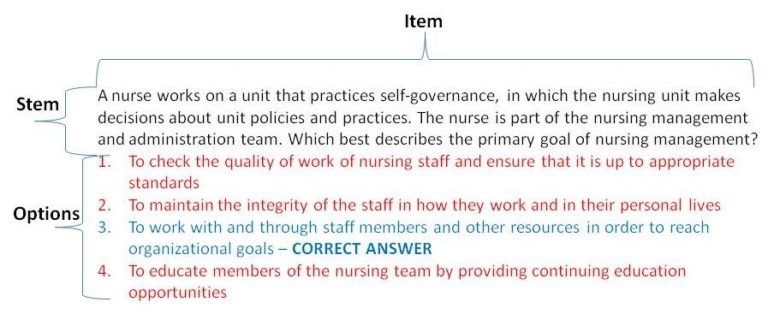
  • Item: the entire question and answer
  • Stem: the actual question, what is being asked
  • Options: possible responses
  • Correct answer: umm, the correct answer
  • Distractors: incorrect answers


Stem:

The stem will have a few characteristics that you must consider.

  • Complete sentence
  • Incomplete sentence – becomes complete with the correct answer
  • Positive – asks a question regarding what is true
  • Negative – asks a question regarding what is false. Be very careful with these questions. These tend to be missed more often simply because students fail to read the entire question. ALWAYS read the entire stem carefully and completely.
    • Look for these words when determining if the stem is negative:
      • Except
      • Not
      • Never
      • Further
      • Least
      • Avoid
      • Contraindicated
    • Sometimes these items will be identified with bold or italic lettering but ultimately it is your job as the student to read the question and identify what is actually being asked . . . so read carefully.

Unlock the Complete Study System

Used by 300,000+ nursing students. 99.25% NCLEX pass rate.

200% NCLEX Pass Guarantee.
No Contract. Cancel Anytime.

Transcript

When we talk about the anatomy of an NCLEX question, a lot of these information might seem really basic, it might seem really simple. But what we’re doing here guys, what we’re doing in this entire course is we’re giving you a tool set of information, of techniques and of skills to help you then go out and approach these questions from a new point. We’re not giving you this simple tree, you know, of decisions, that you then don’t have to learn the information. What we’re doing is we’re giving you the background information to help you approach those questions appropriately. We’re not giving you hacks, what we’re doing is giving you the information you need to approach questions appropriately. So, what we’re gonna do here is we’re gonna just talk really briefly about the anatomy of an NCLEX question or of a nursing school test question. So, first of all, it’s important to understand that the NCLEX is composed entirely of multiple choice question. Now they also might come across as audio, they might be a picture, the might be a SATA question. But each of these questions is a multiple choice question. So, take a moment and think about that for a second. Your ability to work as a nurse comes down to a single test with multiple choice options. Literally, everything you’ve done getting to this point, going through nursing school, taking the NCLEX, becoming a nurse, all of that comes down entirely to a multiple choice test. So, do you think it’s important to understand a bit more about these questions? Now, with this, you basically have two options, we’ve talked about this before but I want to really help this sink in. You can decide to complain about this test, the questions and the answers and say “They’re not fair! They’re terribly written. They’re horrible, I hate them!” or you can learn everything you can about the questions and how to dissect them and demolish them.

Now, since only one of these two options is gonna get you closer to that goal of RN, let’s focus on learning how to dissect questions. Now, let’s picture here, this is obviously not a picture from an NCLEX test because this girl here, she’s way too happy. Either that, or she’s like, I don’t know. This dude is like, “Oh screw it, I’m falling asleep.” And this guy here is like “Yeah, I’m just gonna cheat.” So, obviously not coming from an NCLEX test room but, you know, NCLEX is computer based. You’re gonna go in there, you’re gonna get earphones, you’re gonna get a scratch piece of paper, pen, you’re gonna be able to sit down and take this test.

So, let’s talk about the different pieces of an NCLEX question. For nursing students, your enemy, what you’re trying to conquer is the NCLEX. Now I say enemy a lot, you know, I grew up a lot playing sports. I did wrestling, football, and track in high school, did a little bit of wrestling in college, did a lot of marathons, and competitive running after high school, after college. So, I always remember thinking of my enemy, my opponent, while I was working out. My son is now doing wrestling as well, and one thing that coaches always say is we’re gonna work harder today than your opponent, okay. Or, when they get into the really hard part of the workout, they’ll say, now think about it, your opponent has now quit and gone home, he’s taking an evening off, you’re going to now work harder. Alright, so that’s what you’re doing here. So, that’s what you’re doing as member of the NRSNG Academy. That’s what you’re doing now as you’re getting that extra piece of information that no one else is getting. Every piece of information you get is only going to be to your advantage. Okay, your enemy, your opponent is the NCLEX, it is the one thing standing between you and RN. So rather than complain about the test and how hard it is, let’s present another possible option. So, everything we can about how it is written at the different pieces.

So, this isn’t a great graphic here, but what I want to show you guys, are the different pieces of the question. Because understanding this, understanding this terminology is now going to help you more as we dive in to a couple of the different strategies. This is gonna help you as you sit down and you take a question. Because what you’re gonna be able to do is you’re gonna think, “Okay, what’s the stem saying? What are the options saying, basically?” So, if we take this multiple choice question here, we can break it into basically 3 parts. First of all, we have the item. What the item refers to is the entire question. When you say an NCLEX item, you’re saying the question on the NCLEX. Then, when you say Stem, what you’re talking about when you say stem is you’re talking a about this actual question portion of it. Okay, it’s the actual question. It’s what being asked. What’s being asked of you is the stem. Then, you have options. Options of course, are possible responses. Inside those options, then what you have is you have a correct answer which is drum roll the correct answer and then you have distractors. What distractors are is they are the wrong answers. These are the things that you don’t want to select. So, I really want you to understand this, I know this might seem massively over simple and why am I even covering this? But I really want you to understand your opponent. Okay, the item is the entire question. It’s the entire, everything composed of that point, okay. Stem is the question itself. Options are the possible responses. Correct answer is obviously the correct answer. And distractors are all the wounds you should not select.

Now, there’s a couple of different kinds of stems. So, we’re gonna go over the different kinds of stems that there are. Some stems will be complete sentences, we’ll have full complete sentence with punctuation at the end and then you’re expected to select the response based on that. Some would be incomplete sentences. So, what you’re looking for with an incomplete sentence stem, is you’re looking for an answer option that completes that sentence. Then, the first, okay, so, let me think of an example of this. So, the nurse would first do and then you would select it. Okay, this one here, that we’re looking at, the nurse is part of the nursing management and administration team. Which best describes? That’s obviously a complete sentence. But an incomplete sentence would be something that you’re looking for in your response. The correct response is you’re going to complete that sentence. Then, we’re also gonna have positive stems. What a positive stem is, is it’s asking a question regarding what is true. That’s what we’re used to answering, that’s what we’ve seen so many times in test from kindergarten on, is positive statement. What’s true? What’s the correct answer here? However, what we’re now presented within nursing school and this what we’re gonna spend a little bit of time on, is we’re presented with negative statement. Okay, a stem that’s actually asking a question regarding what is false. And now you might say why do I even need to know what’s false? Well, the point of asking these negative statements is a couple of reasons. They want to see if you’re paying attention, which you need to read questions very closely. They wanna see if you can analyze and critically think and they wanna see if you can draw out what you would not do, right? The NCLEX is all about safety. They wanna know how safe they’re gonna be, they wanna know you know what not to do, just as important as knowing what to do as a nurse is knowing what not to do. So, be really careful with these questions. These tends to be missed more often simply because students fail to read the entire question. Always, always, always read the entire stem carefully and completely. Complete statements are very easy. Positive statements are very easy. Where you can get fumbled up on is incomplete statements where you’re trying to complete a sentence and negative statements where they’re trying to figure out what is false? Now, how can you identify these negative statements? So how can you know when it’s time for you to select the false answer? Now, we’re not talking true or false, we’re talking a multiple choice question where what you’re actually trying to do is you’re trying to find out which one of all these options is false. So, I’m gonna give you a couple of keywords that you can use to know if you’re expected to find the false answer. Now, sometimes, these items or these words will be identified with bold or italic lettering. But a lot of times, they won’t be. And ultimately, it’s your job, as the student, to read the question, identify actually what is being asked, and if you’re supposed to find the correct answer or the false answer. So, read very carefully. I missed these more than anything else because I would get in rush and I would feel over confident, get in rush, and just completely miss the answer then.

So, some of the ways you’re gonna find these would be the word except. The nurse would do all the following except. Which of the following options would the nurse not do? The nurse should never do this. Okay, when taking the temperature of a patient, the nurse should never… And then, you find out. Further. Further, this one can be, this one can be a little bit tricky because you might really miss this and it’s not like this big negative word that we’re used to seeing. So, you might really miss this word in a stem. But further would be which statement by the patient would indicate the need for further teaching. That’s the most popular way they’re gonna use further. Which statement by the patient would indicate the need for further teaching? Or, which finding would indicate the nurse needs further assessment? Alright, so that’s one that you’re looking for the negative one. Alright, for teaching the patient about beta blockers, and they ask which would indicate further teaching? You know, it’s gonna be something about “I’m gonna take it when my blood pressure is 30/10” We don’t wanna do that. So, make sure we identify ‘cause what a lot of time happens is these questions guys, is you get in there, you don’t see that it’s a negative thing. We start reading the responses, you’re like, men, 2 and 3 really sound right, one of them seems a little off, and you don’t realize that you’re actually looking for that negative response. So be really careful with that. Another one is least, okay. Which patient is least likely to experience an aneurysm, for example. Or, which patient is least likely to suffer from high blood pressure. Again, you’re looking for that negative response. Another one here is avoid. Which action would the nurse avoid when caring for a pediatric patient? So, what don’t you wanna do in that instance. That’s a really big one, it’s really important. Another one is contraindicated. Which medication is contraindicated in a patient who is African American? Or, which treatment is contraindicated in a patient who is drinking grapefruit juice? Or, when would it be contraindicated to intubate? So, these are times, you know, these 7 words, I want you to write down, I want you to remember these and I want, more importantly than anything else, I want you to start watching out for these, okay? Start realizing these are gonna be spread out, sprinkled in, peppered in to your questions, so I really want you to be very careful about looking for these, finding these, and making sure you understand that you’re looking for a negative answer, alright. So, that’s really how the NCLEX question is structured, that’s the anatomy, that’s the basic set up of an NCLEX question. And with this information, I want you to kinda store this back in there and realize that with this information, you can now approach these questions.

Study Faster with Full Video Transcripts

99.25% NCLEX Pass Rate vs 88.8% National Average

200% NCLEX Pass Guarantee.
No Contract. Cancel Anytime.

🎉 Special Offer 🎉

Nursing School Doesn't Have To Be So Hard

Go from discouraged and stressed to motivated and passionate

Prep for PN Program

Concepts Covered:

  • Tissues and Glands
  • Circulatory System
  • Respiratory System
  • Digestive System
  • Skeletal System
  • Medication Administration
  • Urinary System
  • Urinary Disorders
  • Reproductive System
  • Noninfectious Respiratory Disorder
  • Muscular System
  • Nervous System
  • Sensory System
  • Endocrine System
  • Hematologic System
  • Developmental Considerations
  • Factors Influencing Community Health
  • Childhood Growth and Development
  • Prenatal and Neonatal Growth and Development
  • Trauma-Stress Disorders
  • Developmental Theories
  • Adulthood Growth and Development
  • Concepts of Mental Health
  • Prefixes
  • Suffixes
  • Fetal Development
  • Terminology
  • Proteins
  • Statistics
  • Med Term Basic
  • Med Term Whole
  • Test Taking Strategies
  • Note Taking
  • Basics of NCLEX
  • Studying
  • Substance Abuse Disorders
  • Behavior
  • Peripheral Nervous System Disorders
  • Cardiac Disorders
  • Musculoskeletal Disorders
  • Communication
  • Concepts of Population Health
  • Basics of Human Biology
  • Central Nervous System Disorders – Brain
  • Respiratory Emergencies
  • Perioperative Nursing Roles
  • Concepts of Pharmacology
  • Emergency Care of the Cardiac Patient
  • Integumentary Disorders
  • Health & Stress
  • Labor and Delivery
  • Gastrointestinal Disorders
  • Disorders of Pancreas
  • Microbiology
  • Neurological Emergencies
  • Intraoperative Nursing
  • Depressive Disorders
  • Central Nervous System Disorders – Spinal Cord
  • Postpartum Care
  • Prioritization
  • Fundamentals of Emergency Nursing
  • Shock
  • Emergency Care of the Trauma Patient
  • Basics of Mathematics
  • Basics of Chemistry
  • Liver & Gallbladder Disorders
  • Hematology
  • Immunological Disorders
  • Adult
  • Anxiety Disorders
  • Vascular Disorders
  • Upper GI Disorders
  • Dosage Calculations
  • Understanding Society
  • Hematologic Disorders
  • Newborn Care
  • Respiratory Disorders
  • Postoperative Nursing
  • Pregnancy Risks
  • Neurological
  • Postpartum Complications
  • Bipolar Disorders
  • Learning Pharmacology
  • Psychotic Disorders
  • Prenatal Concepts

Study Plan Lessons

Anatomy & Physiology Course Introduction
Blood Pressure (BP) Control
Breathing Control
Bowel Elimination
Bone Structure
Drawing Blood from the IV
Gastrointestinal (GI) Course Introduction
Formation & Excretion of Urine
Inserting a Foley (Urinary Catheter) – Male
Male Reproductive Anatomy (Anatomy and Physiology)
Nursing Care Plan (NCP) for Bronchoscopy (Procedure)
Skeletal Muscle
Skin Structure & Function
Small Intestine
Stomach Video
Types of Epithelial (Skin) Tissue
Urinary System Anatomy (Anatomy and Physiology)
Development of Bones
Drawing Blood
Female Reproductive Anatomy (Anatomy and Physiology)
Intro to Circulatory System
Large Intestine
Liver & Gallbladder
Muscle Contraction
Muscle Physiology
Nervous System Anatomy
Renal (Kidney) Structure & Function
Respiratory A&P Module Intro
Respiratory Functions of Blood
Respiratory Structure & Function
Selecting THE vein
Sensory Basics
Skeletal Anatomy
The Heart
ABG Course (Arterial Blood Gas) Introduction
Adrenal Gland
Arterial Pressure Monitoring
Blood Grouping
Blood Plasma
Blood Vessels
Breathing Movements
Calculating Heart Rate
Cardiac (Heart) Physiology
Cardiac A&P Module Intro
Connective Tissues
Digestion & Absorption
Digestive System Anatomy
Body Image Changes Throughout Development
Cultural Awareness and Influences on Development
Cultural Considerations (Interpretive Services, Privacy, Decision Making) for Certified Emergency Nursing (CEN)
Day in the Life of a Hospice, Palliative Care Nurse
Developmental Considerations for End of Life Care
Developmental Considerations for the Hospitalized Individual
Developmental Stages and Milestones
End of Life for Progressive Care Certified Nurse (PCCN)
End-of-Life and Palliative Care (Organ and Tissue Donation, Advance Directives, Care Withholding, Family Presence) for Certified Emergency Nursing (CEN)
Environmental and Genetic Influences on Growth & Development
Erikson’s Theory of Psychosocial Development
Family Structure and Impact on Development
Geriatric: IV Insertion
Growth & Development – Neonate
Growth & Development – Toddlers
Growth & Development – Early Adulthood
Growth & Development – Infants
Growth & Development – Late Adulthood
Growth & Development – Middle Adulthood
Growth & Development – Preschoolers
Growth & Development – School Age- Adolescent
Growth & Development – Toddlers
Growth & Development -Transitioning to Adult Care
Growth and Development – Prenatal
Handling Death and Dying
Human Growth & Development Course Introduction
Kohlberg’s Theory of Moral Development
Overview of Childhood Growth & Development
Overview of Developmental Theories
Pain Management for the Older Adult – Live Tutoring Archive
Palliative Care for Progressive Care Certified Nurse (PCCN)
Piaget’s Theory of Cognitive Development
Postmortem Care
Self Concept
54 Common Medication Prefixes and Suffixes
Alpha-fetoprotein (AFP) Lab Values
Carboxyhemoglobin Lab Values
Cardiac Terminology
Diagnostic Testing Course Introduction
Diagnostics Terminology
Digestive Terminology
Gamma Glutamyl Transferase (GGT) Lab Values
Growth Hormone (GH) Lab Values
Hematology Oncology & Immunology Terminology
Integumentary (Skin) Terminology
Mean Corpuscular Volume (MCV) Lab Values
Mean Platelet Volume (MPV) Lab Values
Medical Terminology Course Introduction
MedTerm Basic Word Structure
MedTerm Body as a Whole
MedTerm Prefixes
MedTerm Suffixes
Metabolic & Endocrine Terminology
Methemoglobin (MHGB) Lab Values
Musculoskeletal Terminology
Myoglobin (MB) Lab Values
Neuro Terminology
Pharmacology Terminology
Prealbumin (PAB) Lab Values
Procedural Terminology
Psychiatry Terminology
Reproductive Terminology
Respiratory Terminology
Sensory Terminology
Urinary Terminology
01.01 CCRN Test Overview for CCRN Review
12 Points to Answering Pharmacology Questions
5 Rules for Powerpoint
5 Things You Never Knew About The NCLEX – Live Tutoring Archive
9 Easy Steps to Passing Every Nursing School Test | With Jon Haws, BSN, RN, Founder of NURSING.com
Absolute Words
Acute vs Chronic
Addiction – Behavioral Problems Nursing Mnemonic (The 5 D’s)
ADLs (Activity of Daily Living) Nursing Mnemonic (BATTED)
Advanced Critical Thinking
Alcoholism – Outcomes Nursing Mnemonic (BAD)
Alkalosis and Acidosis Nursing Mnemonic (Kick Up, Drop Down)
Anatomy of an NCLEX Question

Anticholinergics – Side Effects Nursing Mnemonic (4 Can’ts)
Arterial Blood Gases Nursing Mnemonic (ROME)
Ask Questions
Assessment for Myasthenic Crisis Nursing Mnemonic (BRISH)
Avoiding Alarm Fatigue
Backwards and Forwards
Bacterial Endocarditis – Symptoms Nursing Mnemonic (Be Joan Of Arc)
Be a Mix Tape (Rewind and Fast-Forward)
Beta 1 and Beta 2 Nursing Mnemonic (1 Heart, 2 Lungs)
Bloom’s Taxonomy
C – Content
Can You Draw It
Canes Nursing Mnemonic (COAL)
Care Plan Review (Addresses Patient Considerations) for Certified Perioperative Nurse (CNOR)
Caring Licensed Practical Nurse Nursing Mnemonic (CLPN)
Caring Practices for Progressive Care Certified Nurse (PCCN)
Causes of Dyspnea Nursing Mnemonic (The 6 P’s)
Causes of Poor Gas Exchange Nursing Mnemonic (All People Can Value Lungs)
Chance’s Story on His Personal Journey
Cheatsheets
CHF Treatment Nursing Mnemonic (UNLOAD FAST)
Child Abuse/Neglect – Warning Signs Nursing Mnemonic (CHILD ABUSE)
CHO, CHO, CHON Nursing Mnemonic (CHO, CHO, CHON)
Cholinergic Crisis – Signs and Symptoms Nursing Mnemonic (SLUDGE)
Clinical Inquiry for Progressive Care Certified Nurse (PCCN)
Common Signs of Parkinson’s Nursing Mnemonic (SMART)
Community Health Tool Nursing Mnemonic (MAP-IT)
Complications of Thoracentesis Nursing Mnemonic (Patients Sometimes Bleed Internally)
Concept Map Course Introduction
Connections
Cor Pulmonale – Signs & Symptoms Nursing Mnemonic (Please Read His Text)
Course Introduction to Nursing School Preparation
Critical Thinking
Critical Thinking
Critical Thinking to Facilitate Patient Care for Certified Perioperative Nurse (CNOR)
Degree Restrictions in Career Growth
Denying Feelings
Dig for the Why
Diploma vs ADN vs BSN vs Bridge
Drawing Pictures
Drug Interactions Nursing Mnemonic (These Drugs Can Interact)
Drugs for Bradycardia & Low Blood Pressure Nursing Mnemonic (IDEA)
Duplicate Facts
E – Engagement
Electrolytes – Location in Body Nursing Mnemonic (PISO)
Emergency Drugs Nursing Mnemonic (LEAN)
Environmental Health Assessment Nursing Mnemonic (I PREPARE)
Evaluating Patient Response to Plan of Care for Certified Perioperative Nurse (CNOR)
Evaluation of Irregular Moles Nursing Mnemonic (ABCDE)
Exercise Guidelines Nursing Mnemonic (FIT)
Explaining the “Why”
Exporting and Uploading to Frame.io
Fetal Distress Interventions Nursing Mnemonic (Stop MOAN)
Fetal Wellbeing Assessment Tests Nursing Mnemonic (ALONE)
Fire Safety 1 Nursing Mnemonic (PASS)
Fire Safety 2 Nursing Mnemonic (RACE)
Formulating Nursing Diagnoses for Certified Perioperative Nurse (CNOR)
Getting Access to frame.io
Getting Started with Tech
Gluten Free Diet Nursing Mnemonic (BROW)
Goal Setting
HESI® Prep Course Introduction
High Risk Behavior Nursing Mnemonic (HEADSS)
How to Write a Nursing Care Plan
Hyperkalemia – Causes Nursing Mnemonic (MACHINE)
Hyperkalemia – Management Nursing Mnemonic (AIRED)
Hyperkalemia – Signs and Symptoms Nursing Mnemonic (Murder)
Hypernatremia – Causes Nursing Mnemonic (MODEL)
Hypoglycemia – Signs and Symptoms Nursing Mnemonic (TIRED)
IADLS (Instrumental Activities of Daily Living) Nursing Mnemonic (SCUM)
Identifying Interventions per Nursing Diagnoses for Certified Perioperative Nurse (CNOR)
Identifying Measurable Patient Outcomes for Certified Perioperative Nurse (CNOR)
Increase MAP Nursing Mnemonic (VAK)
Inflammation- Signs and Symptoms Nursing Mnemonic (HIPER)
Interventions for Aphasia Nursing Mnemonic (PROP)
Interviewing for Nursing School
Introduction to CCMM
Jon’s Story on His Personal Journey
Keep it Short
Lesson Elements
Lidocaine Toxicity – Signs and Symptoms Nursing Mnemonic (SAMS)
Management of Pressure Ulcers (Pressure Injuries) Nursing Mnemonic (SKIN)
MAO Inhibitors Nursing Mnemonic (TIPS)
Marie’s Story on Her Personal Nursing Journey
Medications to Prevent Seizures Nursing Mnemonic (Pretty Little Liars Forever)
Miriam’s Story on Her Personal Journey
Mnemonic for Organ Systems (MR DICE RUNS)
MSN (Masters) vs. DNP (Doctorate)
Multiple Sclerosis Symptoms Nursing Mnemonic (DEMYELINATION)
NCLEX Question Traps! – Live Tutoring Archive
NCLEX® Question Traps
Need Help Making A Study Plan? – Live Tutoring Archive
NRSNG | Closing Thoughts
NRSNG Live | 5 Things You Never Knew About NCLEX Questions
NRSNG Live | AMA (Ask Me Anything) Nursing Success Roundtable
NRSNG Live | AMA Student Panel – How I Survive (Barely) Nursing School
NRSNG Live | How I Went From Nursing School Dropout to Passing NCLEX in 75 and Teaching 18 Million Nurses
NRSNG Live | How to Get the Most out of NRSNG
NRSNG Live | How to Pass Any Nursing School Test
NRSNG Live | My Super Secret Note Taking Method
NRSNG Live | The Core Content Mastery Method and How to Use it Throughout Your Nursing Journey
NRSNG Live | The Successful State of Mind
NRSNG Live | What Your Nursing Professors Want to Tell You But Can’t
Nursing Care Plans Course Introduction
Nursing Case Study Introduction
Nursing Process
Nursing Process – Assess
Nursing Process – Diagnose
Nursing Process – Evaluate
Nursing Process – Implement
Nursing Process – Plan
Nursing School Application Essay
NURSING.com Assessment & Skills Checks
NURSING.com Introduction
O – Origins
OLD CARTS Mnemonic (OLD CARTS)
Online vs Brick-and-Mortar
Opposite or the Same – Live Tutoring Archive
Opposites
Our Goals for Teaching
Our Mission
Outline Question Method (Note taking)
Overview of the Nursing Process
Paying for Nursing School
Personal Growth Resources for Certified Perioperative Nurse (CNOR)
Pharmacokinetics Nursing Mnemonic (ADME)
Pictures
Plan of Care Updates for Certified Perioperative Nurse (CNOR)
Planning Community Health Interventions Nursing Mnemonic (PRECEDE-PROCEED)
Post-Partum Assessment Nursing Mnemonic (BUBBLE)
Prioritization
Prioritizing Assessments
Priority
Purpose of Nursing Care Plans
Questions To Ask Before Applying To A Nursing Program
R – Real-Life
Real Life
Real-Life Experiences
Recording
Repeating Words
Resources for Lesson Creation
RN to MSN
Safety Check Nursing Mnemonic (MADLE)
Same
SATA
SATA like a BOSS – Live Tutoring Archive
SATA like a BOSS 2 – Live Tutoring Archive
SBAR Communication Nursing Mnemonic (SBAR)
Screencastify Setup
Seizure Causes Nursing Mnemonic (VITAMIN)
Seizure Documentation Nursing Mnemonic (TDOC)
Share the Wealth
Shock – Signs and symptoms Nursing Mnemonic (TV SPARC CUBE)
SSRI’s Nursing Mnemonic (Effective For Sadness, Panic, and Compulsions)
Start and End with the Linchpin
Steps in the Nursing Process 1 Nursing Mnemonic (ADPIE)
Steps in the Nursing Process 2 Nursing Mnemonic (AAPIE)
Steps In The Nursing Process 3 Nursing Mnemonic (SOAPIE)
Study Setting
Study Tips for Success
Systems Thinking for Progressive Care Certified Nurse (PCCN)
TEAS® Prep Course Introduction
Tenet 1 Filet Mignon
Tenet 2 Linchpins & Connections
Tenet 3 Why Behind the What
Tenet 4 Learner-Centered Talkabouts
Test Taking Course Introduction
The Academy
The CARPET Methods of Teaching
The Nurse Routine
The Nursing Process Pro Tips for Test Taking – Live Tutoring Archive
The Outline is the Foundation
Thinking Like a Nurse
Time Management
Time Management
To The Point
Tracheal Esophageal Fistula – Sign and Symptoms Nursing Mnemonic (The 3 C’s)
Trauma – Complications Nursing Mnemonic (TRAUMATIC)
Trauma Surgery – Medical History Nursing Mnemonic (AMPLE)
Triage Nursing Mnemonic (START)
Trusting your Gut
Two pathways of the peripheral nervous system Nursing Mnemonic (SAME)
Using Nursing Care Plans in Clinicals
Vasospasm Therapy Nursing Mnemonic (Triple H Therapy)
VEAL CHOP Nursing Mnemonic (Fetal Accelerations and Decelerations) (VEAL CHOP)
Vitamins – Fat Soluble Nursing Mnemonic (All Dogs Eat Kibble)
Vitamins – Water Soluble Nursing Mnemonic (Birth Control)
Walkers Nursing Mnemonic (Wandering Wilma Always Late)
Welcome to NURSING.com
What Are the Absolutes
What are the NCLEX Categories? – Live Tutoring Archive
What do you want me to know?
What is CCMM?
What is Pedagogy
What is the NCLEX?
What Should They Learn
What to Expect In Clinical
Where To Start
Why NURSING.com?
Working night shift
Your Role
Working with Fractions
Ratios & Proportions
Normal distribution curve
Mathematics Course Introduction
Common Stat tests
Basic Statistics
Basic Geometry
Basic Operations
Basic Algebra
Acids & Bases (acid base balance)
Atomic Structure & Periodic Table
Chemical Bonds & Compounds
Chemical Equations
Chemical Reactions
Nuclear Chemistry
Oxidation & Reduction
Properties of Matter
Scientific Notation & Measurement
Anti-Infective – Antifungals
Antimicrobial Vaccinations
Antiparasitic Agents
Antiviral Agents for Treatment
Bacteria
Bacterial Role in Disease
Basics of Microbial Control
Biogeochemical cycles
Biohazard Material Handling and Disposition (Blood, Microbiology, Creutzfeldt-Jakob Disease) for Certified Perioperative Nurse (CNOR)
Cefdinir (Omnicef) Nursing Considerations
Cell Membrane Permeability
Cell Structure
Cellular Energy Conversion
CHO, CHO, CHON Nursing Mnemonic (CHO, CHO, CHON)
Disposal of Medical Waste
Fungal Infections
Genetic Basics
Hazardous Material Handling and Disposition (Chemo, Radioactive) for Certified Perioperative Nurse (CNOR)
Hb (Hepatitis) Vaccine
Healthcare-Acquired Infections: Central-Line-Associated Infections (CLABSI) for Progressive Care Certified Nurse (PCCN)
Homeostasis
Host defenses
Human Biology Course Introduction
Infection or Inflammation? The Quick & Dirty on CBCs – Live Tutoring Archive
Infection or Inflammation? The Quick & Dirty on CBCs 2 – Live Tutoring Archive
Infection Stages
Infectious Diseases: Multidrug-Resistant Organisms (MRSA, VRE, CRE, ESBL) for Progressive Care Certified Nurse (PCCN)
Inflammation- Signs and Symptoms Nursing Mnemonic (HIPER)
Intro to Cell Metabolism
Intro to Ions & Molecules
Key Nutrients in the Prevention of Chronic Disease
Lipids, Carbohydrates & Proteins
Macro and Micronutrients
Mechanisms of Antimicrobial Agents
Meiosis & Mitosis
Membranous Organelles
Molecular vs Serological Diagnosis
Multi-Drug Resistant Organisms (MRSA, VRE) for Certified Emergency Nursing (CEN)
Mycotoxins and Mycotoxicosis
Needle Safety
Non-Membranous Organelles
Nursing Care Plan (NCP) for Infection
Nursing Care Plan (NCP) for West Nile Virus
Nutrition Course Introduction
Nystatin (Mycostatin) Nursing Considerations
Parasites and Parasite Replication
Protein Synthesis & Nucleic Acids
Tonicity of Solutions – Live Tutoring Archive
Viral Reproduction
Viruses & Fungi
12 Points to Answering Pharmacology Questions
6 Rights of Medication Administration
ACLS (Advanced cardiac life support) Drugs
Adenosine (Adenocard) Nursing Considerations
Amiodarone (Pacerone) Nursing Considerations
Anesthetic Agents
Anti-Infective – Antifungals
Anti-Platelet Aggregate
Antianxiety Meds
Antidepressants
Atenolol (Tenormin) Nursing Considerations
Atropine (Atropen) Nursing Considerations
Barbiturates
Bariatric: IV Insertion
Basics of Calculations
Benztropine (Cogentin) Nursing Considerations
Bisacodyl (Dulcolax) Nursing Considerations
Buspirone (Buspar) Nursing Considerations
Carbidopa-Levodopa (Sinemet) Nursing Considerations
Cefdinir (Omnicef) Nursing Considerations
Celecoxib (Celebrex) Nursing Considerations
Codeine (Paveral) Nursing Considerations
Combative: IV Insertion
Complex Calculations (Dosage Calculations/Med Math)
Cyclosporine (Sandimmune) Nursing Considerations
Dark Skin: IV Insertion
Dimensional Analysis Nursing (Dosage Calculations/Med Math)
Diphenoxylate-Atropine (Lomotil) Nursing Considerations
Drawing Blood from the IV
Drawing Up Meds
Drug Interactions Nursing Mnemonic (These Drugs Can Interact)
Epoetin Alfa
Eye Prophylaxis for Newborn
Fentanyl (Duragesic) Nursing Considerations
Geriatric: IV Insertion
Giving Medication Through An IV Set Port
Glipizide (Glucotrol) Nursing Considerations
Guaifenesin (Mucinex) Nursing Considerations
Hanging an IV Piggyback
How to Remove (discontinue) an IV
How to Secure an IV (chevron, transparent dressing)
Hydralazine
Hydrocodone-Acetaminophen (Vicodin, Lortab) Nursing Considerations
Hydromorphone (Dilaudid) Nursing Considerations
IM Injections
Injectable Medications
Insulin
Insulin – Long Acting (Lantus) Nursing Considerations
Insulin – Mixtures (70/30)
Insulin Drips
Insulin Mixing
Interactive Pharmacology Practice
Interactive Practice Drip Calculations
IV Catheter Selection (gauge, color)
IV Complications (infiltration, phlebitis, hematoma, extravasation, air embolism)
IV Drip Administration & Safety Checks
IV Drip Therapy – Medications Used for Drips
IV Infusions (Solutions)
IV Insertion Angle
IV Insertion Course Introduction
IV Placement Start To Finish (How to Start an IV)
IV Pump Management
IV Push Medications
Ketorolac (Toradol) Nursing Considerations
Labeling (Medications, Solutions, Containers) for Certified Perioperative Nurse (CNOR)
Lidocaine (Xylocaine) Nursing Considerations
Magnesium Sulfate
Magnesium Sulfate in Pregnancy
Maintenance of the IV
Mannitol (Osmitrol) Nursing Considerations
MAOIs
Medication Errors
Medication Reconciliation Review for Certified Perioperative Nurse (CNOR)
Medications in Ampules
Meds for Postpartum Hemorrhage (PPH)
Meperidine (Demerol) Nursing Considerations
Methadone (Methadose) Nursing Considerations
Methylergonovine (Methergine) Nursing Considerations
Metoclopramide (Reglan) Nursing Considerations
Montelukast (Singulair) Nursing Considerations
Mood Stabilizers
Nalbuphine (Nubain) Nursing Considerations
Needle Safety
Neostigmine (Prostigmin) Nursing Considerations
NG Tube Med Administration (Nasogastric)
NG Tube Medication Administration
Nitro Compounds
NRSNG Live | The S.O.C.K Method for Mastering Nursing Pharmacology and Never Forgetting a Medication Again
Nystatin (Mycostatin) Nursing Considerations
OB Pharm and What Drugs You HAVE to Know – Live Tutoring Archive
Olanzapine (Zyprexa) Nursing Considerations
Opioid Analgesics in Pregnancy
Oral Medications
Oxycodone (OxyContin) Nursing Considerations
Pain Management for the Older Adult – Live Tutoring Archive
Pain Management Meds – Live Tutoring Archive
Parasympathomimetics (Cholinergics) Nursing Considerations
Patient Controlled Analgesia (PCA)
Pediatric Dosage Calculations
Pentobarbital (Nembutal) Nursing Considerations
Pharmacodynamics
Pharmacokinetics
Pharmacokinetics Nursing Mnemonic (ADME)
Pharmacology Course Introduction
Phenobarbital (Luminal) Nursing Considerations
Phytonadione (Vitamin K) for Newborn
Pill Crushing & Cutting
Positioning
Procainamide (Pronestyl) Nursing Considerations
Propofol (Diprivan) Nursing Considerations
Quetiapine (Seroquel) Nursing Considerations
Ranitidine (Zantac) Nursing Considerations
Rh Immune Globulin in Pregnancy
Sedatives-Hypnotics
Sedatives-Hypnotics
Selecting THE vein
Spiking & Priming IV Bags
Starting an IV
Streptokinase (Streptase) Nursing Considerations
Struggling with Dimensional Analysis? – Live Tutoring Archive
SubQ Injections
Supplies Needed
Tattoos IV Insertion
TCAs
The SOCK Method – C
The SOCK Method – K
The SOCK Method – O
The SOCK Method – Overview
The SOCK Method – S
The SOCK Method of Pharmacology 1 – Live Tutoring Archive
The SOCK Method of Pharmacology 2 – Live Tutoring Archive
The SOCK Method of Pharmacology 3 – Live Tutoring Archive
Tips & Tricks
Tips & Advice for Newborns (Neonatal IV Insertion)
Tips & Advice for Pediatric IV
Understanding All The IV Set Ports
Using Aseptic Technique
Verapamil (Calan) Nursing Considerations