Anatomy of an NCLEX Question

You're watching a preview. 300,000+ students are watching the full lesson.
Jon Haws
BS, BSN,RN,CCRN Alumnus
Master
To Master a topic you must score > 80% on the lesson quiz.
Take Quiz

Included In This Lesson

Study Tools For Anatomy of an NCLEX Question

11 Test Taking Tips (Cheatsheet)
Survival Guide for Nurses (Book)
NURSING.com students have a 99.25% NCLEX pass rate.

Outline

The NCLEX® is composed entirely of multiple choice questions. Your ability to work as a nurse comes down to a single test with multiple choice answer options.

Think it’s important to understand a bit more about these questions?

Basically you have two options:

  1. Complain about the tests, the questions, and the answers.
  2. Learn everything you can about the questions and how to dissect them and demolish them.

Since only one of these options is going to get you closer to RN, let’s focus on learning how to dissect the questions.

So let’s break down the anatomy of the question:


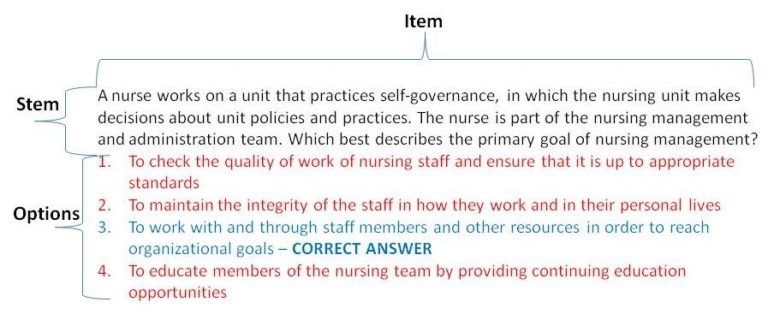
  • Item: the entire question and answer
  • Stem: the actual question, what is being asked
  • Options: possible responses
  • Correct answer: umm, the correct answer
  • Distractors: incorrect answers


Stem:

The stem will have a few characteristics that you must consider.

  • Complete sentence
  • Incomplete sentence – becomes complete with the correct answer
  • Positive – asks a question regarding what is true
  • Negative – asks a question regarding what is false. Be very careful with these questions. These tend to be missed more often simply because students fail to read the entire question. ALWAYS read the entire stem carefully and completely.
    • Look for these words when determining if the stem is negative:
      • Except
      • Not
      • Never
      • Further
      • Least
      • Avoid
      • Contraindicated
    • Sometimes these items will be identified with bold or italic lettering but ultimately it is your job as the student to read the question and identify what is actually being asked . . . so read carefully.

Unlock the Complete Study System

Used by 300,000+ nursing students. 99.25% NCLEX pass rate.

200% NCLEX Pass Guarantee.
No Contract. Cancel Anytime.

Transcript

When we talk about the anatomy of an NCLEX question, a lot of these information might seem really basic, it might seem really simple. But what we’re doing here guys, what we’re doing in this entire course is we’re giving you a tool set of information, of techniques and of skills to help you then go out and approach these questions from a new point. We’re not giving you this simple tree, you know, of decisions, that you then don’t have to learn the information. What we’re doing is we’re giving you the background information to help you approach those questions appropriately. We’re not giving you hacks, what we’re doing is giving you the information you need to approach questions appropriately. So, what we’re gonna do here is we’re gonna just talk really briefly about the anatomy of an NCLEX question or of a nursing school test question. So, first of all, it’s important to understand that the NCLEX is composed entirely of multiple choice question. Now they also might come across as audio, they might be a picture, the might be a SATA question. But each of these questions is a multiple choice question. So, take a moment and think about that for a second. Your ability to work as a nurse comes down to a single test with multiple choice options. Literally, everything you’ve done getting to this point, going through nursing school, taking the NCLEX, becoming a nurse, all of that comes down entirely to a multiple choice test. So, do you think it’s important to understand a bit more about these questions? Now, with this, you basically have two options, we’ve talked about this before but I want to really help this sink in. You can decide to complain about this test, the questions and the answers and say “They’re not fair! They’re terribly written. They’re horrible, I hate them!” or you can learn everything you can about the questions and how to dissect them and demolish them.

Now, since only one of these two options is gonna get you closer to that goal of RN, let’s focus on learning how to dissect questions. Now, let’s picture here, this is obviously not a picture from an NCLEX test because this girl here, she’s way too happy. Either that, or she’s like, I don’t know. This dude is like, “Oh screw it, I’m falling asleep.” And this guy here is like “Yeah, I’m just gonna cheat.” So, obviously not coming from an NCLEX test room but, you know, NCLEX is computer based. You’re gonna go in there, you’re gonna get earphones, you’re gonna get a scratch piece of paper, pen, you’re gonna be able to sit down and take this test.

So, let’s talk about the different pieces of an NCLEX question. For nursing students, your enemy, what you’re trying to conquer is the NCLEX. Now I say enemy a lot, you know, I grew up a lot playing sports. I did wrestling, football, and track in high school, did a little bit of wrestling in college, did a lot of marathons, and competitive running after high school, after college. So, I always remember thinking of my enemy, my opponent, while I was working out. My son is now doing wrestling as well, and one thing that coaches always say is we’re gonna work harder today than your opponent, okay. Or, when they get into the really hard part of the workout, they’ll say, now think about it, your opponent has now quit and gone home, he’s taking an evening off, you’re going to now work harder. Alright, so that’s what you’re doing here. So, that’s what you’re doing as member of the NRSNG Academy. That’s what you’re doing now as you’re getting that extra piece of information that no one else is getting. Every piece of information you get is only going to be to your advantage. Okay, your enemy, your opponent is the NCLEX, it is the one thing standing between you and RN. So rather than complain about the test and how hard it is, let’s present another possible option. So, everything we can about how it is written at the different pieces.

So, this isn’t a great graphic here, but what I want to show you guys, are the different pieces of the question. Because understanding this, understanding this terminology is now going to help you more as we dive in to a couple of the different strategies. This is gonna help you as you sit down and you take a question. Because what you’re gonna be able to do is you’re gonna think, “Okay, what’s the stem saying? What are the options saying, basically?” So, if we take this multiple choice question here, we can break it into basically 3 parts. First of all, we have the item. What the item refers to is the entire question. When you say an NCLEX item, you’re saying the question on the NCLEX. Then, when you say Stem, what you’re talking about when you say stem is you’re talking a about this actual question portion of it. Okay, it’s the actual question. It’s what being asked. What’s being asked of you is the stem. Then, you have options. Options of course, are possible responses. Inside those options, then what you have is you have a correct answer which is drum roll the correct answer and then you have distractors. What distractors are is they are the wrong answers. These are the things that you don’t want to select. So, I really want you to understand this, I know this might seem massively over simple and why am I even covering this? But I really want you to understand your opponent. Okay, the item is the entire question. It’s the entire, everything composed of that point, okay. Stem is the question itself. Options are the possible responses. Correct answer is obviously the correct answer. And distractors are all the wounds you should not select.

Now, there’s a couple of different kinds of stems. So, we’re gonna go over the different kinds of stems that there are. Some stems will be complete sentences, we’ll have full complete sentence with punctuation at the end and then you’re expected to select the response based on that. Some would be incomplete sentences. So, what you’re looking for with an incomplete sentence stem, is you’re looking for an answer option that completes that sentence. Then, the first, okay, so, let me think of an example of this. So, the nurse would first do and then you would select it. Okay, this one here, that we’re looking at, the nurse is part of the nursing management and administration team. Which best describes? That’s obviously a complete sentence. But an incomplete sentence would be something that you’re looking for in your response. The correct response is you’re going to complete that sentence. Then, we’re also gonna have positive stems. What a positive stem is, is it’s asking a question regarding what is true. That’s what we’re used to answering, that’s what we’ve seen so many times in test from kindergarten on, is positive statement. What’s true? What’s the correct answer here? However, what we’re now presented within nursing school and this what we’re gonna spend a little bit of time on, is we’re presented with negative statement. Okay, a stem that’s actually asking a question regarding what is false. And now you might say why do I even need to know what’s false? Well, the point of asking these negative statements is a couple of reasons. They want to see if you’re paying attention, which you need to read questions very closely. They wanna see if you can analyze and critically think and they wanna see if you can draw out what you would not do, right? The NCLEX is all about safety. They wanna know how safe they’re gonna be, they wanna know you know what not to do, just as important as knowing what to do as a nurse is knowing what not to do. So, be really careful with these questions. These tends to be missed more often simply because students fail to read the entire question. Always, always, always read the entire stem carefully and completely. Complete statements are very easy. Positive statements are very easy. Where you can get fumbled up on is incomplete statements where you’re trying to complete a sentence and negative statements where they’re trying to figure out what is false? Now, how can you identify these negative statements? So how can you know when it’s time for you to select the false answer? Now, we’re not talking true or false, we’re talking a multiple choice question where what you’re actually trying to do is you’re trying to find out which one of all these options is false. So, I’m gonna give you a couple of keywords that you can use to know if you’re expected to find the false answer. Now, sometimes, these items or these words will be identified with bold or italic lettering. But a lot of times, they won’t be. And ultimately, it’s your job, as the student, to read the question, identify actually what is being asked, and if you’re supposed to find the correct answer or the false answer. So, read very carefully. I missed these more than anything else because I would get in rush and I would feel over confident, get in rush, and just completely miss the answer then.

So, some of the ways you’re gonna find these would be the word except. The nurse would do all the following except. Which of the following options would the nurse not do? The nurse should never do this. Okay, when taking the temperature of a patient, the nurse should never… And then, you find out. Further. Further, this one can be, this one can be a little bit tricky because you might really miss this and it’s not like this big negative word that we’re used to seeing. So, you might really miss this word in a stem. But further would be which statement by the patient would indicate the need for further teaching. That’s the most popular way they’re gonna use further. Which statement by the patient would indicate the need for further teaching? Or, which finding would indicate the nurse needs further assessment? Alright, so that’s one that you’re looking for the negative one. Alright, for teaching the patient about beta blockers, and they ask which would indicate further teaching? You know, it’s gonna be something about “I’m gonna take it when my blood pressure is 30/10” We don’t wanna do that. So, make sure we identify ‘cause what a lot of time happens is these questions guys, is you get in there, you don’t see that it’s a negative thing. We start reading the responses, you’re like, men, 2 and 3 really sound right, one of them seems a little off, and you don’t realize that you’re actually looking for that negative response. So be really careful with that. Another one is least, okay. Which patient is least likely to experience an aneurysm, for example. Or, which patient is least likely to suffer from high blood pressure. Again, you’re looking for that negative response. Another one here is avoid. Which action would the nurse avoid when caring for a pediatric patient? So, what don’t you wanna do in that instance. That’s a really big one, it’s really important. Another one is contraindicated. Which medication is contraindicated in a patient who is African American? Or, which treatment is contraindicated in a patient who is drinking grapefruit juice? Or, when would it be contraindicated to intubate? So, these are times, you know, these 7 words, I want you to write down, I want you to remember these and I want, more importantly than anything else, I want you to start watching out for these, okay? Start realizing these are gonna be spread out, sprinkled in, peppered in to your questions, so I really want you to be very careful about looking for these, finding these, and making sure you understand that you’re looking for a negative answer, alright. So, that’s really how the NCLEX question is structured, that’s the anatomy, that’s the basic set up of an NCLEX question. And with this information, I want you to kinda store this back in there and realize that with this information, you can now approach these questions.

Study Faster with Full Video Transcripts

99.25% NCLEX Pass Rate vs 88.8% National Average

200% NCLEX Pass Guarantee.
No Contract. Cancel Anytime.

🎉 Special Offer 🎉

Nursing School Doesn't Have To Be So Hard

Go from discouraged and stressed to motivated and passionate

Study Plan for Test Taking for the NCLEX® designed for Bolivar Technical College

Concepts Covered:

  • Noninfectious Respiratory Disorder
  • Test Taking Strategies
  • Respiratory Disorders
  • EENT Disorders
  • Prenatal Concepts
  • Studying
  • Prefixes
  • Suffixes
  • Acute & Chronic Renal Disorders
  • Disorders of the Adrenal Gland
  • Legal and Ethical Issues
  • Preoperative Nursing
  • Integumentary Disorders
  • Oncology Disorders
  • Musculoskeletal Trauma
  • Bipolar Disorders
  • Disorders of the Posterior Pituitary Gland
  • Hematologic Disorders
  • Community Health Overview
  • Immunological Disorders
  • Renal Disorders
  • Childhood Growth and Development
  • Labor Complications
  • Upper GI Disorders
  • Medication Administration
  • Neurological Emergencies
  • Adulthood Growth and Development
  • Disorders of Pancreas
  • Musculoskeletal Disorders
  • Cardiac Disorders
  • Disorders of the Thyroid & Parathyroid Glands
  • Integumentary Important Points
  • Pregnancy Risks
  • Urinary Disorders
  • Vascular Disorders
  • Eating Disorders
  • Learning Pharmacology
  • Anxiety Disorders
  • Basic
  • Basics of NCLEX
  • Factors Influencing Community Health
  • Lower GI Disorders
  • Intraoperative Nursing
  • Integumentary Disorders
  • Neurologic and Cognitive Disorders
  • Trauma-Stress Disorders
  • Central Nervous System Disorders – Brain
  • Somatoform Disorders
  • Fundamentals of Emergency Nursing
  • Dosage Calculations
  • Depressive Disorders
  • Personality Disorders
  • Cognitive Disorders
  • Substance Abuse Disorders
  • Psychological Emergencies
  • Circulatory System
  • Postoperative Nursing
  • Hematologic Disorders
  • Liver & Gallbladder Disorders
  • Infectious Respiratory Disorder
  • Central Nervous System Disorders – Spinal Cord
  • Emergency Care of the Cardiac Patient
  • Concepts of Population Health
  • Peripheral Nervous System Disorders
  • Emotions and Motivation
  • Note Taking
  • Female Reproductive Disorders
  • Delegation
  • Oncologic Disorders
  • Prioritization
  • Postpartum Complications
  • Endocrine and Metabolic Disorders
  • Fetal Development
  • Shock
  • Emergency Care of the Neurological Patient
  • Respiratory Emergencies
  • Labor and Delivery
  • Gastrointestinal Disorders
  • Communication
  • Concepts of Mental Health
  • Health & Stress
  • EENT Disorders
  • Urinary System
  • Digestive System
  • Tissues and Glands
  • Developmental Theories
  • Postpartum Care
  • Cardiovascular Disorders
  • Newborn Care
  • Renal and Urinary Disorders
  • Newborn Complications
  • Musculoskeletal Disorders
  • Infectious Disease Disorders
  • Nervous System
  • Behavior
  • Respiratory System
  • Basics of Human Biology
  • Neurological Trauma
  • Concepts of Pharmacology
  • Microbiology
  • Psychotic Disorders
  • Emergency Care of the Trauma Patient

Study Plan Lessons

Nursing Care and Pathophysiology of COPD (Chronic Obstructive Pulmonary Disease)
12 Points to Answering Pharmacology Questions
ABGs Nursing Normal Lab Values
Care of the Pediatric Patient
Glaucoma
Menstrual Cycle
Time Management
X-Ray (Xray)
54 Common Medication Prefixes and Suffixes
ABG (Arterial Blood Gas) Interpretation-The Basics
Nursing Care and Pathophysiology of Acute Kidney (Renal) Injury (AKI)
Addisons Disease
Advance Directives
Burn Injuries
Cataracts
Computed Tomography (CT)
Family Planning & Contraception
Informed Consent
Lung Sounds
Study Setting
Vitals (VS) and Assessment
Alveoli & Atelectasis
Nursing Care and Pathophysiology for Cushings Syndrome
Goal Setting
Macular Degeneration
Magnetic Resonance Imaging (MRI)
Preoperative (Preop)Assessment
Pressure Ulcers/Pressure injuries (Braden scale)
Therapeutic Drug Levels (Digoxin, Lithium, Theophylline, Phenytoin)
Nursing Care and Pathophysiology for Diabetes Insipidus (DI)
Nursing Care and Pathophysiology for Disseminated Intravascular Coagulation (DIC)
Epidemiology
Essential NCLEX Meds by Class
Gas Exchange
Nursing Care and Pathophysiology of Glomerulonephritis
Growth & Development – Infants
Nursing Care and Pathophysiology for Herpes Zoster – Shingles
Isotonic Solutions (IV solutions)
Nursing Care and Pathophysiology of Osteoarthritis (OA)
Nursing Care and Pathophysiology for Pancreatitis
Preoperative (Preop) Education
6 Rights of Medication Administration
Cerebral Angiography
Growth & Development – Toddlers
Health Promotion & Disease Prevention
Hearing Loss
Hypotonic Solutions (IV solutions)
Nursing Care and Pathophysiology of Osteoporosis
Nursing Care and Pathophysiology for Peptic Ulcer Disease (PUD)
Preoperative (Preop) Nursing Priorities
Respiratory Acidosis (interpretation and nursing interventions)
Thrombocytopenia
Blood Transfusions (Administration)
Cardiovascular Angiography
Fractures
Growth & Development – Preschoolers
Nursing Care and Pathophysiology for Hyperthyroidism
Hypertonic Solutions (IV solutions)
Integumentary (Skin) Important Points
Preload and Afterload
Respiratory Alkalosis
Nursing Care and Pathophysiology of Urinary Tract Infection (UTI)
Echocardiogram (Cardiac Echo)
Growth & Development – School Age- Adolescent
Nursing Care and Pathophysiology for Hypothyroidism
Legal Considerations
Metabolic Acidosis (interpretation and nursing diagnosis)
Performing Cardiac (Heart) Monitoring
HIPAA
Metabolic Alkalosis
The SOCK Method – Overview
Ultrasound
The SOCK Method – S
The SOCK Method – O
Base Excess & Deficit
The SOCK Method – C
The SOCK Method – K
Biopsy
Anxiety
Basics of Calculations
Brief CPR (Cardiopulmonary Resuscitation) Overview
Critical Thinking
Cultural Care
Gestation & Nägele’s Rule: Estimating Due Dates
Potassium-K (Hyperkalemia, Hypokalemia)
Nursing Care and Pathophysiology of Angina
Nursing Care and Pathophysiology for Appendicitis
Nursing Care and Pathophysiology for Asthma
Bloom’s Taxonomy
Nursing Care and Pathophysiology of Chronic Kidney (Renal) Disease (CKD)
Nursing Care and Pathophysiology of Diabetes Mellitus (DM)
Dimensional Analysis Nursing (Dosage Calculations/Med Math)
Environmental Health
Fire and Electrical Safety
General Anesthesia
Generalized Anxiety Disorder
Gravidity and Parity (G&Ps, GTPAL)
Impetigo
Leukemia
Levels of Consciousness (LOC)
Sodium-Na (Hypernatremia, Hyponatremia)
Nursing Care and Pathophysiology of COPD (Chronic Obstructive Pulmonary Disease)
Diabetes Management
Dialysis & Other Renal Points
Local Anesthesia
Lymphoma
Nursing Care and Pathophysiology of Myocardial Infarction (MI)
Oral Medications
Pediculosis Capitis
Post-Traumatic Stress Disorder (PTSD)
Routine Neuro Assessments
What is the NCLEX?
Adjunct Neuro Assessments
Anatomy of an NCLEX Question

Burn Injuries
Chloride-Cl (Hyperchloremia, Hypochloremia)
Nursing Care and Pathophysiology of Diabetic Ketoacidosis (DKA)
Fundal Height Assessment for Nurses
Injectable Medications
Moderate Sedation
Oncology Important Points
Somatoform
Technology & Informatics
Nursing Care and Pathophysiology of Coronary Artery Disease (CAD)
Fall and Injury Prevention
Hyperglycaemic Hyperosmolar Non-ketotic syndrome (HHNS)
Nursing Care and Pathophysiology for Inflammatory Bowel Disease (IBD)
IV Infusions (Solutions)
Malignant Hyperthermia
Maternal Risk Factors
Complex Calculations (Dosage Calculations/Med Math)
Intracranial Pressure ICP
Mood Disorders (Bipolar)
Nursing Care and Pathophysiology for Ulcerative Colitis(UC)
Cerebral Perfusion Pressure CPP
Nursing Care and Pathophysiology for Crohn’s Disease
Depression
Isolation Precaution Types (PPE)
Paranoid Disorders
Personality Disorders
Cognitive Impairment Disorders
Eating Disorders (Anorexia Nervosa, Bulimia Nervosa)
Alcohol Withdrawal (Addiction)
Grief and Loss
Suicidal Behavior
Normal Sinus Rhythm
Physiological Changes
Post-Anesthesia Recovery
Red Blood Cell (RBC) Lab Values
SATA
Sickle Cell Anemia
Absolute Words
Nursing Care and Pathophysiology for Acquired Immune Deficiency Syndrome (AIDS)
Nursing Care and Pathophysiology for Cholecystitis
Discomforts of Pregnancy
Nursing Care and Pathophysiology for Heart Failure (CHF)
Hemoglobin (Hbg) Lab Values
Nursing Care and Pathophysiology for Influenza (Flu)
Nursing Care and Pathophysiology for Multiple Sclerosis (MS)
Postoperative (Postop) Complications
Sinus Bradycardia
Nursing Care and Pathophysiology for Anaphylaxis
Antepartum Testing
Hematocrit (Hct) Lab Values
Hemophilia
Nursing Care and Pathophysiology for Hepatitis (Liver Disease)
Opposites
Sinus Tachycardia
Nursing Care and Pathophysiology for Tuberculosis (TB)
Nursing Care and Pathophysiology for Cirrhosis (Liver Disease, Hepatic encephalopathy, Portal Hypertension, Esophageal Varices)
Discharge (DC) Teaching After Surgery
Nutrition in Pregnancy
Pacemakers
Nursing Care and Pathophysiology of Pneumonia
Same
White Blood Cell (WBC) Lab Values
Atrial Fibrillation (A Fib)
Communicable Diseases
Platelets (PLT) Lab Values
Priority
Coagulation Studies (PT, PTT, INR)
Disasters & Bioterrorism
Nursing Process
Acute vs Chronic
Miscellaneous Nerve Disorders
Premature Ventricular Contraction (PVC)
What do you want me to know?
Duplicate Facts
Ventricular Tachycardia (V-tach)
Repeating Words
Ventricular Fibrillation (V Fib)
Denying Feelings
NCLEX® Question Traps
Albumin Lab Values
Maslow’s Hierarchy of Needs in Nursing
Outline Question Method (Note taking)
Nursing Care and Pathophysiology for Pelvic Inflammatory Disease (PID)
Benzodiazepines
Cholesterol (Chol) Lab Values
Delegation
Drawing Pictures
Nursing Care and Pathophysiology for Hemorrhagic Stroke (CVA)
Nursing Care and Pathophysiology of Hypertension (HTN)
Ammonia (NH3) Lab Values
Artificial Airways
Nursing Care and Pathophysiology for Endometriosis
Nursing Care and Pathophysiology for Ischemic Stroke (CVA)
Nephroblastoma
Prioritization
Airway Suctioning
Chorioamnionitis
Nursing Care and Pathophysiology for Menopause
Stroke Assessment (CVA)
Triage
Nursing Care and Pathophysiology for Cardiomyopathy
Gestational Diabetes (GDM)
Stroke Therapeutic Management (CVA)
Disseminated Intravascular Coagulation (DIC)
Stroke Nursing Care (CVA)
Ectopic Pregnancy
Nursing Care and Pathophysiology for Thrombophlebitis (clot)
Hydatidiform Mole (Molar pregnancy)
Gestational HTN (Hypertension)
Infections in Pregnancy
Preeclampsia: Signs, Symptoms, Nursing Care, and Magnesium Sulfate
Blood Urea Nitrogen (BUN) Lab Values
Fever
Overview of the Nursing Process
Creatinine (Cr) Lab Values
Dehydration
Fetal Development
Nursing Care and Pathophysiology for Hypovolemic Shock
Seizure Causes (Epilepsy, Generalized)
Nursing Care and Pathophysiology for Cardiogenic Shock
Fetal Environment
Seizure Assessment
Chest Tube Management
Nursing Care and Pathophysiology for Distributive Shock
Fetal Circulation
Seizure Therapeutic Management
Urinalysis (UA)
Nursing Care and Pathophysiology for Seizure
Glucose Lab Values
Process of Labor
Vomiting
Pediatric Gastrointestinal Dysfunction – Diarrhea
Hemoglobin A1c (HbA1C)
Mechanisms of Labor
Therapeutic Communication
Defense Mechanisms
Leopold Maneuvers
Celiac Disease
Fetal Heart Monitoring (FHM)
Nursing Care and Pathophysiology for Meningitis
Appendicitis
Intussusception
Abuse
Constipation and Encopresis (Incontinence)
Patient Positioning
Complications of Immobility
Conjunctivitis
Prolapsed Umbilical Cord
Acute Otitis Media (AOM)
Placenta Previa
Abruptio Placentae (Placental abruption)
Tonsillitis
Preterm Labor
Urinary Elimination
Bowel Elimination
Precipitous Labor
Dystocia
Pain and Nonpharmacological Comfort Measures
Hygiene
Overview of Developmental Theories
Postpartum Physiological Maternal Changes
Bronchiolitis and Respiratory Syncytial Virus (RSV)
MAOIs
Postpartum Discomforts
Breastfeeding
Asthma
SSRIs
Cystic Fibrosis (CF)
TCAs
Congenital Heart Defects (CHD)
Intake and Output (I&O)
Defects of Increased Pulmonary Blood Flow
Blood Glucose Monitoring
Postpartum Hemorrhage (PPH)
Defects of Decreased Pulmonary Blood Flow
Mastitis
Insulin
Obstructive Heart (Cardiac) Defects
Mixed (Cardiac) Heart Defects
Specialty Diets (Nutrition)
Enteral & Parenteral Nutrition (Diet, TPN)
Histamine 1 Receptor Blockers
Initial Care of the Newborn (APGAR)
Nephrotic Syndrome
Enuresis
Newborn Physical Exam
Body System Assessments
Histamine 2 Receptor Blockers
Newborn Reflexes
Babies by Term
Cerebral Palsy (CP)
Renin Angiotensin Aldosterone System
Head to Toe Nursing Assessment (Physical Exam)
Meconium Aspiration
Meningitis
Transient Tachypnea of Newborn
Hyperbilirubinemia (Jaundice)
Spina Bifida – Neural Tube Defect (NTD)
ACE (angiotensin-converting enzyme) Inhibitors
Autism Spectrum Disorders
Attention Deficit Hyperactivity Disorder (ADHD)
Newborn of HIV+ Mother
Angiotensin Receptor Blockers
Calcium Channel Blockers
Cardiac Glycosides
Scoliosis
Metronidazole (Flagyl) Nursing Considerations
Ciprofloxacin (Cipro) Nursing Considerations
Vancomycin (Vancocin) Nursing Considerations
Anti-Infective – Penicillins and Cephalosporins
Atypical Antipsychotics
Rubeola – Measles
Mumps
Varicella – Chickenpox
Pertussis – Whooping Cough
Autonomic Nervous System (ANS)
Sympathomimetics (Alpha (Clonodine) & Beta (Albuterol) Agonists)
Parasympathomimetics (Cholinergics) Nursing Considerations
Parasympatholytics (Anticholinergics) Nursing Considerations
Diuretics (Loop, Potassium Sparing, Thiazide, Furosemide/Lasix)
Epoetin Alfa
HMG-CoA Reductase Inhibitors (Statins)
Magnesium Sulfate
NSAIDs
Corticosteroids
Hydralazine (Apresoline) Nursing Considerations
Nitro Compounds
Vasopressin
Nursing Care and Pathophysiology of Acute Kidney (Renal) Injury (AKI)
Addiction – Behavioral Problems Nursing Mnemonic (The 5 D’s)
Addisons Assessment Nursing Mnemonic (STEROID)
ADLs (Activity of Daily Living) Nursing Mnemonic (BATTED)
Adrenal Gland Hormones Nursing Mnemonic (The 3 S’s)
Airborne Precaution Diseases Nursing Mnemonic (MTV)
Alcoholism – Outcomes Nursing Mnemonic (BAD)
Alkalosis and Acidosis Nursing Mnemonic (Kick Up, Drop Down)
Altered Mental Status Nursing Mnemonic (AEIOU TIPS)
Alzheimer – Diagnosis Nursing Mnemonic (The 5 A’s)
Nursing Care and Pathophysiology for Anemia
Anion Gap Acidosis 1 Nursing Mnemonic (KULT)
Anion Gap Acidosis 2 Nursing Mnemonic (MUDPILES)
Anorexia – Signs and Symptoms Nursing Mnemonic (ANOREXIA)
Anticholinergics – Side Effects Nursing Mnemonic (4 Can’ts)
Aortic Aneurysm – Management Nursing Mnemonic (CRAM)
Aortic Aneurysm – Thoracic signs Nursing Mnemonic (PEE BADS)
Aortic Stenosis Symptoms Nursing Mnemonic (SAD)
Appendicitis – Assessment Nursing Mnemonic (PAINS)
ARDS causes Nursing Mnemonic (GUT PASS)
Arterial Blood Gases Nursing Mnemonic (ROME)
Assessment for Myasthenic Crisis Nursing Mnemonic (BRISH)
Assessment of a Burn Nursing Mnemonic (SCALD)
Assessment of Guillain-Barre Syndrome Nursing Mnemonic (GBS=PAID)
Asthma management Nursing Mnemonic (ASTHMA)
At Risk for Gout Nursing Mnemonic (MALE)
AVPU Mnemonic (The AVPU Scale)
Bacterial Endocarditis – Symptoms Nursing Mnemonic (Be Joan Of Arc)
Benzodiazepines Nursing Mnemonic (Donuts and TLC)
Beta 1 and Beta 2 Nursing Mnemonic (1 Heart, 2 Lungs)
Bleeding Complications (Minor) Nursing Mnemonic (BEEP)
Bleeding Precautions Nursing Mnemonic (RANDI)
Blood Type O Nursing Mnemonic (Universally Odd)
BPH Symptoms Nursing Mnemonic (FUN WISE)
Bulimia – Signs and Symptoms 1 Nursing Mnemonic (BULIMIA)
Bulimia – Signs and Symptoms 2 Nursing Mnemonic (WASHED)
Cancer – Early Warning Signs Nursing Mnemonic (CAUTION UP)
Cancer – Nursing Priorities Nursing Mnemonic (CANCER)
Canes Nursing Mnemonic (COAL)
Cardiac Valves Blood Flow Nursing Mnemonic (Toilet Paper my Ass)
Caring Licensed Practical Nurse Nursing Mnemonic (CLPN)
Causes of Anaphylaxis Nursing Mnemonic (Many Boys Love Food)
Causes of Chorioamnionitis Nursing Mnemonic (Pregnancies Are Very Interesting)
Causes of Dyspnea Nursing Mnemonic (The 6 P’s)
Causes of Labor Dystocia Nursing Mnemonic (Having Extremely Frustrating Labor)
Causes of Pancreatitis Nursing Mnemonic (BAD HITS)
Causes of Poor Gas Exchange Nursing Mnemonic (All People Can Value Lungs)
Causes of Postpartum Hemorrhage Nursing Mnemonic (4 T’s)
Causes of Renal Calculi Nursing Mnemonic (Patients Complain of Pain and Difficulty Urinating)
Chest Tube Assessment Nursing Mnemonic (Two AA’s)
CHF Treatment Nursing Mnemonic (UNLOAD FAST)
Child Abuse/Neglect – Warning Signs Nursing Mnemonic (CHILD ABUSE)
CHO, CHO, CHON Nursing Mnemonic (CHO, CHO, CHON)
Cholinergic Crisis – Signs and Symptoms Nursing Mnemonic (SLUDGE)
Circulatory Checks (5 P’s) Nursing Mnemonic (The 5 P’s)
Cirrhosis Complications Nursing Mnemonic (Please Bring Happy Energy)
Cleft Lip Repair – Post Op Care Nursing Mnemonic (CLEFT LIP)
Common Pathogens for UTI Nursing Mnemonic (KEEPS)
Common Signs of Parkinson’s Nursing Mnemonic (SMART)
Community Health Tool Nursing Mnemonic (MAP-IT)
Complications of Spinal Cord Injuries Nursing Mnemonic (ABCDEFG)
Complications of Thoracentesis Nursing Mnemonic (Patients Sometimes Bleed Internally)
Nursing Care and Pathophysiology for Heart Failure (CHF)
COPD management Nursing Mnemonic (COPD)
Cor Pulmonale – Signs & Symptoms Nursing Mnemonic (Please Read His Text)
Coronary Arteries – Location Nursing Mnemonic (I have a RIGHT to CAMP if you LEFT off the AC)
Cranial Nerve Mnemonic 01 Nursing Mnemonic (Olympic Opium Occupies Troubled Triathletes After Finishing Vegas Gambling Vacations Still High)
Cranial Nerve Mnemonic 02 Nursing Mnemonic (Oh Oh Oh To Touch And Feel Very Good Velvet AH!)
Cranial Nerve Mnemonic 03 Nursing Mnemonic (On Old Obando Tower Top A Filipino Army Guards Villages And Huts)
Crohn’s Morphology and Symptoms Nursing Mnemonic (CHRISTMAS)
Cushings Assessment Nursing Mnemonic (STRESSED)
Cyanotic Defects Nursing Mnemonic (The 4 T’s)
Decrease ICP Nursing Mnemonic (Craniums Excite Me)
Dementia Nursing Mnemonic (DEMENTIA)
Depression Assessment Nursing Mnemonic (SIGNS)
Diabetes Insipidus Nursing Mnemonic (DDD)
Nursing Care and Pathophysiology of Diabetes Mellitus (DM)
Diabetes Mellitus Type 1- Signs & Symptoms Nursing Mnemonic (The 3 P’s)
Diagnostic Criteria for Lupus Nursing Mnemonic (SOAP BRAIN MD)
Diarrhea – Treatment Nursing Mnemonic (BRAT)
Dissociative Disorders
Diverticulitis Complications Nursing Mnemonic (Please Fix His Abscess SOon)
DKA Treatment Nursing Mnemonic (KING UFC)
Drug Interactions Nursing Mnemonic (These Drugs Can Interact)
Drugs for Bradycardia & Low Blood Pressure Nursing Mnemonic (IDEA)
Drugs that Cause SJS Nursing Mnemonic (I C NASA)
Eczema
Electrolytes – Location in Body Nursing Mnemonic (PISO)
Emergency Drugs Nursing Mnemonic (LEAN)
Environmental Health Assessment Nursing Mnemonic (I PREPARE)
Epiglottitis – Signs and Symptoms Nursing Mnemonic (AIR RAID)
Episiotomy – Evaluation of Healing Nursing Mnemonic (REEDA)
Evaluation of Irregular Moles Nursing Mnemonic (ABCDE)
Exercise Guidelines Nursing Mnemonic (FIT)
Factors That Can Put a Pregnancy at Risk Nursing Mnemonic (RIBCAGE)
Fetal Distress Interventions Nursing Mnemonic (Stop MOAN)
Fetal Wellbeing Assessment Tests Nursing Mnemonic (ALONE)
Fire Safety 1 Nursing Mnemonic (PASS)
Fire Safety 2 Nursing Mnemonic (RACE)
Flu Symptoms Nursing Mnemonic (FACTS)
Fractures
GERD causes Nursing Mnemonic (Reflux Is Probably Mean)
Global Symptoms for Brain Tumors Nursing Mnemonic (HAS)
Gluten Free Diet Nursing Mnemonic (BROW)
Heart Failure – Right Sided Nursing Mnemonic (HEAD)
Heart Failure-Left-Sided Nursing Mnemonic (CHOP)
Heart Failure-Origin Nursing Mnemonic (Left – Lung|Right – Rest)
Heart Sounds Nursing Mnemonic (APE To Man – All People Enjoy Time Magazine)
HELLP Syndrome – Signs and Symptoms Nursing Mnemonic (HELLP)
Hemodynamics
Nursing Care and Pathophysiology for Hemorrhagic Stroke (CVA)
Hemorrhagic Stroke Risk Factors Nursing Mnemonic (HATS)
Hiatal Hernia Symptoms Nursing Mnemonic (Her Belly Really Hurts Following Dinner)
High Pressure Vent Alarms Nursing Mnemonic (Kings Eat Big Cakes)
High Risk Behavior Nursing Mnemonic (HEADSS)
Hypercalcemia – Signs and Symptoms Nursing Mnemonic (GROANS, MOANS, BONES, STONES, OVERTONES)
Hyperglycemia Management Nursing Mnemonic (Dry and Hot – Insulin Shot)
Hyperkalemia – Causes Nursing Mnemonic (MACHINE)
Hyperkalemia – Management Nursing Mnemonic (AIRED)
Hyperkalemia – Signs and Symptoms Nursing Mnemonic (Murder)
Hypernatremia – Causes Nursing Mnemonic (MODEL)
Hypernatremia – Signs and Symptoms 2 Nursing Mnemonic (FRIED)
Hypernatremia – Signs and Symptoms 2 Nursing Mnemonic (SWINE)
Hypernatremia – Signs and Symptoms 3 Nursing Mnemonic (SALT)
Hypertension – Nursing care Nursing Mnemonic (DIURETIC)
Hypertension- Complications Nursing Mnemonic (The 4 C’s)
Hypocalcemia – Definition, Signs and Symptoms Nursing Mnemonic (CATS)
Hypoglycemia – Signs and Symptoms Nursing Mnemonic (TIRED)
Hypoglycemia Management Nursing Mnemonic (Cool and Clammy – Give ‘Em Candy)
Hypoglycemia symptoms Nursing Mnemonic (DIRE)
Hypokalemia – Signs and Symptoms Nursing Mnemonic (6 L’s)
Hyponatremia- Definition, Signs and Symptoms Nursing Mnemonic (SALT LOSS)
Hypoxia – Signs and Symptoms (in Pediatrics) Nursing Mnemonic (FINES)
Hypoxia – Signs and Symptoms Nursing Mnemonic (RAT BED)
IADLS (Instrumental Activities of Daily Living) Nursing Mnemonic (SCUM)
Increase MAP Nursing Mnemonic (VAK)
Inflammation- Signs and Symptoms Nursing Mnemonic (HIPER)
Insulin Mnemonic (Ready, Set, Inject, Love)
Interventions for Aphasia Nursing Mnemonic (PROP)
Intra Uterine Device – Potential Problems Nursing Mnemonic (PAINS)
Intrarenal Causes of Acute Kidney Injury Nursing Mnemonic (TONIC)
Leukemia – Signs and Symptoms Nursing Mnemonic (ANT)
Levels of consciousness Nursing Mnemonic (Never Carry Dirty Socks Or Smelly Clothes)
Lidocaine Toxicity – Signs and Symptoms Nursing Mnemonic (SAMS)
Low Pressure Vent Alarms Nursing Mnemonic (Cake Everyday)
Lymphoma – Signs and Symptoms Nursing Mnemonic (NURSE For Pete’s Sake)
Management of Glomerulonephritis Nursing Mnemonic (Please Help Deliver Diuretics)
Management of Lyme Disease Nursing Mnemonic (BAR)
Management of Pressure Ulcers (Pressure Injuries) Nursing Mnemonic (SKIN)
Manic Attack – Signs and Symptoms Nursing Mnemonic (DIG FAST)
MAO Inhibitors Nursing Mnemonic (TIPS)
Medication Classess for IBD Nursing Mnemonic (Sometimes I Can’t Answer)
Medications for Pancreatitis Nursing Mnemonic (Please Make Tummy Better)
Medications to Prevent Seizures Nursing Mnemonic (Pretty Little Liars Forever)
Meningitis Assessment Findings Nursing Mnemonic (FAN LIPS)
Mnemonic for Organ Systems (MR DICE RUNS)
Multiple Sclerosis Symptoms Nursing Mnemonic (DEMYELINATION)
Murmur locations Nursing Mnemonic (hARD ASS MRS. MSD)
Nursing Care and Pathophysiology of Myocardial Infarction (MI)
Myocardial Infarction Nursing Mnemonic (MONATAS)
OB Non-Stress Test Results Nursing Mnemonic (NNN)
OLD CARTS Mnemonic (OLD CARTS)
Oral Birth Control Pills – Serious Complications Nursing Mnemonic (Aches)
Pain Assessment Questions Nursing Mnemonic (OPQRST)
Nursing Care and Pathophysiology for Parkinsons
Asthma
Pediatric Gastrointestinal Dysfunction – Diarrhea
Pharmacokinetics Nursing Mnemonic (ADME)
Planning Community Health Interventions Nursing Mnemonic (PRECEDE-PROCEED)
Pneumonia Risk Factors Nursing Mnemonic (VENTS)
Pneumothorax Signs and Symptoms Nursing Mnemonic (P-THORAX)
Possible Infections During Pregnancy Nursing Mnemonic (TORCH)
Post-Partum Assessment Nursing Mnemonic (BUBBLE)
Postpartum Hemorrhage (PPH)
Preeclampsia: Signs, Symptoms, Nursing Care, and Magnesium Sulfate
Pregnancy Outcomes Nursing Mnemonic (GTPAL)
Probable Signs of Pregnancy Nursing Mnemonic (CHOP BUGS)
Process of Labor – Mom Nursing Mnemonic (4 P’s)
Process of Labor – Baby Nursing Mnemonic (ALPPPS)
Promotion and Evaluation of Normal Elimination Nursing Mnemonic (POOPER SCOOP)
Prostate Nursing Mnemonic (FUN)
Proton Pump Inhibitors
Pulmonary edema treatment Nursing Mnemonic (MAD DOG)
Pupil Reactions Nursing Mnemonic (PERRLA)
Reactivation of Herpes Zoster Nursing Mnemonic (FICA)
Reasons for a Bronchoscopy Nursing Mnemonic (Please Assess His Weird Bronchoscopy Results)
Reasons for Chest Tube Nursing Mnemonic (Don’t Ever Fail)
Restrictive Lung Disease Causes Nursing Mnemonic (PAINT)
Rheumatoid Arthritis Assessment Nursing Mnemonic (RHEUMATOID)
Risk Factors for Cholelithiasis Nursing Mnemonic (5-F’s)
Risk Factors for Osteoporosis Nursing Mnemonic (ACCESS)
Safety Check Nursing Mnemonic (MADLE)
SBAR Communication Nursing Mnemonic (SBAR)
Schizophrenia
Scleroderma Symptoms Nursing Mnemonic (CREST)
Seizure Causes Nursing Mnemonic (VITAMIN)
Seizure Documentation Nursing Mnemonic (TDOC)
Senile Dementia – Assess for Changes Nursing Mnemonic (JAMCO)
Shock – Signs and symptoms Nursing Mnemonic (TV SPARC CUBE)
Nursing Care and Pathophysiology for SIADH (Syndrome of Inappropriate antidiuretic Hormone Secretion)
Signs of Osteoarthritis Nursing Mnemonic (OSTEO)
Sprains and Strains – Nursing Care Nursing Mnemonic (RICE)
SSRI’s Nursing Mnemonic (Effective For Sadness, Panic, and Compulsions)
Stages of Fetal Development Nursing Mnemonic (Proficiently Expanding Fetus)
Stages of Hepatitis Nursing Mnemonic (PIP)
Steps in the Nursing Process 1 Nursing Mnemonic (ADPIE)
Steps in the Nursing Process 2 Nursing Mnemonic (AAPIE)
Steps In The Nursing Process 3 Nursing Mnemonic (SOAPIE)
Steroids – Side Effects Nursing Mnemonic (6 S’s)
Stoke Assessments Nursing Mnemonic (FAST)
Symptoms of Hyperthyroidism Nursing Mnemonic (SWEATING)
Symptoms of Hypothyroidism Nursing Mnemonic (MOM’S SO TIRED)
Symptoms of Nephrotic Syndrome Nursing Mnemonic (NAPHROTIC)
Symptoms of Wernicke’s Encephalopathy Nursing Mnemonic (COAT)
TB Drugs Nursing Mnemonic (RIPE)
Toxicity Sepsis- Signs and Symptoms Nursing Mnemonic (The 6 T’s)
Tracheal Esophageal Fistula – Sign and Symptoms Nursing Mnemonic (The 3 C’s)
Traction – Nursing Care Nursing Mnemonic (TRACTION)
Transient Incontinence – Common Causes Nursing Mnemonic (P-DIAPERS)
Trauma – Assessment (Emergency) Nursing Mnemonic (ABCDEFGHI)
Trauma – Complications Nursing Mnemonic (TRAUMATIC)
Trauma Surgery – Medical History Nursing Mnemonic (AMPLE)
Treatment of Sickle Cell Nursing Mnemonic (HOP to the hospital)
Triage Nursing Mnemonic (START)
Two pathways of the peripheral nervous system Nursing Mnemonic (SAME)
Types of Anemia Nursing Mnemonic (Always Introduce Special Patients)
Types of Hemorrhoids Nursing Mnemonic (Pie)
Ulcerative Colitis – Assessment Nursing Mnemonic (MADE 10)
Umbilical Cord Vasculature Nursing Mnemonic (2A1V)
Vascular Disease – Deep Vein Thrombosis Nursing Mnemonic (HIS Leg Might Fall off)
Vascular disease – Raynaud’s symptoms Nursing Mnemonic (COLD HAND)
Vasospasm Therapy Nursing Mnemonic (Triple H Therapy)
VEAL CHOP Nursing Mnemonic (Fetal Accelerations and Decelerations) (VEAL CHOP)
Vitamins – Fat Soluble Nursing Mnemonic (All Dogs Eat Kibble)
Vitamins – Water Soluble Nursing Mnemonic (Birth Control)
Walkers Nursing Mnemonic (Wandering Wilma Always Late)
Who Needs Dialysis Nursing Mnemonic (AEIOU)