
Drawing Pictures


Included In This Lesson
Study Tools For Drawing Pictures
Outline
When I was in college the first time I randomly enrolled in an Anatomy and Physiology course.
At the time I was a Health Science major. My goal was to teach and coach or maybe work with the Red Cross.
This was back in 2003 . . . and I can honestly say that the thought of becoming a nurse had never crossed my mind . . . not even once!
I had never considered myself great at science. I signed up for the Anatomy course simply because I loved learning about the body and this seemed “fun”.
Obviously, I didn’t realize at the time that A&P is one of the most difficult undergraduate courses you will take in college.
I quickly learned that this was going to be a HARD class.
But something happened . . . . I LOVED the content and despite it being hard I actually enjoyed studying.
What I learned was that prior to this course no other subject had truly sparked my interest. With this motivation came a search for ways to learn the material.
Memorization was not going to work for me . . . I had tried that before.
And . . .
Memorization only works until . . . you forget!
I needed to find tricks that allowed me to learn the material for good and to burn it into my brain.
Here’s what I learned.
Drawing Pictures Improves Learning and Memory
The concept called picture superiority effect, as studied by Carnegie Mellon University, states that:
“concepts are much more likely to be remembered if they are presented as pictures rather than words”
So much of learning science and health care is reading, reading, reading . . . there is so much to learn in order to provide the best care for our patients.
As a student one of the best things you can do to learn those concepts is to translate the text you are reading into pictures . . .
Here are some pictures from my personal notes that I took when I recently studied for the CCRN:
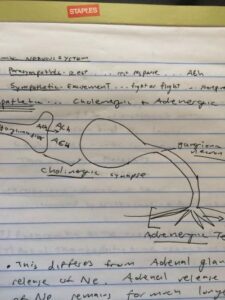
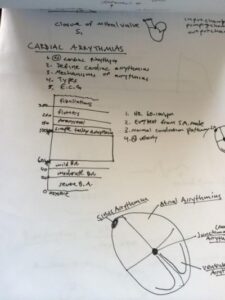
As you can see I use pictures EXTENSIVELY . . .
Not only do the pictures that you create help you to remember, but the actual process of creating the pictures FORCES you to learn the material well enough to create the picture in the first place.
There is an incredible study conducted by the American Federation of Teachers that states that:
“people who had high scores on spatial tests (visual learning/drawing pictures) . . . where much more likely to major in [science] disciplines . . . .”
Not only that, but they found that developing your ability to think spatially will improve your performance in science.
One last quote . . .
“Spatial training has been found to improve educational outcome . . . ”
Tips to Help you Draw Pictures to Learn
So it’s obvious that drawing can aid in learning, especially in a science based curriculum like nursing but how/what should you draw?
- Practice: ultimately you need to find what types of images work for you. Do you remember diagrams best, mind maps, illustrations of process, what works for you? Start today with multiple types of drawings and see what you remember best.
- Color: keep a pack of colored pencils, markers, or dry erase markers in your backpack. Use the color to give depth to your drawings and highlight key information.
- Mind maps: yes, there is a reason your teachers are trying to force you to make mind maps . . . they CAN work. I say “can” because they may not work for everyone, but they might work for you. Here are some places you can create mind maps.
- Pen and paper: simply draw your mind maps out on paper this is a fast way to create mind maps without constraints.
- Lucid Chart: I really like Lucid Chart for clean mind maps but it does take longer to create. You can start making charts for free but if you want to have multiple charts you will need an account for a couple bucks a month.
- PowerPoint: this is an easy way to make free charts and illustrations and you can save your presentation as a PDF or JPG.
- Think through the process: nursing is the perfect field of study to use charts. So much of what we do is process based and the body works via feedback loops in such a visual manner. Simply requiring yourself to think through these process as you draw will allow your imagination to flow.
- Don’t be a perfectionist: the point here is to help you learn. Don’t over think or overdo your drawings. Just draw exactly what works for you to help you learn the content. (as you can see my drawings are VERY crude, but they worked).
Just Get Started
So in the end I received at 98% in that Anatomy class of over 100 students and for the first time in my life I gained confidence that maybe I could learn complex material.
That ONE class changed the trajectory of my entire life. I learned how to study, I learned to love studying the body, and I began investigating health care as a career.
I know that whether or not you are a visual learner, drawing pictures will help with learning and retaining what you are studying and learning.
If mind maps don’t work for you no worries . . . actually sit down and draw the liver and label it with anatomical features and functions.
Conclusion
You can do this! The NCLEX® and nursing school are tough . . . they need to be to insure that we are prepared to provide the best patient care possible. But you can pass and have a brilliant future as a nurse!
exit exam
Concepts Covered:
- Test Taking Strategies
- Basics of NCLEX
- Studying
- Substance Abuse Disorders
- Behavior
- Urinary System
- Nervous System
- Peripheral Nervous System Disorders
- Cardiac Disorders
- Note Taking
- Noninfectious Respiratory Disorder
- Respiratory System
- Central Nervous System Disorders – Brain
- Concepts of Population Health
- Respiratory Emergencies
- Perioperative Nursing Roles
- Concepts of Pharmacology
- Emergency Care of the Cardiac Patient
- Factors Influencing Community Health
- Integumentary Disorders
- Health & Stress
- Labor and Delivery
- Gastrointestinal Disorders