
Goal Setting
Included In This Lesson
Study Tools For Goal Setting
Outline
Obtaining your RN requires a tremendous amount of effort. To effectively reach that goal you must learn some tips and tricks about how to effectively set goals.
When applied correctly, these tips will help you reach your RN and complete all the small goals along the way.
What is Your Why?
You must identify your “WHY”.
Why do you want to be a nurse?
What is your reason . . . that is stronger than any difficulty you will face?
It doesn’t matter what your WHY is honestly. I have met incredible nurses and students with heart-wrenching backstories that motivated them to be a nurse to those who went to nursing school just to be able to go to CRNA school and make a great salary.
The point is, it doesn’t matter what the WHY is. All that matters is that your particular reason is strong enough to help you get through the tough times in school.
You should print out your WHY on a large sheet of paper so that you can refer to it often.
This WHY becomes your DREAM. The underlying reason for everything you do.
90 Day Sprint
Ever wonder why you don’t follow through with your New Year’s resolutions?
Your ability to realistically see goals into completion is limited to about 90 days.
Essentially, the feedback loop on long term goals is just too far away and we are never able to close it.
With shorter-term goals (90 days) we can close these loops and focus solely on one task and build confidence.
Rather than setting long term goals that will be too far out and possibly leave you depressed that you are not achieving them, you can build confidence in yourself by setting concrete 90 days goals.
This works perfectly for school as semesters are about 90 days.
Here’s how you do this:
- What is the MOST important thing that you can accomplish in the next 90 days that will create the most positive impact in your life?
- Limit this to one skill or goal.
- This is your outcome goal.
- Devote the largest portion of your energy to achieving this one goal.
- What we like to do as humans is to focus on what we are already good at . . . this is flawed. You need to downplay all other skills and goals and focus the vast majority of your time and energy on the ONE goal for those 90 days.
- Break it down into 2-week performance goals.
- It is important that you do not focus so hard on the outcome but break the outcome into two-week chunks of attainable goals.
- These goals answer the question: What are you going to improve?
- Achieving our outcome goal becomes inevitable as we reach our short term performance goals one by one.
- At the end of the 90 days . . . Reassess and Reset.
Example:
Outcome Goal: In 90 days I will improve my average score on cardiac NCLEX practice questions from 40% to 85%.
Performance Goal 1: I am going to increase the amount of time I read cardiac lectures from 0 hours a day to 1 hour a day (M-F between 2 pm – 4 pm) in my study area.
Performance Goal 2: I will increase the # of cardiac NCLEX style questions I take a day from 5 to 20 (M-F from 2 pm-4 pm in the school library) using NPQ by NRSNG and study the rationale for every question I get wrong making a list of those topics and questions.
Do you see how this works?
If you continue this process with improving your cardiac NCLEX question scores for 90 days broken down into two-week sprints it will become inevitable that your scores will improve.
With these performance goals in mind and focused on for the next two weeks, you will then reevaluate and set new performance goals in two weeks.
How to Set Performance Goals:
Formula: W+W+W+W=C+M
WHO is going to do WHAT, WHEN, and WHERE this will equate to CLARITY and MOMENTUM
Notice how on the performance goals above there is a WHO, WHAT, WHEN, and were in each goal. The goals are not ambiguous but they are highly targeted and measurable. Having them so specific allows you to have clarity about what you are doing and the motivation and momentum you need to work on the goal.
The biggest enemy to confidence and momentum is confusion and uncertainty.
Because you haven’t reached your goals doesn’t mean that YOU are a bad student, nurse, or person. It just means you need to fix your model. These process goals give you control and allow you to reach those goals and gain confidence in yourself.
SCRUM
Scrum is a project management methodology that was originally developed for software development, but it also works well for goal setting.
Utilizing scrum is a great way to keep your 90 Day Spring in check and staying on track.
It works like this:
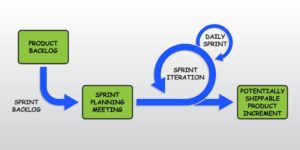
Product Backlog: a list of everything that needs to be done . . . everything!
Sprint Planning: you pull the most important projects that need to be done into your sprint section. These are the things that you plan to do in a short time frame.
Sprint Iteration: these are the short two week projects that you will work on.
Daily Sprint: this is what you will work on today to complete your sprint.
While SCRUM and 90 Day Sprints don’t align perfectly, do you see how you can use SCRUM to accomplish your 90 Day Sprints?
Here is a video on SCRUM to outline it a bit more.
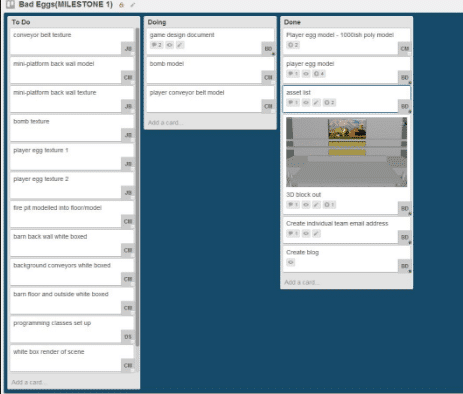
A tool that helps you stay organized on your goals is called Trello. This is a free tool/app that works like a big whiteboard with sticky notes.
Check it out here: https://trello.com/
You essentially can set up any “board” but if you just set up boards called: ToDo, Doing, Done you will be up and running.
To-Do will include all the things that need to be done. Doing is what you are currently working on. Done is everything you have completed.
You can further customize your boards to fit your situation and your goals.
While I realize this module is a bit meta, it is important to take the time required to prepare and understand how to attack a problem before just diving in. Goal setting the right way will make a tremendous impact on your nursing school success.
nclex rn
Concepts Covered:
- Basics of NCLEX
- Test Taking Strategies
- Behavior
- Studying
- Urinary System
- Note Taking
- Perioperative Nursing Roles
- Integumentary Disorders
- Disorders of Pancreas
- Communication